Properties of Mathematical Operations
The formal properties of mathematical operations include the following:
The Commutative Property
Commutative Property of Addition
In addition, changing the order of the addends does not affect the sum. $$ a + b = b + a $$
For example:
$$ 4 + 3 = 3 + 4 $$
$$ 7 = 7 $$
However, the commutative property does not apply to subtraction.
For example:
$$ 4 - 3 \ne 3 - 4 $$
$$ 1 \ne -1 $$
Commutative Property of Multiplication
In multiplication, changing the order of the factors does not affect the product.
For example:
$$ 4 \cdot 3 = 3 \cdot 4 $$
$$ 12 = 12 $$
However, the commutative property does not apply to division.
For example:
$$ 10 : 5 \ne 5 : 10 $$
$$ 2 \ne 0.5 $$
The Associative Property
Associative Property of Addition
The sum of three numbers, a, b, and c, remains the same regardless of how the addends are grouped, as long as their order remains unchanged. $$ (a + b) + c = a + (b + c) $$
For example:
$$ (2 + 5) + 3 = 2 + (5 + 3) $$
$$ 7 + 3 = 2 + 8 $$
$$ 10 = 10 $$
However, the associative property does not hold for subtraction.
For example:
$$ (2 - 5) - 3 \ne 2 - (5 - 3) $$
$$ -3 - 3 \ne 2 - 2 $$
$$ -6 \ne 0 $$
Associative Property of Multiplication
The product of three numbers, a, b, and c, remains the same regardless of how the factors are grouped, provided their order does not change. $$ (a \cdot b) \cdot c = a \cdot (b \cdot c) $$
For example:
$$ (2 \cdot 5) \cdot 3 = 2 \cdot (5 \cdot 3) $$
$$ 10 \cdot 3 = 2 \cdot 15 $$
$$ 30 = 30 $$
However, the associative property does not apply to division.
$$ (8 : 4) : 2 \ne 8 : (4 : 2) $$
$$ 2 : 2 \ne 8 : 2 $$
$$ 1 \ne 4 $$
The Distributive Property
Distributive Property of Multiplication over Addition
Multiplying a number a by the sum (b + c) is equivalent to multiplying a by each addend separately and then adding the results. $$ a \cdot (b + c) = a \cdot b + a \cdot c $$
For example:
$$ 2 \cdot (3 + 4) = 2 \cdot 3 + 2 \cdot 4 $$
$$ 2 \cdot 7 = 6 + 8 $$
$$ 14 = 14 $$
The distributive property of multiplication over addition holds true whether the multiplication is performed on the left or the right because multiplication itself is commutative.
$$ (3 + 4) \cdot 2 = 3 \cdot 2 + 4 \cdot 2 $$
$$ 7 \cdot 2 = 6 + 8 $$
$$ 14 = 14 $$
The distributive property also applies to subtraction:
$$ (4 - 3) \cdot 2 = 4 \cdot 2 - 3 \cdot 2 $$
$$ 1 \cdot 2 = 8 - 6 $$
$$ 2 = 2 $$
Geometric Proof
The distributive property of multiplication over addition can be demonstrated geometrically.
Consider a rectangle with a base of \( a \) and a height of \( (b + c) \).
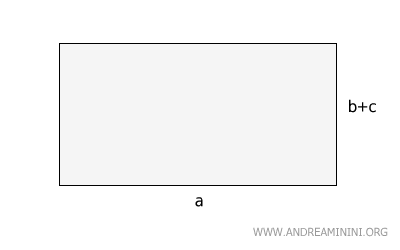
The area $ A $ of the rectangle is calculated by multiplying the base by the height:
$$ A = a \cdot (b + c) $$
If we divide the height into two segments, \( b \) and \( c \), we create two smaller rectangles, each sharing the same base \( a \), but with heights \( b \) and \( c \) respectively.
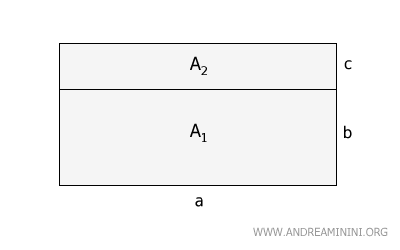
The combined area of these two smaller rectangles, $ A_1 + A_2 $, is equal to the total area $ A $.
$$ A = A_1 + A_2 $$
Since $ A = a \cdot (b + c) $, and $ A_1 = a \cdot b $ while $ A_2 = a \cdot c $, it follows that:
$$ a \cdot (b + c) = a \cdot b + a \cdot c $$
Thus, we have proven the distributive property of multiplication over addition through a geometric decomposition using natural numbers.
In other words, the total area of the rectangle can be viewed either as one single rectangle with height \( b + c \), or as the sum of the areas of two separate rectangles.
Note: The distributive property cannot be applied in the reverse direction, that is, distributing addition over multiplication. $$ 2 + (3 \cdot 4) \ne (2 + 3) \cdot (2 + 4) $$ $$ 2 + 12 \ne 5 \cdot 6 $$ $$ 14 \ne 30 $$
Distributive Property of Division over Addition
Dividing a sum (a + b) by a nonzero divisor c is equivalent to dividing each term separately by c and then adding the results. $$ (a + b) : c = a : c + b : c $$
For example:
$$ (4 + 8) : 2 = 4 : 2 + 8 : 2 $$
$$ 12 : 2 = 2 + 4 $$
$$ 6 = 6 $$
Note: The distributive property of division applies to both addition and subtraction. $$ (4 - 8) : 2 = 4 : 2 - 8 : 2 $$ $$ -4 : 2 = 2 - 4 $$ $$ -2 = -2 $$
However, the distributive property of division over addition only holds when the division is performed from the left, because division is not a commutative operation.
$$ 10 : (2 + 5) \ne 10 : 2 + 10 : 5 $$
$$ 10 : 7 \ne 5 + 2 $$
$$ 10 : 7 \ne 7 $$
And so on.