Determinism
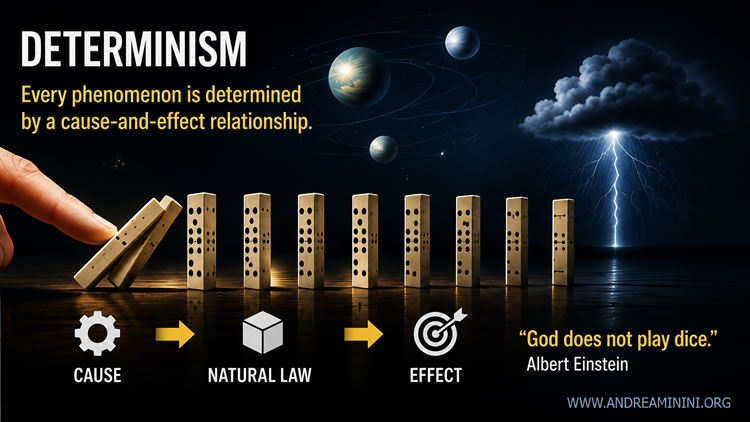
Determinism is a philosophical and scientific view of reality according to which every phenomenon is governed by a cause-and-effect relationship.
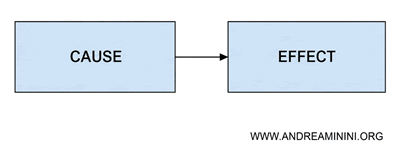
According to determinism, every event in nature can be explained and predicted once the laws governing natural processes are understood. What people commonly call chance is simply the result of limited knowledge.
This idea is often summarized by Albert Einstein's famous statement, God does not play dice.
Origins of Determinism
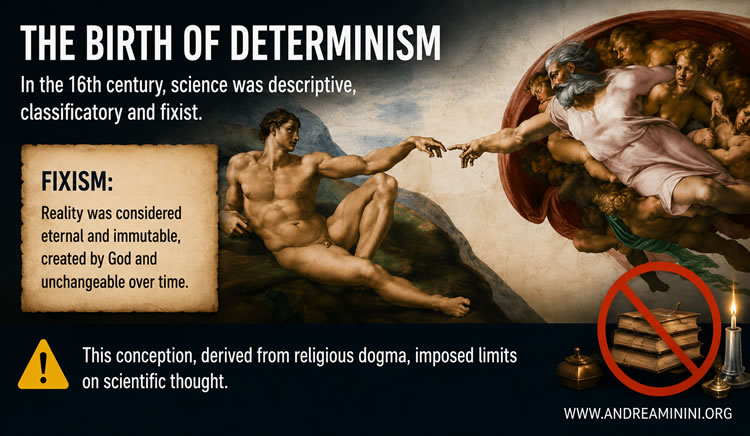
During the 15th century, science was mainly descriptive and classificatory, and it was strongly influenced by a fixed conception of reality.
What does "fixed conception" mean? Reality was believed to be eternal and unchanging. The world, human beings, and animals were thought to have been created by God through an original act of creation. According to religious doctrine, nature itself was therefore considered immutable over time.
This worldview was deeply connected to religious dogma, which for centuries limited free scientific inquiry.
Ideas that contradicted religious teachings were often condemned as heresy and suppressed.
Discovery of Fossils
The fixed conception of reality began to weaken during the 18th century with the discovery of fossils.
The existence of extinct species, such as dinosaurs, challenged the traditional idea of divine creation.
Fossils provided clear evidence that reality and life on Earth could change over time.
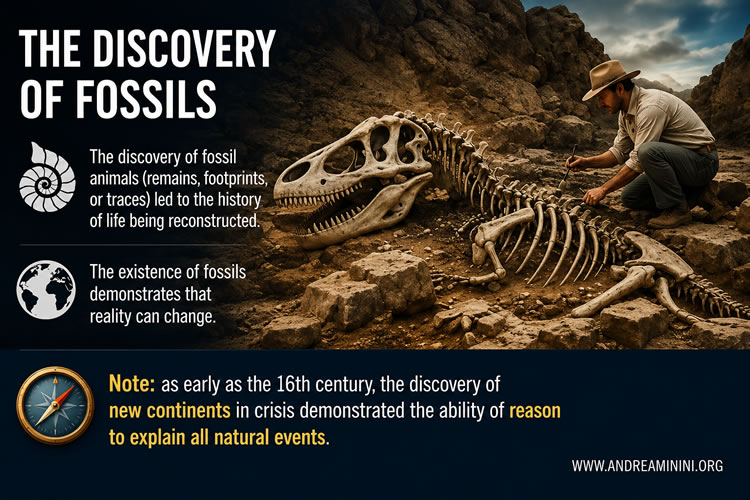
Note. Religious dogma had already been weakened by the discovery of new continents during the 15th century. Encounters with previously unknown peoples, cultures, and civilizations raised new questions that religion struggled to answer from a scientific perspective.
Transformist Conception
As a result, a new transformist conception of nature gradually emerged, while the older fixed conception lost importance.
The study of fossils encouraged scientists to investigate the relationship between the environment (cause) and living species (effect).
At first, the deistic conception of nature became widespread.
Over time, species evolve into more advanced, more complex, and more refined forms.
For example, human beings were considered the evolutionary descendants of apes.
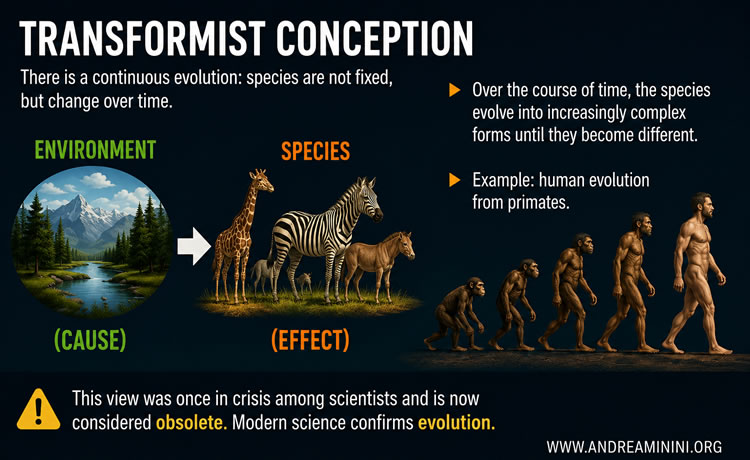
However, this interpretation was criticized because, much like religious dogma, it lacked solid scientific evidence.
In many respects, it was little more than a tautological explanation.
Example. Changes in nature are not always progressive improvements. Throughout Earth's history, there have also been regressions from more complex forms to simpler ones. For this reason, the deistic conception of nature is considered incorrect.
Darwin's Theory of Evolution
The decisive answer to this problem came with Charles Darwin's theory of evolution.
According to Darwin, the evolution of species is driven by natural selection.
Individuals with traits that provide an advantage for survival and reproduction within a specific environment are more likely to pass those hereditary traits on to future generations, gradually transforming the species over time.
This meant that species could evolve not only into more complex forms, but also into simpler ones.
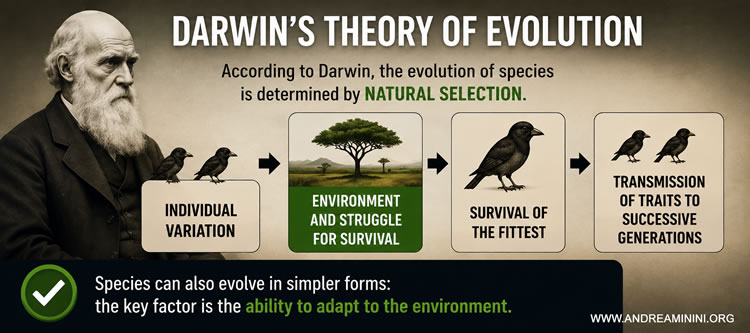
The key factor behind natural selection was the ability to adapt to the environment.
Darwin's work provided a scientifically grounded explanation that answered many of the criticisms directed at the transformist conception.
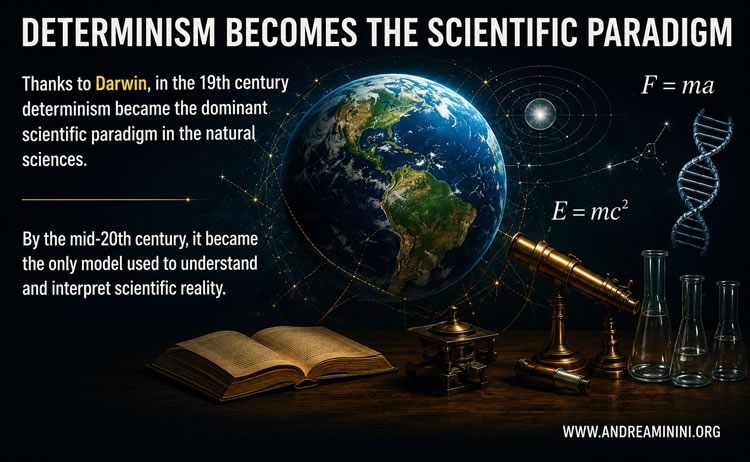
During the 19th century, determinism became the dominant scientific paradigm in the natural sciences.
Until the early 20th century, it remained the most widely accepted framework for understanding and interpreting scientific reality.