
Logarithmic Equations
A logarithmic equation is an equation in which the unknown variable appears inside the argument of at least one logarithm. $$ \log_b P(x) = \log_b Q(x) $$ Here, P and Q are polynomials or more general functions of x.
There are two main strategies commonly used to solve logarithmic equations.
Method 1
- determine the domain where each logarithm is defined
- solve the equation between the arguments, that is, solve P(x)=Q(x)
- discard any candidate solutions that violate the domain conditions
Method 2
- introduce an auxiliary variable, for example u=log(x)
- solve the resulting equation in the new variable u
- solve each logarithmic equation of the form log(x)=s
- eliminate the solutions that fall outside the admissible domain
Note. The equation below is logarithmic because the unknown appears inside the logarithmic argument $$ 3 \log(x) = 2 $$ In contrast, the next equation is not logarithmic, since the variable does not occur inside a logarithm. $$ (x-1) \log(3) = 5 $$
A Practical Example
Consider the logarithmic equation
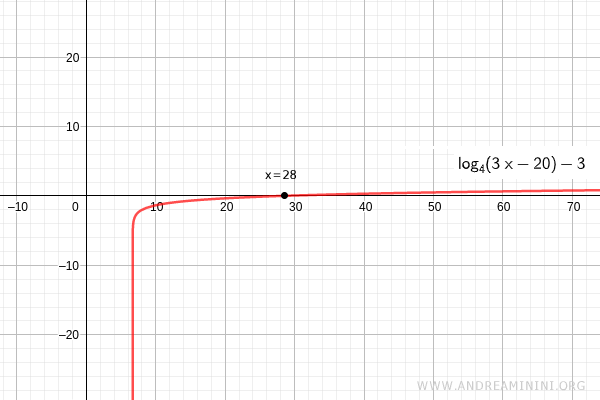
$$ \log_4 (3x-20) = 3 $$
We begin by determining the domain of definition of the logarithm. Its argument must be positive.
$$ 3x - 20 > 0 $$
Thus the variable must satisfy
$$ x > \frac{20}{3} $$
We now exponentiate both sides using base 4.
$$ 4^{\log_4 (3x-20)} = 4^3 $$
$$ 4^{\log_4 (3x-20)} = 64 $$
Since exponentiation is the inverse operation of the logarithm, the expression simplifies to
$$ 3x - 20 = 64 $$
$$ 3x = 64 + 20 $$
$$ x = \frac{84}{3} $$
We obtain the value
$$ x = 28 $$
This is a valid solution of the logarithmic equation because it satisfies the condition x>20/3.
Example 2
Now solve the following logarithmic equation using the auxiliary variable method:
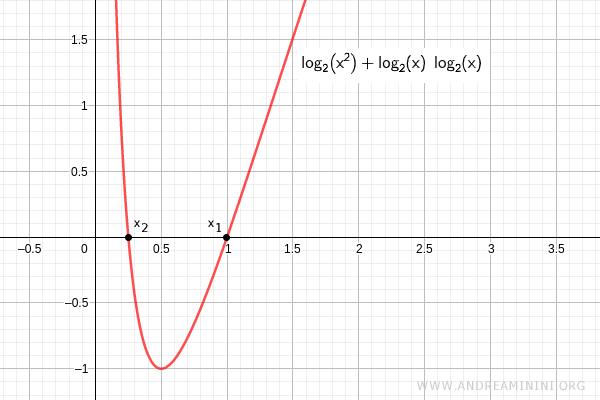
$$ \log_2 x^2 + \log_2^2 x = 0 $$
Rewrite it in a clearer form:
$$ \log_2 x^2 + ( \log_2 x )^2 = 0 $$
The domain condition is simply x>0.
$$ \begin{cases} x^2 > 0 \\ \\ x > 0 \end{cases} \Rightarrow x > 0 $$
To apply the auxiliary variable method, both logarithms must share the same base and the same argument.
Using the power rule for logarithms, bring down the exponent from x2:
$$ 2 \cdot \log_2 x + ( \log_2 x )^2 = 0 $$
Now the logarithmic terms are expressed in a uniform way.
Introduce the auxiliary variable u = \log_2 x.
$$ 2u + u^2 = 0 $$
This converts the problem into a quadratic equation.
$$ u (u + 2) = 0 $$
The solutions are u=0 and u=-2.
$$ u = \begin{cases} 0 \\ \\ -2 \end{cases} $$
Substitute back u = log2 x:
$$ \log_2 x = \begin{cases} 0 \\ \\ -2 \end{cases} $$
We now solve these logarithmic equations.
The first gives x1=20=1.
$$ \log_2 x = 0 \Rightarrow 2^0 = 1 $$
This value is admissible for the original equation because it satisfies x>0.
The second gives x2=2-2=1/4.
$$ \log_2 x = -2 \Rightarrow 2^{-2} = \frac{1}{4} $$
This value also satisfies the condition x>0, so it is acceptable.
Therefore, the solutions of the logarithmic equation are x1=1 and x2=1/4.
Derivation and Explanation
Logarithms are defined only when their arguments are positive.
$$ P(x) > 0 $$
$$ Q(x) > 0 $$
This requirement forms the domain of definition of the logarithm.
Consequently, a logarithmic equation may have solutions only if these domain conditions are satisfied.
The key principle for solving logarithmic equations is the equivalence
$$ P(x) = Q(x) \Leftrightarrow \log_b P(x) = \log_b Q(x) $$
Explanation. By the invariance property of equations, we may exponentiate both sides: $$ \log_b P(x) = \log_b Q(x) $$ $$ b^{\log_b P(x)} = b^{\log_b Q(x)} $$ Since exponentiation is the inverse of the logarithm, we obtain $$ P(x) = Q(x) $$
Thus, solving a logarithmic equation reduces to solving the equation between the arguments
$$ P(x) = Q(x) $$
and then discarding any solutions that violate the domain conditions.
And so on.


