
Ratios and Proportions
A proportion is an equality between two ratios x:y = z:w. It is read as "x is to y as z is to w".

The terms x and z are called the antecedents, while y and w are the consequents.
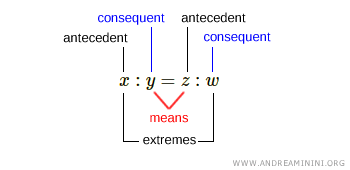
The outer terms x and w are known as the extremes, while the inner terms y and z are called the means.
There is another way to look at proportions that is often more intuitive.
A proportion is an equality between two equivalent fractions $$ x:y = z:w \Longleftrightarrow \frac{x}{y} = \frac{z}{w} $$
In other words, the ratios x:y and z:w represent the same quantity when written as fractions.
So the proportion x:y = z:w can always be rewritten as
$$ \frac{x}{y} = \frac{z}{w} $$
A practical example
Consider the proportion: two is to four as five is to ten
$$ 2:4 = 5:10 $$
To check whether this is a valid proportion, rewrite it as an equality between fractions
$$ \frac{2}{4} = \frac{5}{10} $$
Now verify that the two fractions are equivalent by computing their cross products
$$ 2 \cdot 10 = 5 \cdot 4 $$
$$ 20 = 20 $$
Since the results are equal, the two fractions are equivalent, and the equality is indeed a proportion.
Example 2
Consider another proportion: three is to nine as five is to fifteen
$$ 3:9 = 5:15 $$
Again, rewrite it as fractions
$$ \frac{3}{9} = \frac{5}{15} $$
Simplify both fractions
$$ \frac{3:3}{9:3} = \frac{5:5}{15:5} $$
$$ \frac{1}{3} = \frac{1}{3} $$
Both fractions reduce to the same value, so this is a proportion.
Example 3
This equality, instead, is not a proportion
$$ 4:7 = 6:10 $$
Rewrite it as fractions
$$ \frac{4}{7} = \frac{6}{10} $$
Check the cross products
$$ 4 \cdot 10 = 6 \cdot 7 $$
$$ 40 = 42 $$
The results are different, so the fractions are not equivalent. Therefore, 4:7 = 6:10 is not a proportion.
Continuous proportions
A proportion is called a continuous proportion when the means or the extremes are equal. $$ x:\color{red}y = \color{red}y:w $$ $$ \color{red}x:y = z:\color{red}x $$
If a term appears twice among the means, it is called the mean proportional.
If a term appears twice among the extremes, it is called the extreme proportional.
Example 1
This proportion is continuous because the means are both equal to three
$$ 9:\color{red}3 = \color{red}3:1 $$
In this case, three is the mean proportional.
Note. To verify that 9:3 = 3:1 is a proportion, rewrite it as fractions $$ \frac{9}{3} = \frac{3}{1} $$ and compute the cross products. $$ 9 \cdot 1 = 3 \cdot 3 $$ $$ 9 = 9 $$ The identity holds, so the fractions are equivalent and the proportion is valid.
Example 2
This proportion is also continuous because the extremes are both equal to eight
$$ \color{red}8:16 = 4:\color{red}8 $$
In this case, eight is the extreme proportional.
Note. To verify that 8:16 = 4:8 is a proportion, rewrite it as fractions $$ \frac{8}{16} = \frac{4}{8} $$ and compute the cross products. $$ 8 \cdot 8 = 4 \cdot 16 $$ $$ 64 = 64 $$ The results match, so the fractions are equivalent and the proportion is valid.
Properties of proportions
Proportions satisfy several useful properties
- Fundamental property
The product of the means is equal to the product of the extremes $$ x:y = z:w \Longleftrightarrow y \cdot z = x \cdot w $$ - Componendo
$$ x:y = z:w \Longleftrightarrow (x+y):x = (z+w):z $$ $$ x:y = z:w \Longleftrightarrow (x+y):y = (z+w):w $$ - Dividendo
$$ x:y = z:w \Longleftrightarrow (x-y):x = (z-w):z $$ $$ x:y = z:w \Longleftrightarrow (x-y):y = (z-w):w $$ - Permutation
$$ x:y = z:w \Longleftrightarrow x:z = y:w $$ $$ x:y = z:w \Longleftrightarrow w:y = z:x $$ - Inversion
$$ x:y = z:w \Longleftrightarrow y:x = w:z $$
These properties allow you to manipulate proportions and solve many types of problems efficiently.


