
Schrödinger's Cat
Schrödinger's cat is one of the best-known thought experiments in modern physics. Proposed by physicist Erwin Schrödinger in 1935, it was designed to highlight one of the deepest conceptual questions in quantum mechanics: how should quantum superposition be interpreted?
According to quantum theory, a particle can exist in a superposition of multiple possible states until a measurement is made. Schrödinger extended this idea to a familiar, everyday object to show how strange the mathematics of quantum mechanics appears when applied to the macroscopic world.
The experiment was never meant to be carried out. It was conceived as a thought experiment to challenge the dominant interpretation of quantum mechanics at the time.
The Thought Experiment
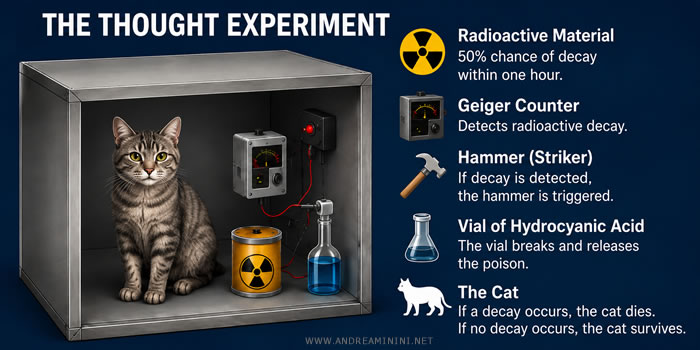
Imagine a cat sealed inside a box that is completely isolated from the outside world.
This is purely a thought experiment. No real cat was ever used, and Schrödinger never intended the experiment to be performed in practice.
Inside the box are:
- a small amount of radioactive material;
- a Geiger counter;
- a hammer connected to the counter;
- a vial of hydrocyanic acid;
- the cat.
The amount of radioactive material is carefully chosen so that, over the course of one hour, there is a 50% probability that one of its atoms will undergo radioactive decay and a 50% probability that no decay will occur.
If a decay occurs, the Geiger counter detects it, triggering the hammer. The hammer shatters the vial, releasing the poison and killing the cat.
If no decay occurs, nothing happens, and the cat remains alive.
Quantum Superposition
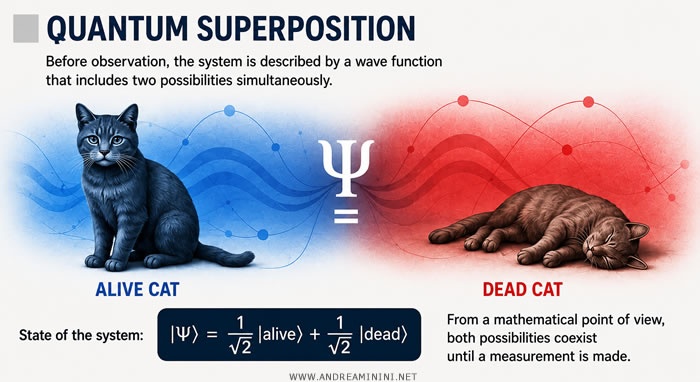
According to the mathematical formalism of quantum mechanics, before a measurement is made, the radioactive nucleus is neither decayed nor undecayed. Instead, it is described as existing in a superposition of both possible states.
Because the cat's fate depends entirely on the nucleus, the whole system is represented by a single wave function that simultaneously includes two possible outcomes:
- the cat is alive;
- the cat is dead.
From a mathematical point of view, both possibilities coexist until a measurement is performed.
The system's wave function can therefore be expressed as a linear combination of these two states.
Where Does the Paradox Lie?
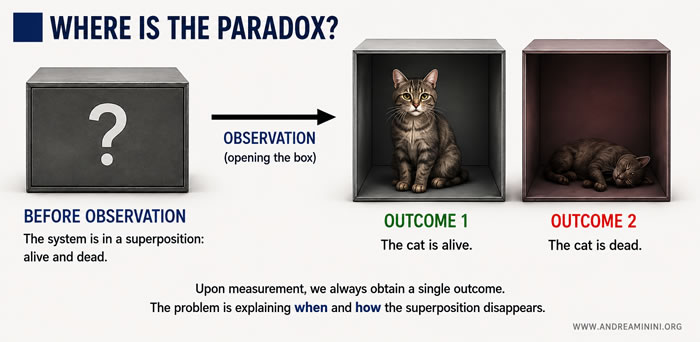
In everyday life, we never observe a cat that is both alive and dead at the same time.
When the box is opened, the cat is always found in one definite state. The real question is how and when the quantum superposition disappears, leaving only a single observable outcome.
This is known as the measurement problem, one of the central unresolved issues in quantum mechanics.
In other words, the mathematics predicts several possible outcomes, while every observation reveals only one.
Why Did Schrödinger Propose This Thought Experiment?
Schrödinger was not claiming that a cat could literally be both alive and dead.
His goal was to show how paradoxical it becomes to apply the mathematical formalism of quantum mechanics directly to macroscopic objects.
The idea also emerged in response to the debates sparked by Albert Einstein and the famous EPR paper, which questioned whether quantum mechanics provides a complete description of physical reality.
By extending the quantum uncertainty of a single microscopic particle to an object as familiar as a cat, Schrödinger exposed the interpretational difficulties that still lie at the heart of quantum theory.
The Meaning of the Paradox
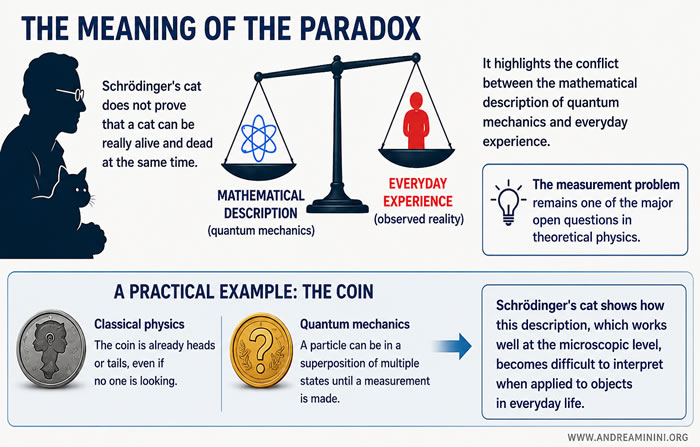
Schrödinger's cat does not suggest that a cat can literally exist in two contradictory states at once.
Instead, it illustrates the tension between the mathematical description of quantum mechanics and our everyday experience of reality.
Nearly a century later, the measurement problem remains one of the most important open questions in the foundations of quantum mechanics.
For this reason, Schrödinger's cat continues to be one of the most effective and widely used examples for introducing the conceptual foundations of quantum theory.
A Simple Analogy
Imagine flipping a coin and immediately covering it with your hand.
In classical physics, the coin has already landed on either heads or tails, even though no one has looked at it.
Quantum mechanics describes microscopic systems differently. Until a measurement is made, a particle can be represented mathematically as a superposition of multiple possible states.
Schrödinger introduced his famous cat to illustrate how difficult it is to extend this mathematical description to ordinary objects in the everyday world.
 Can the Experiment Be Performed?
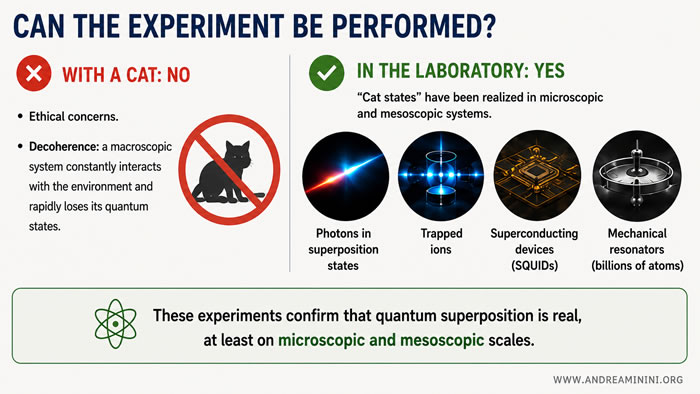
The original thought experiment is not performed in practice.
Besides the obvious ethical concerns, a macroscopic object such as a cat constantly interacts with its surroundings. These interactions rapidly destroy quantum coherence through a process known as decoherence.
Even so, the same physical principles have been confirmed experimentally in much smaller quantum systems.
Cat States in the Laboratory
Over the past several decades, physicists have created quantum systems that display properties analogous to those described in Schrödinger's thought experiment.
Some of the best-known examples include:
- photons prepared in superposition states;
- trapped ions;
- superconducting quantum interference devices (SQUIDs);
- mechanical resonators made of billions of atoms.
These experiments demonstrate that quantum superposition is a genuine physical phenomenon, at least on microscopic and mesoscopic scales.
Schrödinger's Cat and Quantum Computing
In quantum computing, researchers often refer to the cat state or the GHZ state.
These are highly entangled quantum states in which multiple qubits exist in a shared quantum superposition.
Such states are among the essential resources for quantum information processing and the development of future quantum computers.
Major Interpretations
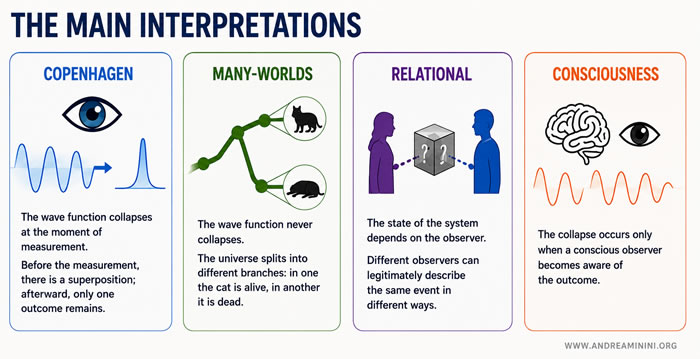
Over the years, several interpretations have been proposed to explain the meaning of Schrödinger's thought experiment and, more broadly, the measurement problem.
The Copenhagen Interpretation
According to the Copenhagen interpretation, the wave function collapses when a measurement is performed.
Before the measurement, the system is described by a superposition of possible states. After the measurement, only a single outcome remains.
Although this interpretation successfully predicts experimental results, it does not explain the physical mechanism responsible for wave function collapse.
The Many-Worlds Interpretation
According to Hugh Everett's interpretation, the wave function never collapses.
Instead, every measurement causes the universe to branch into multiple, non-interacting worlds.
In one branch, the cat is alive.
In another, the cat is dead.
Each branch evolves independently, and no communication between them is possible.
The Relational Interpretation
Proposed by Carlo Rovelli, the relational interpretation argues that the state of a physical system is always relative to the observer or to another physical system.
As a result, different observers may legitimately describe the same event differently without creating any logical contradiction.
Consciousness-Based Interpretations
According to these interpretations, the wave function collapses only when a conscious observer becomes aware of the measurement outcome.
This idea inspired other influential thought experiments, including Wigner's friend.
Other Interpretations
Other theoretical approaches include:
- the transactional interpretation;
- objective collapse theories;
- the ensemble interpretation.
Each offers a different explanation for how quantum superposition gives rise to the single reality we observe.
And so on.


