
Euler's Number
Euler's number is an irrational mathematical constant approximately equal to 2.71828. It is represented by the symbol "e". $$ e = 2.718281828459 $$ It is also known as Napier's constant.
Euler's number is the base of the natural logarithms, also called Napierian logarithms.
A useful way to remember its first decimal digits is to notice that 2.7 is followed by the repeating pattern 18 and 28. After that, the sequence of digits changes.
$$ e = 2.7\color{red}{18}\color{blue}{28}\color{red}{18}\color{blue}{28}459 $$
This simple mnemonic makes it easy to remember at least 2.718281828.
In most practical applications, this approximation is more than accurate enough.
How is Euler's number defined?
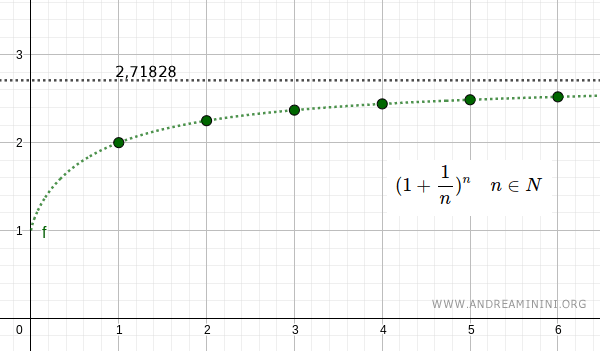
Euler's number can be defined as the limit of the following sequence:
$$ \left( 1 + \frac{1}{n} \right)^n \ \ \ \ n \in N $$
As n→∞, the sequence converges to the irrational number 2.71828.
Note. Euler's number was discovered by the Scottish mathematician John Napier (Nepero) in the 16th century. However, Napier did not use it as the base of logarithms. The symbol "e" was introduced two centuries later by the mathematician Leonhard Euler, who also helped establish the modern theory of natural logarithms.
And so on.


