
Logarithms
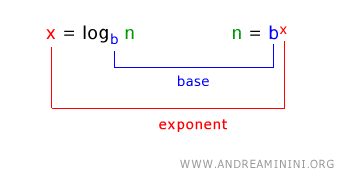
A logarithm of a positive real number n (called the argument) is the exponent x to which a base must be raised in order to obtain n. $$ x=\log_b n \Leftrightarrow b^x = n $$ where b > 0 and n > 0 are positive real numbers, and b ≠ 1.
In simple terms, a logarithm answers the following question:
To what exponent must I raise the base b in order to get the number n?
Logarithms and exponents are two ways of expressing the same mathematical relationship.
For example, the following expressions are equivalent:
$$ 25=5^2 \Leftrightarrow 2 = \log_5 25 $$
The exponential form states that 5 squared is equal to 25.
The logarithmic form states that the exponent needed to obtain 25 from base 5 is equal to 2.
Conditions for existence
A logarithm exists only under the following conditions:
- The base (b) must be a positive real number different from 1.
- The argument (n) must be a positive real number.
Therefore:
- The logarithm of zero does not exist.
- The logarithm of a negative number does not exist.
- A logarithm with base 1 does not exist.
Proof. A logarithm with a negative base does not exist because the exponential function is defined only for positive bases. $$ b>0 $$ Consequently, if the base satisfies b>0, there is no real number x such that bx<0. $$ \forall \ x \in \mathbb{R} \ , \ b>0 \Rightarrow b^x >0 $$ A logarithm with base zero does not exist because zero raised to any exponent x (except zero) is always equal to zero. $$ 0^x = 0 \ \ \text{with} \ \ x \ne 0 $$ The logarithm of a number n with base 1 does not exist because, for every real number x, the power of 1 is always equal to 1. $$ 1^x = 1 $$
The logarithmic function
The logarithmic function x=logb(n) behaves differently depending on the value of the base.
If the base satisfies b>1, the logarithmic function is increasing. This means that the logarithm grows as the argument n increases.
If the base satisfies 0< b<1, the logarithmic function is decreasing.
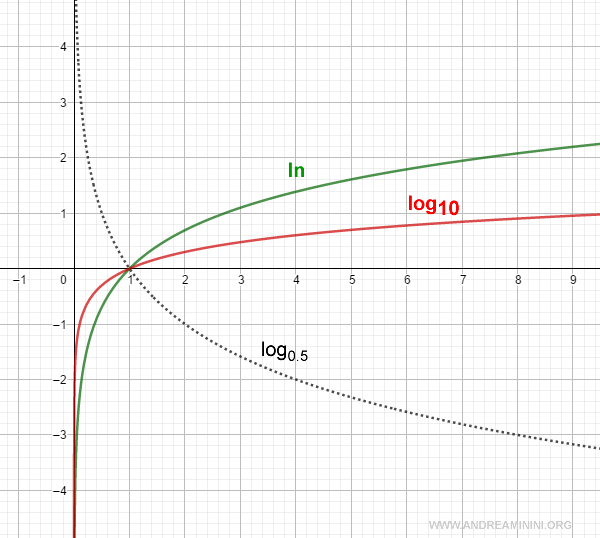
Note. The logarithms most commonly used in mathematics, engineering, and the physical sciences are the base-10 logarithm ( log10 ), also called the common logarithm, and the natural logarithm ( ln or loge ), whose base is 2.71828... ( Euler's number ).
A practical example
Consider the following logarithm:
$$ x = \log_{3} 9 $$
This means:
To what exponent must 3 be raised in order to obtain 9?
The equivalent exponential equation is:
$$ 3^x = 9 $$
Since
$$ 3^2 = 9 $$
the solution is
$$ x = \log_{3} 9 = 2 $$
Useful properties of logarithms
Some important properties of logarithms are listed below.
- The logarithm is equal to 1 when the base and the argument are the same because b1=b. $$ \log_b b = 1 $$
Example. $$ \log_5 5 = 1 $$ because $$ 5^1 = 5 $$
- The logarithm of 1 is equal to 0 because b0=1. $$ \log_b 1 = 0 $$
Example. $$ \log_5 1 = 0 $$ because $$ 5^0 = 1 $$
- Raising the base b to the logarithm base b of a number n returns the number n itself. $$ b^{\log_b n} = n $$ Indeed, if bx=n, then x = logb n.
Example. $$ 5^{\log_5 25} = 25 $$
- If two positive numbers are equal, x=y, then their logarithms with respect to the same base are also equal, and vice versa. $$ x=y \Leftrightarrow \log_b x = \log_b y $$
The history of logarithms
The use of exponents dates back to the earliest human civilizations during the second millennium BC.
The first attempts to determine the exponent needed to obtain a given power can be traced back to Mesopotamian mathematics, although these attempts were unsuccessful.
The problem was finally solved in the sixteenth century by the Scottish mathematician John Napier and the Swiss mathematician J. Bürgi.
Napier was the first to use the term "logarithm" and to compile logarithmic tables.
A few years later, the English mathematician Henry Briggs introduced base-10 logarithms ( common logarithms ), which were considered simpler and more practical for calculations.
Over time, logarithmic tables were expanded to include additional powers and bases.
In the eighteenth century, the mathematician Leonhard Euler introduced the use of Euler's number e=2.71828 as the base of logarithms in order to define powers with imaginary exponents.
Euler is therefore credited with the development of natural logarithms.
He also formalized the idea that logarithms and exponentiation are inverse operations of each other.
And so on.


