
Infinitesimals in Mathematics
What is an infinitesimal?
In mathematics, an infinitesimal is a quantity that is infinitely small. The concept of infinitesimals was first introduced by Leibniz and is a fundamental idea in calculus. It is also commonly referred to as "little o".
The infinitesimal function
A function is called an infinitesimal function at x0 if the limit of f(x) approaches zero as x approaches x0: $$ \lim_{x \rightarrow x_0} f(x) = 0 $$
In many cases, the term infinitesimal is used informally to refer to an infinitesimal function.
Example
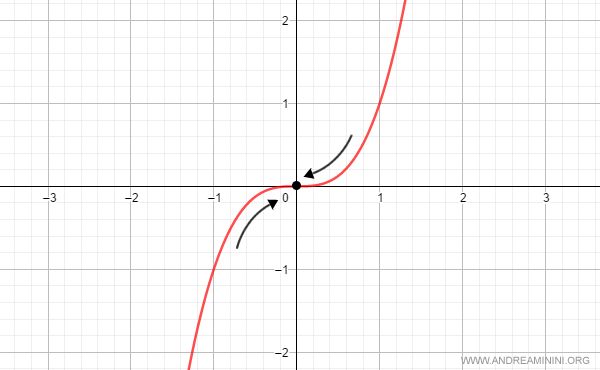
The following function is infinitesimal as x approaches zero:
$$ f(x) = x^3 $$
Although f(x) is nonzero in any neighborhood of x0,
its limit as x approaches x0 is zero:
$$ \lim_{x \rightarrow 0} x^3 = 0 $$
Thus, f(x) is an infinitesimal function as x tends to zero.
Example 2
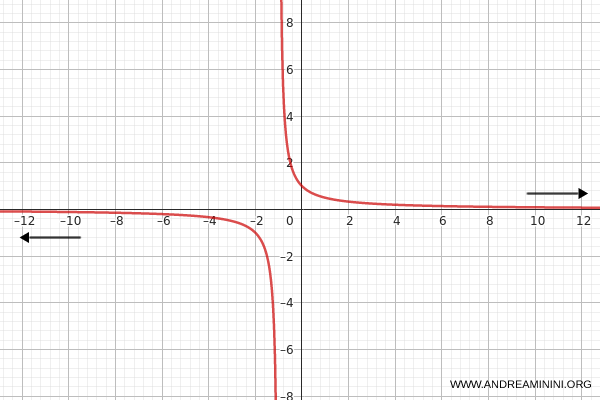
This function is infinitesimal as $ x $ approaches both positive and negative infinity.
Indeed, as $ x \to \infty $, the limit of the function is zero.
$$ \lim_{x \to \infty} \frac{1}{x+1} = 0 $$
The same result holds as $ x \to -\infty $.
$$ \lim_{x \to -\infty} \frac{1}{x+1} = 0 $$
As the graph shows, the function approaches zero asymptotically, without ever reaching it.
Higher-Order Infinitesimals
Let f(x) and g(x) be two functions that are infinitesimal as $ x \to x_0 $, defined in a neighborhood of the point x0 (possibly excluding x0 itself), and nonzero for x≠x0. The function f(x) is said to be a higher-order infinitesimal relative to g(x) as x approaches x0 if $$ \lim_{x \rightarrow x_0} \frac{f(x)}{g(x)} = 0 $$ In other words, $ f(x) $ tends to zero faster than $ g(x) $.
Infinitesimal functions can be compared and ranked, much like infinite functions.
When both f(x) and g(x) approach zero as x → x0, the function that approaches zero faster is called a higher-order infinitesimal.
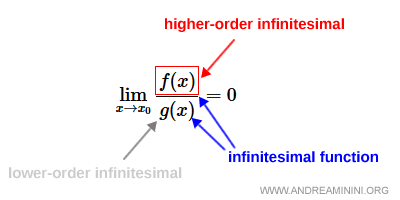
Conversely, g(x) is referred to as a lower-order infinitesimal relative to f(x) as x → x0.
In this case, the limit of the ratio g(x)/f(x) tends to infinity:
$$ \lim_{x \rightarrow x_0} \frac{g(x)}{f(x)} = \pm \infty $$
Note: The order of infinitesimals can only be established when the infinitesimal functions near x → x0 can be meaningfully compared. If the limit of the ratio f(x)/g(x) is a finite, nonzero constant, then the two functions are said to be infinitesimals of the same order: $$ \lim_{x \rightarrow x_0} \frac{g(x)}{f(x)} = l $$
Higher-order infinitesimals are closely connected to the mathematical concept known as little o.
Example
Consider two infinitesimal functions f(x) and g(x) as x approaches zero:
$$ f(x) = x^3 $$
$$ g(x) = x^2 $$
Both functions are infinitesimal since their limits are zero as x approaches zero:
$$ \lim_{x \rightarrow 0} x^3 = 0 $$
$$ \lim_{x \rightarrow 0} x^2 = 0 $$
However, they are of different orders of infinitesimal.
This becomes evident when looking at their graphs:

Note: Near x0 = 0, the function f(x) = x3 (red curve) lies much closer to the x-axis (that is, to zero) than g(x) = x2 (blue curve).
If f(x) approaches zero faster than g(x) as x → 0, then the ratio f(x)/g(x) also tends to zero as x → 0:
$$ \lim_{x \rightarrow x_0} \frac{f(x)}{g(x)} = \lim_{x \rightarrow x_0} \frac{x^3}{x^2} = \lim_{x \rightarrow x_0} x = 0 $$
Thus, f(x) is a higher-order infinitesimal compared to g(x) as x → 0.
The meaning of "little o"
If f(x) is a higher-order infinitesimal relative to g(x) as x → x0, this can also be expressed using the little o notation: $$ f(x) = o(g(x)) \:\:\: \text{as} \: x \rightarrow x_0 $$
Example
Consider two infinitesimal functions as x approaches zero:
$$ f(x) = x^3 $$
$$ g(x) = x^2 $$
Since f(x) is a higher-order infinitesimal relative to g(x) as x approaches zero:
$$ \lim_{x \rightarrow x_0} \frac{f(x)}{g(x)} = 0 $$
We can express this relationship using little o notation:
$$ f(x) = o(g(x)) \:\:\: \text{as} \: x \rightarrow x_0 $$
In other words, f(x) is "little o of g(x)".
Order of vanishing of a function
The order of vanishing quantifies how rapidly a function approaches zero relative to a chosen reference function.
Let \( f(x) \) and \( g(x) \) be functions that vanish as \( x \to \alpha \). We say that \( f(x) \) has order of vanishing \( \gamma > 0 \) with respect to \( g(x) \) if the following finite, nonzero limit exists: \[ \lim_{x \to \alpha} \frac{f(x)}{[g(x)]^\gamma} = l \neq 0 \] In this case, \( g(x) \) serves as a reference function, and \( f(x) \) is asymptotically equivalent to \( [g(x)]^\gamma \).
Equivalently, the order of vanishing describes how many times faster \( f(x) \) tends to zero compared to \( g(x) \).
The parameter \( \gamma \) characterizes the rate of decay:
- If \( \gamma = 1 \), the functions have the same order of vanishing.
- If \( \gamma > 1 \), \( f(x) \) vanishes more rapidly.
- If \( 0 < \gamma < 1 \), \( f(x) \) vanishes more slowly.
In practice, one typically uses standard comparison functions as references.
- If \( x \to x_0 \), a natural choice is \( g(x) = x - x_0 \).
- If \( x \to \pm \infty \), a natural choice is \( g(x) = \frac{1}{x} \).
This convention allows for consistent comparisons without redefining the reference function each time.
Note. Unless explicitly stated otherwise, the order is understood with respect to standard comparison functions. This ensures uniformity and makes results directly comparable in the analysis of limits.
Example
Consider the function
\[ f(x) = \frac{2x^2 + 1}{x^5} \]
This function vanishes as \( x \to +\infty \)
$$ \lim_{x \to \infty} \frac{2x^2 + 1}{x^5} = 0 $$
Determine the order of vanishing \( \gamma \) with respect to the standard comparison function \( g(x) = \frac{1}{x} \)
\[ \lim_{x \to +\infty} \frac{f(x)}{ [ g(x) ]^\gamma} = l \neq 0 \]
\[ \lim_{x \to +\infty} \frac{ \frac{2x^2 + 1}{x^5} }{\left(\frac{1}{x}\right)^\gamma} = l \neq 0 \]
Perform the algebraic simplifications
\[ \lim_{x \to +\infty} \frac{2x^2 + 1}{x^5} \cdot x^{\gamma} \]
To obtain a finite, nonzero limit, the leading powers in the numerator and denominator must balance.
In this case, multiplying by \( x^\gamma \) achieves this balance when \( \gamma = 3 \).
\[ \lim_{x \to +\infty} \frac{2x^2 + 1}{x^5} \cdot x^{3} \]
\[ \lim_{x \to +\infty} \frac{2x^2 + 1}{x^2} \]
At this stage, the leading terms in the numerator and denominator are of the same order.
To evaluate the limit, separate the terms and simplify.
\[ \lim_{x \to +\infty} \frac{2x^2}{x^2} + \frac{1}{x^2} \]
\[ \lim_{x \to +\infty} 2 + \frac{1}{x^2} \]
Since the second term tends to zero as $ x \to \infty $, the limit is 2.
\[ \lim_{x \to +\infty} 2 + \frac{1}{x^2} = 2 \ne 0 \]
This yields a finite, nonzero value.
Therefore, the function $ f(x) $ has order of vanishing \( \gamma=3 \) with respect to the reference function $ g(x) = \frac{1}{x} $.
Asymptotic Equivalence
Two functions \( f(x) \) and \( g(x) \), as \( x \to \alpha \), are said to be asymptotically equivalent if their ratio tends to 1: \[\lim_{x \to \alpha} \frac{f(x)}{g(x)} = 1 \] In this case, we write \[ f(x) \sim g(x) \] The symbol \( \sim \) denotes an asymptotic equality.
At its core, asymptotic equivalence means that two functions behave in the same way near a given point.
More precisely, as \( x \to \alpha \), their ratio gets closer and closer to 1. This tells us that the two functions vanish at the same rate and therefore have the same order of vanishing.
In practical terms, near the point \( \alpha \), the difference between the two functions becomes negligible when studying limits.
For example, consider the limit \[\lim_{x \to 0} \frac{\sin x}{x} = 1 \] If we take a small value such as \( x = 0.01 \), we get \( \sin(0.01) \approx 0.0099998 \), while \( x = 0.01 \). These values are essentially the same. This is why, near zero, we can write \( \sin x \sim x \). This is the key idea behind asymptotic equivalence.
If \( f(x) \sim g(x) \), then one function can be used as the leading term of the other.
In other words, \( g(x) \) provides a reliable approximation of \( f(x) \) near the point, while any additional terms become negligible.
Substitution Principle for Equivalent Infinitesimals
If \( f(x) \sim h(x) \) as \( x \to x_0 \), then in limit computations one can replace an infinitesimal with an equivalent one. In particular, whenever the limits exist, \[ \lim_{x \to x_0} \frac{f(x)}{g(x)} = \lim_{x \to x_0} \frac{h(x)}{g(x)} \]
This principle allows us to simplify the evaluation of limits, avoid lengthy expansions, and directly identify the dominant behavior.
In practice, more complicated functions are replaced with simpler asymptotically equivalent ones.
Note. As \( x \to 0 \), some fundamental asymptotic equivalences used in limit computations are: \[ \sin x \sim x \] \[ \ln(1+x) \sim x \] \[ e^x - 1 \sim x \]
Example in limit computations
Compute the limit:
\[ \lim_{x \to 0} \frac{\sin x}{x} \]
Using the equivalence \( \sin x \sim x \), we replace the function in the expression:
\[ \frac{\sin x}{x} \sim \frac{x}{x} = 1 \]
Therefore, the original limit has the same value:
\[ \lim_{x \to 0} \frac{\sin x}{x} = 1 \]
This approach works because we replace a more complicated function with a simpler one that has the same asymptotic behavior.
Example 2
Consider the limit:
\[ \lim_{x \to 0} \frac{e^x - 1}{\sin x} \]
Using the equivalences \( e^x - 1 \sim x \) and \( \sin x \sim x \), we substitute:
\[ \frac{e^x - 1}{\sin x} \sim \frac{x}{x} = 1 \]
Therefore, the original limit tends to 1 as \( x \to 0 \):
\[ \lim_{x \to 0} \frac{e^x - 1}{\sin x} = 1 \]
And this same strategy can be applied to many other limit problems.
And so on.


