
Similar Radicals
- Two radicals are defined as similar radicals if
- they are irreducible radicals
- they have the same index (n)
- they have the same radicand (m)
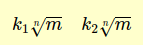
Similar radicals may differ in their coefficients (k1 and k2), which are numerical factors that multiply the radical.
In many cases, radicals that are not initially similar can be transformed into similar radicals by bringing factors inside or extracting them outside the root.
Note. Similar radicals play a key role in algebra because they can be combined through addition or subtraction. For example $$ k_1 \sqrt[n]{m} + k_2 \sqrt[n]{m} = ( k_1 + k_2 ) \cdot \sqrt[n]{m} $$
A Practical Example
Consider the following two radicals
$$ 4 \sqrt[3]{2} $$
$$ 5 \sqrt[3]{2} $$
These are similar radicals because they are irreducible, have the same index, and share the same radicand.
Example 2
The following radicals are not similar
$$ 4 \sqrt[4]{2} $$
$$ 5 \sqrt[3]{2} $$
because their indices are different.
Example 3
These radicals are not similar because their radicands are different
$$ 2 \sqrt[3]{16} $$
$$ 5 \sqrt[3]{2} $$
However, the first expression can be rewritten by extracting perfect powers from the radicand
$$ 2 \sqrt[3]{16} $$
$$ 2 \sqrt[3]{2^4} $$
$$ 2 \sqrt[3]{2^3 \cdot 2} $$
$$ 2 \cdot 2 \sqrt[3]{2} $$
$$ 4 \sqrt[3]{2} $$
This manipulation produces an equivalent radical.
$$ 4 \sqrt[3]{2} $$
$$ 5 \sqrt[3]{2} $$
The two expressions are now similar radicals, since they have the same index and the same radicand.
And so on.


