
Taylor’s Formula
Taylor’s formula provides an approximation of a function f(x) that is differentiable n times in a neighborhood of a point x0 ∈ ℝ, using a polynomial of degree n along with a remainder term R. $$ f(x) = \sum_{k=0}^{n} \frac{f^{(k)}(x_0)}{k!} \cdot (x-x_0)^k + R_n(x) $$ where $$ \lim_{x \rightarrow x_0} \frac{R_n}{(x-x_0)^n} = 0 $$
This polynomial is called the Taylor Polynomial of f(x) at x0, of degree (or order) n.
The higher the degree n, the more accurately the polynomial approximates the function.
As n approaches infinity, the remainder term R tends to zero:
$$ \lim_{n \rightarrow \infty} R_n = 0 $$
Why is it useful? Taylor’s formula enables us to express a function f(x) as an algebraic polynomial P(x). This form often makes it easier and more efficient to analyze the function’s properties and behavior.
A Worked Example
Let’s consider the exponential function:
$$ f(x) = e^x $$
We’ll expand it around the point x0 = 0:
$$ x_0 = 0 $$
At this point, the function evaluates to:
$$ f(0) = e^0 = 1 $$
Since all derivatives of ex are equal to ex, we have:
$$ D[e^x] = e^x $$
Therefore, for any integer k:
$$ f^{(k)}(0) = 1 $$
Hence, the Taylor polynomial of degree n = 2 is:
$$ f(x) = \frac{f^{(0)}(x_0)}{0!} \cdot (x - x_0)^0 + \frac{f^{(1)}(x_0)}{1!} \cdot (x - x_0)^1 + \frac{f^{(2)}(x_0)}{2!} \cdot (x - x_0)^2 + R_2 $$
$$ f(x) = \frac{D^{(0)}[e(x_0)]}{0!} \cdot (x - x_0)^0 + \frac{D^{(1)}[e(x_0)]}{1!} \cdot (x - x_0)^1 + \frac{D^{(2)}[e(x_0)]}{2!} \cdot (x - x_0)^2 + R_2 $$
Recalling that the zeroth derivative is simply the function itself, we get:
$$ f(x) = \frac{e(x_0)}{0!} \cdot (x - x_0)^0 + \frac{D^{(1)}[e(x_0)]}{1!} \cdot (x - x_0)^1 + \frac{D^{(2)}[e(x_0)]}{2!} \cdot (x - x_0)^2 + R_2 $$
Substituting x0 = 0 gives:
$$ f(x) = \frac{e(0)}{0!} \cdot (x - 0)^0 + \frac{D^{(1)}[e(0)]}{1!} \cdot (x - 0)^1 + \frac{D^{(2)}[e(0)]}{2!} \cdot (x - 0)^2 + R_2 $$
$$ f(x) = \frac{e(0)}{0!} \cdot x^0 + \frac{D^{(1)}[e(0)]}{1!} \cdot x^1 + \frac{D^{(2)}[e(0)]}{2!} \cdot x^2 + R_2 $$
Given that every k-th derivative of ex is still ex, we have:
$$ f(x) = \frac{e(0)}{0!} \cdot x^0 + \frac{e(0)}{1!} \cdot x^1 + \frac{e(0)}{2!} \cdot x^2 + R_2 $$
Since e0 = 1:
$$ f(x) = \frac{1}{0!} \cdot x^0 + \frac{1}{1!} \cdot x^1 + \frac{1}{2!} \cdot x^2 + R_2 $$
Evaluating the factorials in the denominators (with 0! defined as 1) yields:
$$ f(x) = \frac{1}{1} \cdot x^0 + \frac{1}{1} \cdot x^1 + \frac{1}{2} \cdot x^2 + R_2 $$
$$ f(x) = \frac{x^0}{1} + \frac{x^1}{1} + \frac{x^2}{2} + R_2 $$
$$ f(x) = 1 + x + \frac{x^2}{2} + R_2 $$
Even though this Taylor polynomial is only of degree 2, it already provides a reasonably good approximation of the function f(x) = ex.
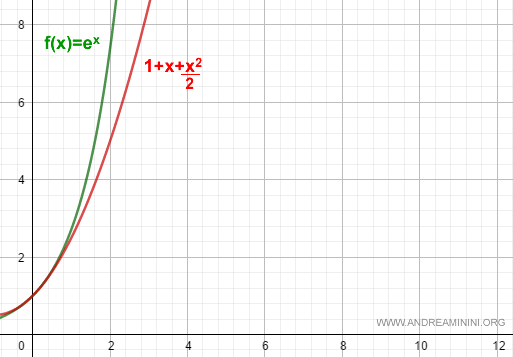
By increasing the degree of the polynomial to k + 1 = 3, the approximation becomes even more precise:
$$ f(x) = 1 + x + \frac{x^2}{2} + \frac{x^3}{6} + R_3 $$
This new third-degree polynomial fits the graph of the function more closely than the previous second-degree polynomial (shown as a dotted curve).
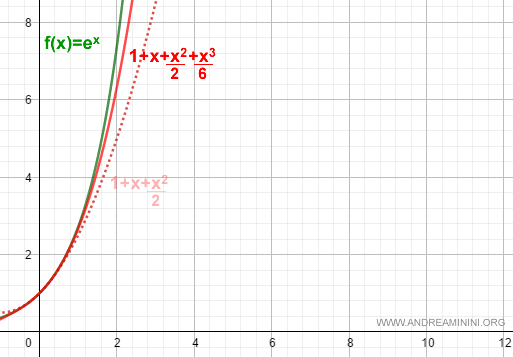
Thus, the remainder term of the Taylor polynomial approaches zero as k approaches infinity:
$$ \lim_{k \rightarrow \infty} R_k = 0 $$
Proof
Assume that the n-th derivative f(n)(x) is continuous at x0.
We aim to show that the remainder term in Taylor’s formula approaches zero as x tends toward x0:
$$ \lim_{x \rightarrow x_0} \frac{R_n}{(x - x_0)^n} = 0 $$
By definition, the remainder R is the difference between the function f(x) and its Taylor polynomial:
$$ R_n = f(x) - P(x) $$
$$ R_n = f(x) - \left[ f(x_0) + f'(x_0)(x - x_0) + \dots + \frac{f^{(n)}(x_0)(x - x_0)^n}{n!} \right] $$
Substituting R into the limit yields:
$$ \lim_{x \rightarrow x_0} \frac{f(x) - \left[ f(x_0) + f'(x_0)(x - x_0) + \dots + \frac{f^{(n)}(x_0)(x - x_0)^n}{n!} \right]}{(x - x_0)^n} = \frac{0}{0} $$
Note. The numerator becomes zero because f(x) and its Taylor polynomial coincide at x0. The denominator tends to zero as x approaches x0. This explains why the limit takes the indeterminate form 0/0.
To resolve this indeterminate form, we apply L’Hôpital’s Theorem.
We differentiate both the numerator and denominator with respect to x:
$$ \lim_{x \rightarrow x_0} \frac{D \left[ f(x) - \left( f(x_0) + f'(x_0)(x - x_0) + \dots + \frac{f^{(n)}(x_0)(x - x_0)^n}{n!} \right) \right]}{D \left[ (x - x_0)^n \right]} $$
$$ \lim_{x \rightarrow x_0} \frac{ f'(x) - \left[ f'(x_0) + f''(x_0)(x - x_0) + \dots + \frac{f^{(n)}(x_0)(x - x_0)^{n - 1}}{(n - 1)!} \right] }{ n \cdot (x - x_0)^{n - 1} } = \frac{0}{0} $$
Since this remains an indeterminate form, we continue applying L’Hôpital’s Theorem, differentiating numerator and denominator a total of n times.
After n differentiations, we obtain:
$$ \lim_{x \rightarrow x_0} \frac{f^{(n)}(x) - f^{(n)}(x_0)}{n!} $$
Because f(x) is continuous at x0, the numerator approaches zero as x → x0 since f^{(n)}(x) - f^{(n)}(x_0) → 0.
The denominator is the constant n!, the factorial of the polynomial’s degree.
Thus, the limit evaluates to zero:
$$ \lim_{x \rightarrow x_0} \frac{f^{(n)}(x) - f^{(n)}(x_0)}{n!} = 0 $$
Hence, the original limit also equals zero:
$$ \lim_{x \rightarrow x_0} \frac{ f'(x) - \left[ f'(x_0) + f''(x_0)(x - x_0) + \dots + \frac{f^{(n)}(x_0)(x - x_0)^{n - 1}}{(n - 1)!} \right] }{ n \cdot (x - x_0)^{n - 1} } = 0 $$
which establishes that:
$$ \lim_{x \rightarrow x_0} \frac{R_n}{(x - x_0)^n} = 0 $$
This completes the proof of Taylor’s formula.
Peano’s Remainder
Peano’s remainder is defined as the difference between the Taylor polynomial pn of degree n, centered at x0, and the function f(x) being approximated: $$ R_n(x) = f(x) - p_n(x) $$
Peano’s remainder quantifies the error in approximating f(x) by its Taylor polynomial:
$$ f(x) = \sum_{k=0}^{n} \frac{f^{(k)}(x_0)}{k!} \cdot (x - x_0)^k + R_n(x) $$
The Taylor polynomial pn(x) is given by:
$$ p_n(x) = \sum_{k=0}^{n} \frac{f^{(k)}(x_0)}{k!} \cdot (x - x_0)^k $$
Hence, by straightforward algebraic rearrangement:
$$ f(x) = p_n(x) + R_n(x) $$
$$ f(x) - p_n(x) = R_n(x) $$
Thus, Peano’s remainder R precisely represents the difference between the function f(x) and its Taylor polynomial pn(x) of degree n centered at x0.
Peano’s remainder Rn(x) is said to be of higher order than (x - x0)n if f(x) is differentiable up to order n at x0: $$ \lim_{x \rightarrow x_0} \frac{R_n(x)}{(x - x_0)^n} = 0 $$
The Proof
$$ \lim_{x \rightarrow x_0} \frac{R_n(x)}{(x - x_0)^n} $$
Since Rn(x) = f(x) - pn(x):
$$ \lim_{x \rightarrow x_0} \frac{f(x) - p_n(x)}{(x - x_0)^n} $$
We substitute pn(x) with its Taylor expansion:
$$ \lim_{x \rightarrow x_0} \frac{f(x) - \left[ f(x_0) + f'(x_0)(x - x_0) + \dots + \frac{f^{(n)}(x_0)(x - x_0)^n}{n!} \right]}{(x - x_0)^n} $$
This limit also yields an indeterminate form of type 0/0.
To evaluate it, we apply L’Hôpital’s Theorem repeatedly (n - 1 times):
$$ \lim_{x \rightarrow x_0} \frac{f^{(n-1)}(x) - \left[ f^{(n-1)}(x_0) + f^{(n)}(x_0)(x - x_0) \right]}{n! \cdot (x - x_0)} $$
We can factor out 1/n! from the limit:
$$ \frac{1}{n!} \lim_{x \rightarrow x_0} \frac{f^{(n-1)}(x) - \left[ f^{(n-1)}(x_0) + f^{(n)}(x_0)(x - x_0) \right]}{(x - x_0)} $$
$$ \frac{1}{n!} \lim_{x \rightarrow x_0} \frac{f^{(n-1)}(x) - f^{(n-1)}(x_0) - f^{(n)}(x_0)(x - x_0)}{(x - x_0)} $$
Separating terms and simplifying:
$$ \frac{1}{n!} \lim_{x \rightarrow x_0} \left[ \frac{f^{(n-1)}(x) - f^{(n-1)}(x_0)}{(x - x_0)} - \frac{f^{(n)}(x_0)(x - x_0)}{(x - x_0)} \right] $$
$$ \frac{1}{n!} \lim_{x \rightarrow x_0} \left[ \frac{f^{(n-1)}(x) - f^{(n-1)}(x_0)}{(x - x_0)} - f^{(n)}(x_0) \right] $$
We may split the limit into separate terms:
$$ \frac{1}{n!} \left[ \lim_{x \rightarrow x_0} \frac{f^{(n-1)}(x) - f^{(n-1)}(x_0)}{(x - x_0)} - \lim_{x \rightarrow x_0} f^{(n)}(x_0) \right] $$
Applying L’Hôpital’s Theorem to the first limit gives f(n)(x):
$$ \frac{1}{n!} \cdot \left[ f^{(n)}(x_0) - f^{(n)}(x_0) \right] $$
$$ \frac{1}{n!} \cdot 0 $$
$$ = 0 $$
Note. Peano’s remainder Rn(x) is an infinitesimal of higher order than (x - x0)n: $$ \lim_{x \rightarrow x_0} \frac{R_n(x)}{(x - x_0)^n} = 0 $$ Consequently, in Taylor’s polynomial, we can express it using the little-o notation: $$ R_n(x) = o\bigl((x - x_0)^n\bigr) $$ which yields: $$ f(x) = \sum_{k=0}^{n} \frac{f^{(k)}(x_0)}{k!} \cdot (x - x_0)^k + o\bigl((x - x_0)^n\bigr) $$
Taylor’s Formula in Alternative Notation
If Peano’s remainder is of order o((x - x0)n), Taylor’s formula can also be expressed in this alternative form:
$$ f(x) = \sum_{k=0}^{n} \frac{f^{(k)}(x_0)}{k!} \cdot (x - x_0)^k + o\bigl((x - x_0)^n\bigr) $$
Estimating Peano’s Remainder
If f(x) is differentiable (n+1) times in a neighborhood of x0, and its (n+1)-th derivative is continuous, and if M denotes the maximum value of that derivative in the neighborhood, an estimate for Peano’s remainder is given by: $$ |R_n(x)| \le M \cdot \frac{|x - x_0|^{n+1}}{(n+1)!} $$
Maclaurin’s Formula
Maclaurin’s formula is a special case of Taylor’s formula where x0 = 0: $$ f(x) = \sum_{k=0}^{n} \frac{f^{(k)}(0)}{k!} \cdot x^k + o\bigl(x^n\bigr) $$
And so on.


