
Kinematics
What Is Kinematics?
Kinematics is the branch of mechanics that describes and analyzes the motion of objects without considering the forces that cause that motion.
Its goal is to explain how an object moves through space and time, regardless of the physical mechanisms responsible for the movement.
By focusing solely on the geometry of motion, kinematics provides the mathematical tools needed to describe an object's position, velocity, and acceleration as it moves.
Kinematics vs. Dynamics. Kinematics and dynamics study different aspects of motion. Kinematics describes how objects move, while dynamics investigates why they move by analyzing the forces and interactions acting on them.
Particle Kinematics
In many kinematic models, an object is treated as a particle (or material point). This is an idealized object whose dimensions are so small compared with the distances involved that its size can be ignored.
To describe the motion of a particle, its position must be known at every instant within a chosen reference frame.
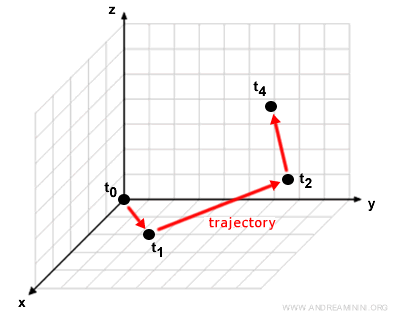
In a three-dimensional Cartesian coordinate system, the particle's position is specified by the coordinates \( x \), \( y \), and \( z \), each of which may change over time:
$$ \vec r(t)= \begin{pmatrix} x(t) \\ y(t) \\ z(t) \end{pmatrix} $$
where \( \vec r(t) \) represents the particle's position vector.
Note. Position can also be expressed using other coordinate systems, such as polar or spherical coordinates. The most appropriate system depends on the characteristics of the problem being studied.
Trajectory
As a particle moves, it occupies different positions over time.
The complete set of positions occupied by the particle defines its trajectory.
Put simply, the trajectory is the path traced by the particle as it moves through space.
Example
For motion along a straight line, the particle's position can be described by a single coordinate, \( x(t) \), expressed as a function of time.
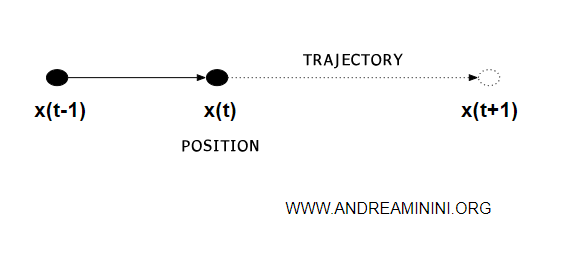
Each value of the function identifies the position occupied by the particle at a particular instant.
Trajectory vs. Motion. A trajectory should not be confused with motion itself. The trajectory describes only the geometric path followed by an object, whereas motion describes how the object's position changes over time. For example, two cars may travel along the same road and therefore follow the same trajectory while moving at different speeds. The path is identical, but the motions are not.
Physical Quantities in Kinematics
The main physical quantities used in kinematics are:
- position
- displacement
- velocity
- acceleration (the rate of change of velocity)
- time
Position, velocity, and acceleration are vector quantities, while time is a scalar quantity that acts as the independent variable.
Together, these quantities form the foundation of kinematic analysis.
Displacement
Displacement is the change in a particle's position between two instants in time.
It is a vector quantity that depends only on the initial and final positions.
For one-dimensional motion, displacement is given by:
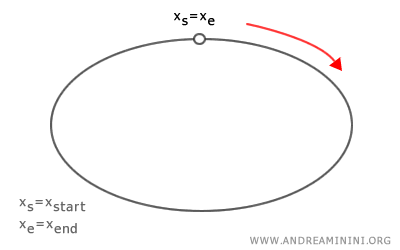
$$ \Delta x = x_e - x_s $$
Displacement is not necessarily the same as distance traveled.
For example, an object that moves along a closed path and returns to its starting point has zero displacement, even though it has covered a nonzero distance.
Velocity
Velocity measures how quickly position changes with time.
Two important forms of velocity are commonly used:
- Average Velocity
Average velocity is defined as the ratio of displacement to the corresponding time interval: $$ v_m=\frac{\Delta x}{\Delta t} $$ where \( \Delta x \) is the displacement and \( \Delta t \) is the elapsed time. - Instantaneous Velocity
Instantaneous velocity is the velocity of an object at a specific moment in time. Mathematically, it is defined as the derivative of position with respect to time: $$ v=\frac{dx}{dt} $$ Unlike average velocity, instantaneous velocity can vary continuously throughout the motion.
Acceleration
Acceleration measures how quickly velocity changes with time.
As with velocity, two forms of acceleration are commonly considered:
- Average Acceleration
Average acceleration is defined as: $$ a_m=\frac{\Delta v}{\Delta t} $$ where \( \Delta v \) is the change in velocity during the time interval \( \Delta t \). - Instantaneous Acceleration
Instantaneous acceleration describes the rate at which velocity changes at a particular instant: $$ a=\frac{dv}{dt} $$
Acceleration may result from a change in speed, a change in direction, or both.
Types of Motion
Some of the most important types of motion studied in kinematics are:
- Rectilinear Motion
- Uniform Rectilinear Motion
- Uniformly Accelerated Rectilinear Motion
- Exponentially Damped Rectilinear Motion
- Uniform Circular Motion
- Simple Harmonic Motion
- Planar Motion
- Curvilinear Motion
Each type of motion is governed by its own mathematical relationships between position, velocity, and acceleration.
Rest
An object is said to be at rest with respect to a given reference frame when its position remains unchanged over time.
In this situation, the coordinates that define its position remain constant and its velocity is zero.
Note. Rest is not an absolute concept. Whether an object is considered at rest depends entirely on the reference frame from which it is observed.
Reference Frame
A reference frame is a coordinate system used to specify position and describe the motion of an object in space and time.
Every description of motion depends on the reference frame being used.
An object's position, velocity, and state of rest or motion may appear different when viewed from different reference frames.
Example
Consider a parked car. Relative to the road, nearby buildings, and other stationary objects on Earth's surface, the car is at rest.
Its coordinates remain unchanged over time in that reference frame.

If the Sun is chosen as the reference frame, however, the car is no longer at rest. Although it remains stationary relative to the road, it is carried by Earth as our planet rotates about its axis and revolves around the Sun.
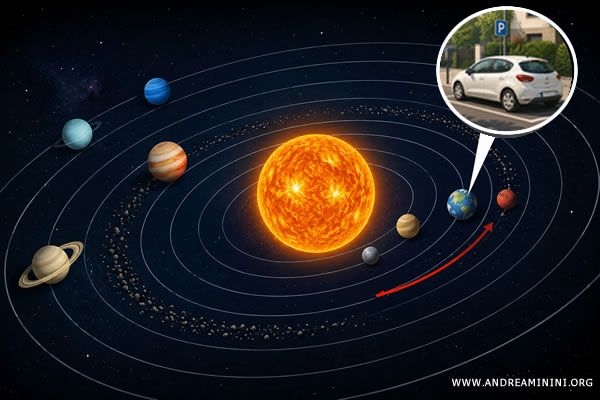
As a result, the car's position changes over time when measured relative to the Sun.
This example illustrates an important principle of mechanics: motion and rest are always relative to the chosen reference frame.
The Importance of Kinematics
Kinematics provides the foundation for the study of mechanics.
Before investigating the forces that cause motion through dynamics, it is essential to understand how motion can be described quantitatively using position, velocity, and acceleration.
For this reason, kinematics is one of the first and most important topics in classical physics. It serves as the basis for the study of dynamics, analytical mechanics, and many other areas of science and engineering.
And so on.


