Point Particle
What Is a Point Particle?
A point particle is an idealized model used in physics in which the entire mass of an object is assumed to be concentrated at a single point in space. Since the model has no size or shape, properties such as rotation and deformation cannot be described. This simplification is useful whenever the dimensions of an object are negligible compared to the distances involved in the problem.
The point particle is one of the most important and widely used models in classical mechanics because it allows many problems to be analyzed much more easily.
It plays a central role in particle kinematics and particle dynamics, where the focus is on describing and predicting motion without having to account for an object's geometry.
Point particles are usually represented within a two-dimensional or three-dimensional Cartesian coordinate system.
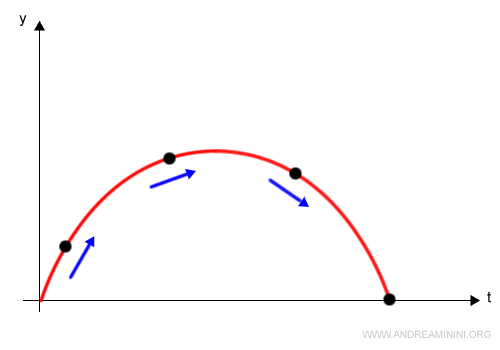
The graph above shows the position as a function of time and the trajectory of a point particle moving along a straight line.
When Can an Object Be Treated as a Point Particle?
An object can be modeled as a point particle when its dimensions are extremely small compared to the distances involved in the situation being studied. This approach is also appropriate when the object's rotation and deformation have little or no effect on the results.
In practice, a point particle can represent many different objects, including a person, a train, a vehicle, or a microscopic particle.
Even the Earth is often treated as a point particle when calculating its orbit around the Sun.
Note. In orbital mechanics, the Earth's diameter is tiny compared to the distance separating it from the Sun. For this reason, the Earth can often be modeled as a point particle. However, this approximation is not suitable when studying phenomena such as Earth's rotation or ocean tides, where the planet's size and shape become important.
A Practical Example
Consider a radar system that monitors air traffic over a large region.
On the radar display, every aircraft appears as a point particle identified by the coordinates \( (x,y,z) \), where \( z \) represents altitude.
This approximation works well because the dimensions of an aircraft are extremely small compared to the distances covered by the radar.
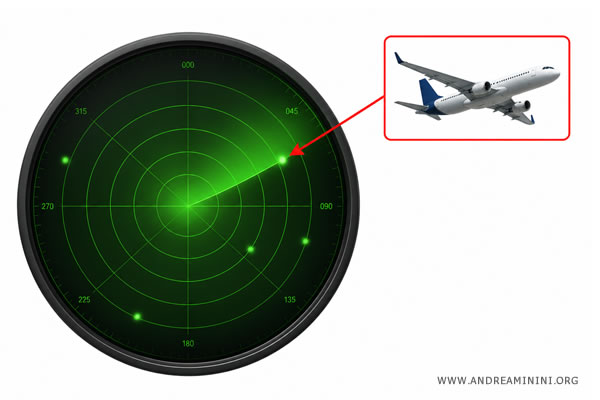
Representing an aircraft as a point particle makes it possible to analyze its motion without worrying about details such as air resistance, wind conditions, or aerodynamic design.
Of course, a real aircraft is not a point particle. It has mass, shape, and physical dimensions, and its interaction with the surrounding air is far more complex.
However, if the goal is simply to determine the aircraft's position, speed, and trajectory, including all those additional details would only complicate the analysis without providing any useful information.
For radar tracking, the most important quantities are the position function, the coordinates \( (x,y,z) \), the direction of motion, velocity, and instantaneous acceleration.
For this reason, representing the aircraft as a point particle is both practical and effective.
Note. The same idea is commonly used in GPS navigation systems, where cars, ships, and other vehicles are often approximated as point particles when only their position and motion are relevant.
Center of Mass
When an object is approximated as a point particle, the chosen point often corresponds to its center of mass.
The center of mass is the point at which the entire mass of a body can be considered concentrated for the purpose of analyzing its motion.
Although mass is actually distributed throughout the object's volume, many problems can be solved accurately by tracking only the motion of the center of mass.
Example
When a ball is thrown into the air, the trajectory followed by its center of mass obeys the laws of projectile motion.
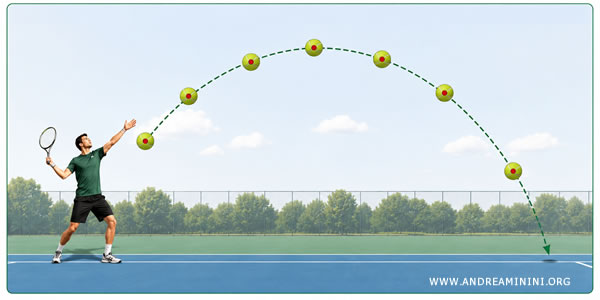
As a result, when the size of the ball and the effects of its rotation are not important, the entire object can be represented as a point particle located at its center of mass.
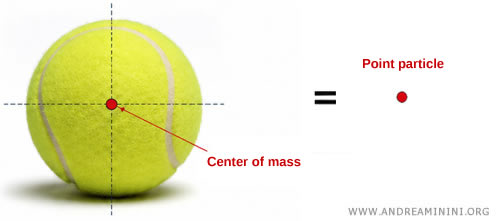
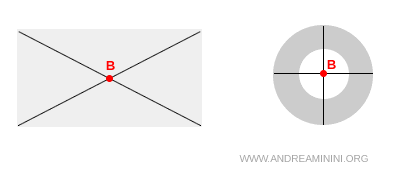
Note. If mass is distributed uniformly and the object has a regular geometric shape, the center of mass often coincides with the geometric center. For example, in a rectangle or a cube, it is located at the intersection of the diagonals.
Point Particle, Rigid Body, and Extended Body
Physicists use different models depending on the level of detail required. The three most common are the point particle, the rigid body, and the extended body.
- Point Particle
In this model, an object is described only by its mass and position. Its shape, dimensions, and rotation are ignored. Because the object is assumed to have no size, only translational motion can be studied. This is the simplest and most abstract model in mechanics.
For example, if a tennis ball is treated as a point particle, only its mass and the trajectory of its center of mass are considered. Its size, shape, and spin are ignored.
- Rigid Body
A rigid body has mass, shape, and dimensions. Unlike a point particle, it can both translate and rotate. The defining feature of this model is that the distance between any two points within the body remains constant. Deformation is neglected, but the point where a force is applied becomes important.
For example, when a tennis ball is struck by a racket, it may acquire spin depending on how the force is applied. In the rigid-body model, the ball's deformation during impact is ignored.
- Extended Body
An extended body is the most realistic model. It has mass, shape, and dimensions, and it can both rotate and deform. In this case, the distance between two points in the object may change over time.
For example, when a tennis ball bounces off the ground, it briefly compresses and changes shape. To describe this behavior accurately, the deformation of the ball must be taken into account.
These three models provide different levels of approximation, allowing physicists to choose the one that best matches the problem being studied.