
Speed of Light
The speed of light in a vacuum is approximately 300 thousand kilometers per second.
More precisely, electromagnetic waves propagate through a vacuum at a speed of 299,792,458 meters per second, or approximately 3 x 10⁸ m/s.
A Simple Example
The Moon is located at an average distance of roughly 400 thousand kilometers from Earth.
Because of this enormous distance, a beam of light takes about 1.3 seconds to travel from Earth to the Moon, and another 1.3 seconds to return.
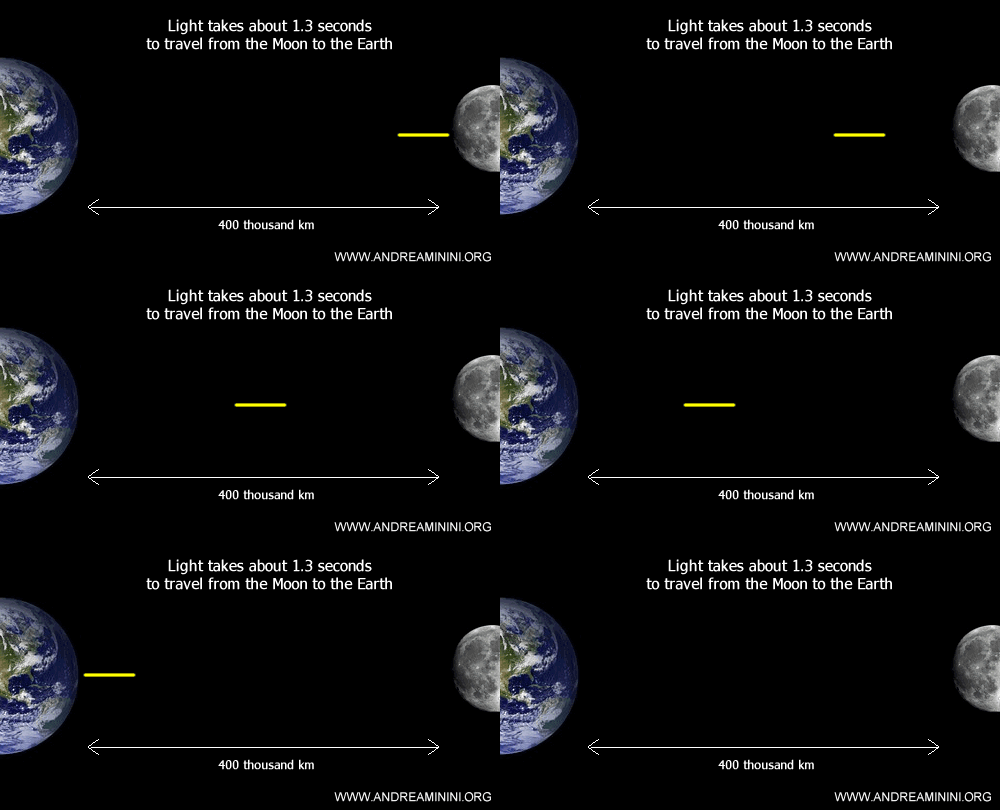
Note. When we look at the Moon in the night sky, we are not seeing it exactly as it is "right now". We see it as it was about 1.3 seconds ago. Light needs this amount of time to travel from the Moon to Earth and reach our eyes.
Nothing Can Move Faster Than Light
In physics, the speed of light is considered the ultimate speed limit of the Universe. Nothing can travel faster.
No known object or signal can exceed the speed of light in a vacuum.
The First Measurements of the Speed of Light
The speed of light was measured for the first time in 1675 by the Danish astronomer Ole Rømer.
During the 19th century, scientists developed increasingly accurate techniques to measure it with greater precision.
Light Slows Down in Water and Dense Materials
Scientists discovered that light travels more slowly in water and dense materials than it does in a vacuum.
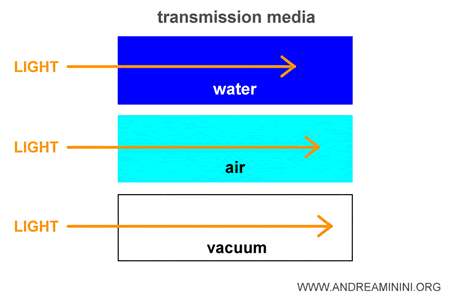
Example. In air, light travels about 1% slower than in a vacuum. In glass, its speed drops to approximately 100 thousand km/s, about one-third of its speed in a vacuum.
This experimental evidence marked the end of Newton's corpuscular theory of light, which predicted the opposite result.
Note. According to Newton, light should travel faster in water and slower in a vacuum. Experimental observations showed that the opposite is true.
The results instead confirmed the predictions of the wave theory of light, according to which light slows down in dense media and reaches its maximum speed in a vacuum.
The Speed of Light Is a Physical Constant
In 1887, the scientists Michelson and Morley studied how light propagates through the ether.
They discovered that the speed of light does not depend on the observer or the reference frame in which it is measured.
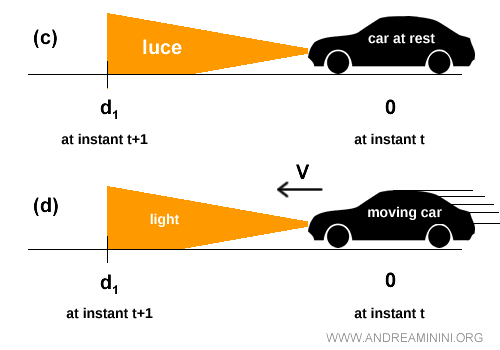
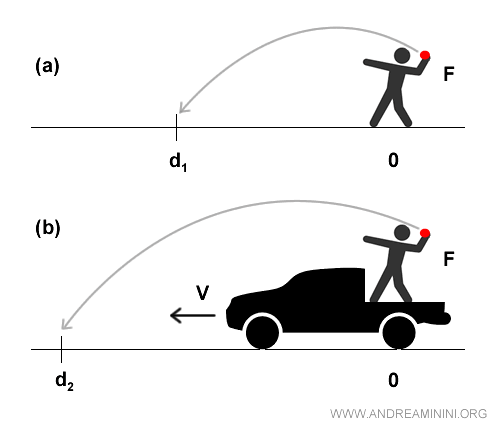
Example. Imagine turning on the headlights of two cars, one parked and one moving at high speed. In classical mechanics, the light emitted by the moving car should travel faster because the velocity of the car should add to the velocity of the light. However, this does not happen. In both cases, light travels at exactly the same speed.
This is one of the key differences between classical mechanics and modern physics. The ordinary rules used for moving objects do not apply to light.
A Fundamental Constant of Physics
After the Michelson-Morley experiment, scientists realized that the speed of light is not a variable but a universal constant.
In the 20th century, Albert Einstein used the speed of light as one of the foundations of the theory of special relativity.
Note. In physics, the letter c is used to represent the speed of light. It may refer to the word constant, but it is also linked to the Latin term celeritas, meaning "speed".


