What Happens to Photons When You Turn Off the Light?
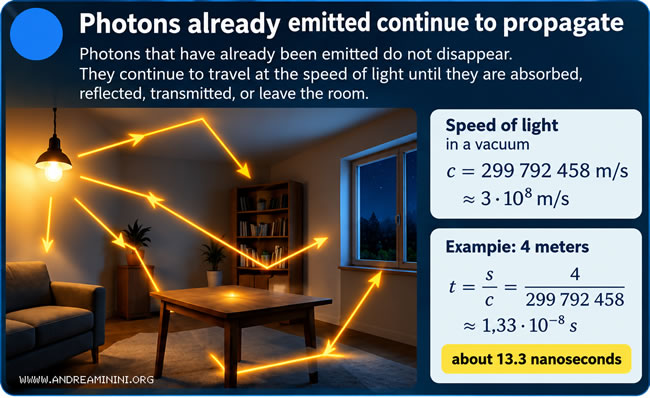
When I turn off a light bulb, the photons it has already emitted do not simply disappear. They continue traveling through the room at the speed of light until they are absorbed by matter, pass through a transparent material, or escape from the room.
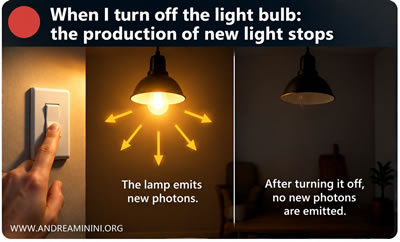
In other words, turning off the light stops the production of new light, but it cannot stop photons that are already on their way. Those photons continue to propagate through the room.
What Happens When I Turn Off the Light Bulb?
When I flip the switch, I cut off the electrical power to the lamp.
The light source then stops emitting new radiation, although exactly how quickly this happens depends on the type of lamp.
For example, the hot filament of an incandescent bulb continues to emit electromagnetic radiation for a short time as it cools.
But what about the light that has already left the bulb? That light keeps traveling.
In a vacuum, the speed of light is
\[ c=299\,792\,458 \text{ m/s} \]
or approximately
\[ c \simeq 3\cdot10^8 \text{ m/s} \]
Light travels slightly more slowly in air. Over the distances involved in an ordinary room, however, the difference is so small that the speed of light in a vacuum is an excellent approximation.
A Practical Example
Consider a photon traveling 4 meters from the light bulb to a wall.
The travel time is
\[ t=\frac{s}{c} \]
where \(s\) is the distance traveled and \(c\) is the speed of light.
Substituting the values gives
\[ t=\frac{4}{299\,792\,458} \]
which is approximately
\[ t=1.33\cdot10^{-8}\text{ s} \]
or about 13.3 nanoseconds.
That means a photon takes only a few billionths of a second to travel several meters across a room.
Note. This does not mean that all the photons emitted by the lamp have disappeared after 13.3 nanoseconds. It is simply the time required for light to travel 4 meters. Some photons may be reflected and continue traveling through the room for longer.
Why Does the Room Go Dark?
If photons keep moving after the light is switched off, why does the room become dark so quickly?
The answer lies in what happens when light encounters the walls, furniture, floor, windows, and other surfaces in the room.
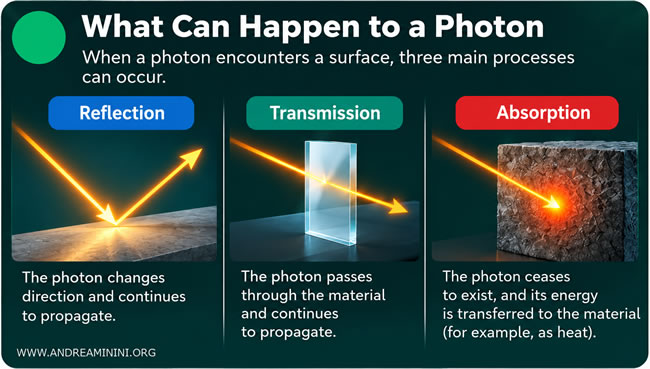
When light strikes a surface, three main processes can occur:
- Reflection
The light is reflected from the surface, changes direction, and continues traveling. - Transmission
The light passes through the material and continues traveling. - Absorption
The photon is absorbed by the material and transfers its energy to the absorbing system. Depending on the material and the photon's energy, this may involve electronic excitations, molecular vibrations, or other microscopic processes. The absorbed energy may ultimately contribute to the material's internal energy.
Real surfaces are not perfect reflectors. Even a white wall reflects only a fraction of the electromagnetic radiation that strikes it.
So every time light is reflected around the room, some of it is absorbed, some may pass through materials, and some may escape from the room entirely.
An Example
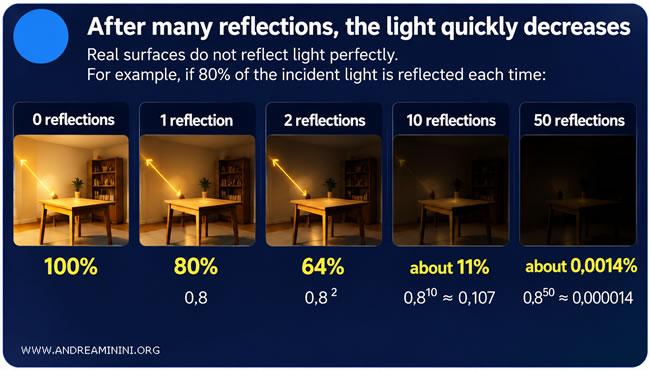
To see how quickly the amount of light can decrease, suppose that a surface reflects 80% of the incident light each time.
After one reflection,
\[ 0.8=80\% \]
of the initial light remains.
After two reflections,
\[ 0.8^2=0.64 \]
so 64% remains.
After ten reflections,
\[ 0.8^{10}\simeq0.107 \]
so only about 11% of the initial amount remains.
After fifty reflections,
\[ 0.8^{50}\simeq0.000014 \]
or about 0.0014% remains.
Even though photons can undergo many reflections, the amount of light remaining in the room therefore falls extremely quickly.
And because light travels several meters in just a few nanoseconds, these reflections happen over incredibly short periods of time.
That is why the room appears to go dark almost instantly. In reality, the light does not vanish all at once. The electromagnetic energy density in the room decreases continuously as photons are absorbed by the walls, furniture, and other objects, or escape from the room.
What Happens When a Photon Is Absorbed?
So what actually happens when one of these photons reaches a surface and is absorbed?
The photon transfers its energy to the absorbing system.
The energy carried by a photon depends on its frequency:
\[ E=h\nu \]
where \(h\) is Planck's constant and \(\nu\) is the frequency of the electromagnetic radiation.
For visible light, absorption can involve transitions between electronic energy states in atoms, molecules, or solids.
Once the energy has been absorbed, it can be redistributed through a variety of microscopic processes.
For example, it may be transferred to molecular vibrations, lattice vibrations in a solid, or other forms of microscopic motion.
In many materials, some or all of this absorbed energy is eventually converted into thermal energy, increasing the material's internal energy.
In everyday terms, absorbed light can therefore contribute to heating an object.
A Practical Example
Imagine light from the lamp striking a nightstand.
Some of the incident light is reflected. This reflected light reaches our eyes and allows us to see the nightstand.
Another fraction of the incident light is absorbed by the material.
When this happens, the energy and momentum carried by the absorbed photons are transferred to the material.
The effect of a single photon on a macroscopic object is negligible.
A large number of photons, however, can collectively transfer a significant amount of energy.
What Ultimately Happens to the Photon?
This brings us to the central question: what actually becomes of the photon itself?
A photon should not be imagined as a tiny material ball with energy stored inside it. So when a photon is absorbed, there is no physical remnant left behind, like the remains of a microscopic projectile.
In quantum field theory, a photon is a quantum excitation of the electromagnetic field.
When a photon is absorbed, it ceases to exist as a photon. Its energy and momentum are transferred to the system with which it interacts, in accordance with the relevant conservation laws.
There is no empty, energyless shell left behind.
Note. Photon number is not, in general, a conserved quantity. Photons can be created and annihilated in physical processes. Energy and momentum, however, must be conserved for the complete interacting system.
This does not mean that photons have a built-in expiration time.
A photon traveling freely through a vacuum is stable. If it does not encounter matter or undergo another interaction that absorbs, scatters, or otherwise alters it, it can continue traveling through space.
Does a Dark Room Still Contain Photons?
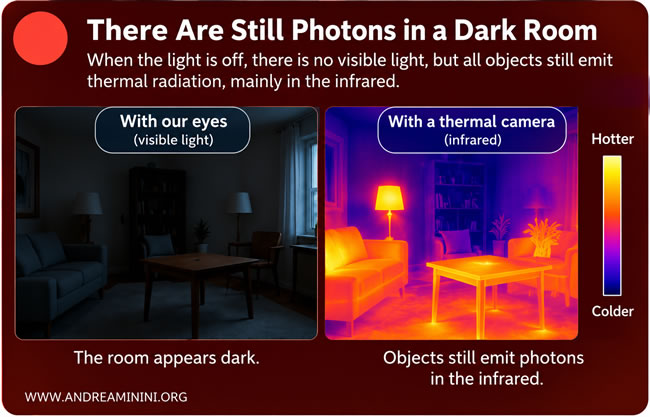
Turning off the light bulb removes the visible light produced by the source, but that does not mean a dark room is empty of electromagnetic radiation.
Even in complete darkness, photons are still present. The walls, furniture, and other objects around us continuously emit infrared radiation simply because they have a temperature above absolute zero.
These infrared photons generally have lower energies and lower frequencies than photons of visible light.
At typical room temperatures, most of this thermal radiation lies in the infrared region of the electromagnetic spectrum.
For example, for a blackbody at about 20 °C, the peak of the spectrum when expressed per unit wavelength occurs at approximately
\[ \lambda\simeq10\,\mu m \]
This wavelength is much longer than the wavelengths of visible light.
That is why our eyes cannot detect this radiation directly, even though it is all around us.
Why Can't We See Thermal Radiation?
The human eye is sensitive to only a narrow portion of the electromagnetic spectrum.
The infrared radiation emitted by objects at room temperature lies outside this range, so our eyes cannot detect it as visible light.
But the radiation is still there. We simply need a different kind of detector to observe it.
One way to do this is with a thermal camera. A thermal camera detects radiation within specific infrared wavelength bands and uses those measurements to produce an image that we can see.
A Practical Example
Suppose I walk into a room and turn on the light.
I can see a table because some of the light from the lamp reflects off its surface and reaches my eyes.
Then I turn off the lamp.
The visible light already present in the room continues to propagate for a very short time, gradually being absorbed by surfaces or escaping from the room.
Very quickly, the table becomes invisible to my eyes.
But the table has not stopped emitting radiation.
It continues to emit thermal radiation, primarily in the infrared.
A thermal camera can therefore continue to detect the table even when the room appears completely dark to us.
The Human Body Emits Photons Too
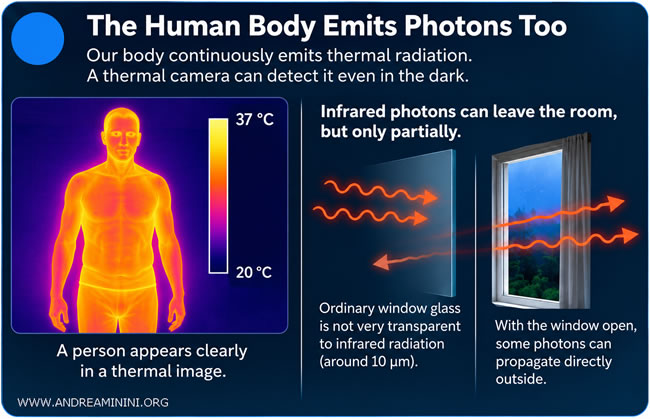
The human body also continuously emits thermal radiation.
Core body temperature is about 37 °C, while skin temperature is generally lower and varies with environmental conditions and other factors.
This is why a person can stand out clearly in a thermal image when their surface temperature differs from that of the surrounding environment.
However, the human body is not necessarily the strongest source of thermal radiation in a room.
A hot radiator, for example, may have a higher surface temperature. As a result, its thermal emission spectrum will be different, and it may radiate more energy per unit area.
Can Infrared Photons Escape from the Room?
That depends on what they encounter along the way.
Ordinary window glass is highly transparent to visible light, which is why we can see through it. At thermal infrared wavelengths around 10 micrometers, however, ordinary glass is largely opaque.
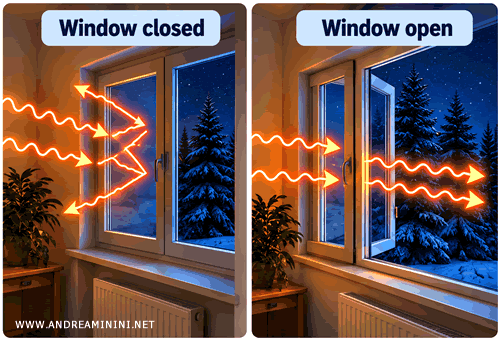
Therefore, infrared photons emitted by our bodies do not pass freely through an ordinary closed window.
Some of the infrared radiation is absorbed by the glass, while some is reflected.
If the window is open, however, some of this radiation can travel directly outside.
Once it enters the atmosphere, its journey may continue. Some photons are absorbed by atmospheric gases or clouds.
Others can travel much farther and, within atmospheric transmission windows, eventually escape into space.
In Conclusion
When I turn off a light bulb, the photons already present in the room do not disappear instantly.
What I actually do is stop the source from producing new light.
The photons that have already been emitted continue to propagate at the speed of light. They may be reflected by surfaces, transmitted through certain materials, escape from the room, or be absorbed.
When a photon is absorbed, it ceases to exist as a photon, transferring its energy and momentum to the system with which it interacts.
The room becomes dark very quickly because real surfaces are not perfect reflectors. With each successive interaction, more visible light is absorbed or lost from the room until the remaining amount becomes far too small for our eyes to detect.
But there is an important distinction: darkness does not mean an absence of photons.
Even when the lamp is off, the walls, furniture, and our bodies continue to emit thermal radiation, primarily in the infrared.
So switching off the light does not make electromagnetic radiation disappear from the room.
It simply leaves us unable to see much of what is still happening around us.