
Absolute Value
Definition of the absolute value
The absolute value, also called the modulus, of a real number is the number itself when it is positive or zero, and its additive inverse when it is negative. $$ |x| = \begin{cases} x \:\:\: if \:\: x \ge 0 \\ \\ -x \:\:\: if \:\: x < 0 \end{cases} $$ The absolute value is denoted by two vertical bars enclosing the argument.
The argument of the absolute value function may be a number, a variable, an algebraic expression, or a function.
If the argument is a number, its absolute value is simply its nonnegative magnitude.
$$ | -3 | = 3 \\ |7| = 7 \\ |-2.5| = 2.5 \vdots $$
Note. Two opposite numbers always share the same absolute value. For example. $$ | 5 | = 5 \\ |-5| = 5 $$
If the argument is a variable or a function, the evaluation of the absolute value requires distinguishing between two cases.
$$ |x| = \begin{cases} x \:\:\: if \:\: x \ge 0 \\ \\ -x \:\:\: if \:\: x < 0 \end{cases} $$
$$ |f(x)| = \begin{cases} f(x) \:\:\: if \:\: f(x) \ge 0 \\ \\ -f(x) \:\:\: if \:\: f(x) < 0 \end{cases} $$
In these expressions, the curly brace { does not indicate a system of equations. It is a standard notational convention used to specify the cases needed to compute the absolute value.
A practical example
Example 1
Within the set of integers Z, consider the number x=7.
$$ x=7 $$
The number 7 is positive.
Therefore, the absolute value |x| is
$$ |x|=x=7 $$
The absolute value is 7.
Example 2
Now consider the integer x=-7.
$$ x=-7 $$
The number -7 is negative.
Therefore, the absolute value |x| is
$$ |x|=-x=-(-7)=7 $$
The absolute value is 7.
Properties of the absolute value
In algebra, the absolute value satisfies the following fundamental properties.
$$ |x| \ge 0 \:\: \forall x \in R $$
$$ |x| = 0 \Leftrightarrow x=0 $$
$$ |-x| = |x| \ \ \ \ \forall x \in R $$
$$ |x \cdot y| = |x| \cdot |y| \ \ \ \ \forall x,y \in R $$
$$ \left| \frac{x}{y} \right| = \frac{|x|}{|y|} \ \ \ \ \forall x,y \in R $$
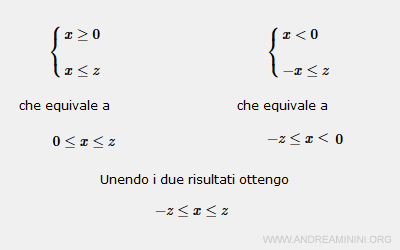
$$ |x| \le z \Leftrightarrow -z \le x \le z \ \ \ \ \forall x,z \in R $$
Proof
Depending on the sign of x, the inequality |x|≤z can be rewritten as two equivalent systems of inequalities.
$$ |x| \le z \Leftrightarrow x^2 \le z^2 \ \ \ \ \forall x,z \in R $$
Proof
The square of any real number is nonnegative. After squaring the argument of the absolute value, the expression inside the modulus is therefore nonnegative. Squaring both sides gives |x2|=x2 and z2. Since squaring preserves the order relation for nonnegative quantities, the inequality remains valid.
$$ |x| = |y| \Leftrightarrow x = \pm y $$
$$ |x| < z \Leftrightarrow -z < x < z $$
$$ \sqrt{x^2} = |x| \ \ \ \ \forall x \in R $$
The triangle inequality
This property is particularly important because it plays a central role in the proofs of many theorems.
$$ |x_1+x_2| \le |x_1| + |x_2| $$
Proof
For any two real numbers x1 and x2, the following inequalities hold: $$ -|x_1| \le x_1 \le |x_1| $$ $$ -|x_2| \le x_2 \le |x_2| $$ Adding the inequalities term by term yields $$ -(|x_1|+|x_2|) \le x_1+x_2 \le |x_1|+|x_2| $$ Let z=|x1|+|x2|. Then $$ -z \le x_1+x_2 \le z $$ This allows us to apply the equivalence, with x = x1+x2: $$ |x| \le z \Leftrightarrow -z \le x \le z $$ Hence $$ |x_1+x_2| \le z \Leftrightarrow -z \le |x_1+x_2| \le z $$ Since z=|x1|+|x2|, we conclude that $$ |x_1+x_2| \le z $$ that is $$ |x_1+x_2| \le |x_1|+|x_2| $$ The triangle inequality is thus established.
And so on.


