Galilean Principle of Relativity
The laws of mechanics are the same in all inertial frames of reference.
An inertial frame of reference is a frame that is not accelerating. In practical terms, it is either at rest or moving in a straight line at a constant speed.
This idea is one of the foundations of classical physics. It tells us that the basic laws governing motion work exactly the same way in every inertial frame, regardless of how fast that frame is moving relative to another.
For example, an object moving at a constant velocity in a straight line will continue moving that way unless an external force acts on it. Likewise, an object at rest will remain at rest until a force causes it to move.
Imagine dropping a book in your living room. Now imagine dropping the same book inside an airplane flying in a straight line at a constant speed of 500 km/h. In both cases, the book falls in exactly the same way.
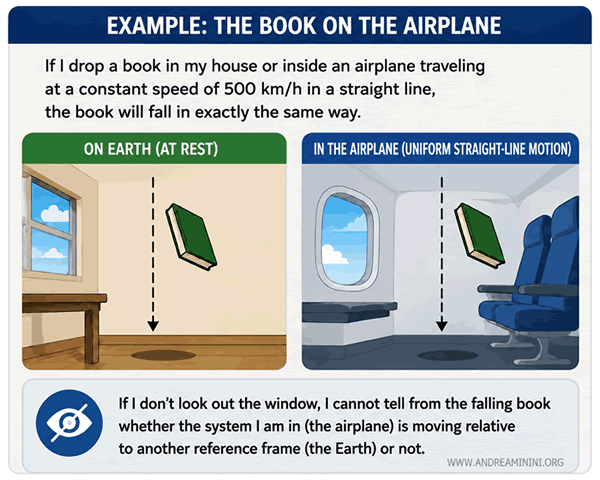
If you are inside the airplane and cannot see outside, the motion of the falling book gives you no clue as to whether the airplane is moving relative to the Earth. From the perspective of the experiment, the two situations are indistinguishable.
This is the key idea behind the principle of relativity: uniform rectilinear motion is relative. No mechanical experiment performed inside an inertial frame can reveal whether that frame is at rest or moving at a constant velocity in a straight line.
Galileo explained this concept through the famous example of a ship traveling smoothly at a constant speed. If you observe objects, insects, or drops of water inside the ship's cabin, their behavior appears exactly the same whether the ship is stationary or moving uniformly.
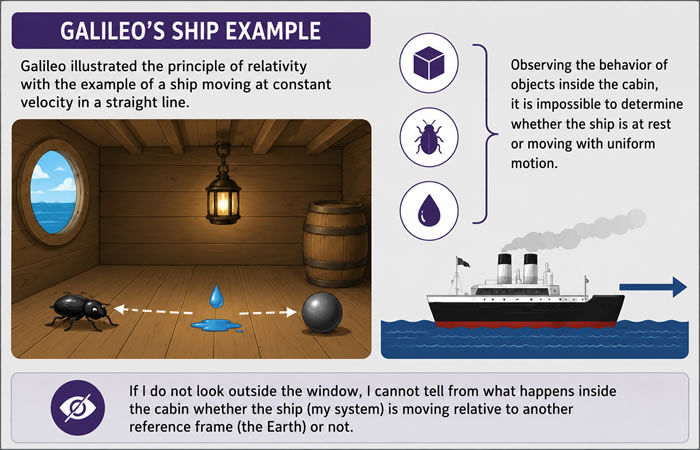
This insight marked a major step in our understanding of motion and laid the groundwork for later developments in physics.
Centuries later, Einstein expanded the Galilean principle of relativity, extending it from the laws of mechanics to all the laws of physics.
And so on.