Principle of Energy Conservation
The principle of energy conservation states that in an isolated system, the total amount of energy remains unchanged over time.
Put simply, energy can never be created or destroyed - it can only change from one form to another. This is one of the cornerstones of physics.
The principle applies regardless of the form energy takes (kinetic, potential, thermal, chemical, etc.) and remains valid as energy shifts from one form into another.
- Kinetic energy ($E_k$): energy of motion
- Potential energy ($E_p$): energy due to position in a force field
- Thermal energy: energy associated with particle motion
- Chemical, electrical, nuclear, radiant energy, and so on...
There is, however, one essential condition: the system must be an isolated system, meaning it does not exchange energy (or matter) with its surroundings.
If this condition is not met, the energy balance is open - energy can flow into or out of the system.
The Law of Energy Conservation
For a simple mechanical system (without friction), the total energy remains constant and can be expressed as:
$$ E = E_p + E_k = \text{constant} $$
where $E_p$ is potential energy and $E_k$ is kinetic energy.
In the more general case, with several forms of energy involved:
$$ E_{\text{total}} = E_{\text{kinetic}} + E_{\text{potential}} + E_{\text{thermal}} + \dots = \text{constant} $$
The total energy stays constant only if every form is accounted for and no exchange occurs with the outside world - in other words, if the system is truly isolated.
Examples
Example 1 - Free fall
Consider dropping a sphere from a height $h$ in the absence of air resistance.
At the start, while the sphere is still in your hand, all the energy is potential: $E_p = mgh$, with no kinetic contribution.
Once released, potential energy decreases as the sphere falls, while kinetic energy increases.
The energy doesn’t disappear - it simply shifts from one form to the other.
$$ E_k(t) + E_p(t) = \text{constant} $$
Just before hitting the ground, potential energy is nearly zero ($E_p \approx 0$) and kinetic energy reaches its maximum: $E_k = \tfrac{1}{2}mv^2$.
Worked example. Take a sphere of mass $m = 0.5 \,\text{kg}$ dropped from a height $h = 2 \,\text{m}$, ignoring air resistance. Initially, all the energy is potential: $$ E_p = m g h = 0.5 \cdot 9.81 \cdot 2 \approx 9.81 \,\text{J} $$ while kinetic energy is zero: $$E_k = 0 $$ So the system’s initial total energy is: $$E_{\text{tot}} = 9.81 \,\text{J}$$ Halfway down $(h/2 = 1 \,\text{m})$, the energy is evenly split: half still potential, half already converted into kinetic. $$ E_p = m g h/2 = 0.5 \cdot 9.81 \cdot 1 = 4.905 \,\text{J} $$ $$ E_k = E_{\text{tot}} - E_p = 9.81 - 4.905 = 4.905 \,\text{J} $$ The total energy is unchanged: $$ E_{\text{tot}} = E_p + E_k = 4.905 \,\text{J} + 4.905 \,\text{J} = 9.81 \,\text{J} $$ The speed at the halfway point is: $$ E_k = \tfrac{1}{2} m v^2 \;\;\Rightarrow\;\; v = \sqrt{\tfrac{2 E_k}{m}} = \sqrt{\tfrac{2 \cdot 4.905}{0.5}} \approx 4.43 \,\text{m/s} $$ Just before impact, potential energy is negligible: $$ E_p \approx 0 $$ while kinetic energy reaches its peak: $$ E_k = E_{\text{tot}} = 9.81 \,\text{J} $$ The impact velocity is therefore: $$ v = \sqrt{\tfrac{2 E_k}{m}} = \sqrt{\tfrac{2 \cdot 9.81}{0.5}} = \sqrt{39.24} \approx 6.26 \,\text{m/s} $$ In short, throughout the fall, the sum of potential and kinetic energy remains constant: $$ E_{\text{total}} = E_p + E_k = 9.81 \,\text{J} = \text{constant} $$ No energy is ever lost; it simply shifts from gravitational potential to kinetic form.
Example 2 - A swinging pendulum
In an ideal pendulum (no friction), potential energy is at its maximum when velocity is zero - at the turning points, when the pendulum pauses before swinging back.
At the lowest point, kinetic energy peaks, as the pendulum reaches its maximum speed.
Once again:
$$ E_k + E_p = \text{constant} $$
Note. If air resistance were included, mechanical energy would gradually be converted into heat instead of being fully conserved. Even then, the overall sum (mechanical + thermal) would remain constant. The principle of energy conservation still holds.
Example 3 - Energy conversion in a power plant
In a thermal power station, the chemical energy in the fuel is released through combustion.
The combustion produces hot gases, which transfer thermal energy to a working fluid (usually water), turning it into high-pressure steam.
The steam drives a turbine, converting thermal energy into mechanical rotational energy.
The turbine is coupled to a generator, which transforms mechanical energy into electrical energy by electromagnetic induction.
At every stage, the total energy is conserved - it simply changes form.
Note. Not all of the thermal energy is converted; some is inevitably lost as waste heat. Nevertheless, in an isolated system, the sum of the useful electrical output and the dissipated heat remains constant. The conservation principle is never broken.
Energy Conservation in Particle Physics
The principle of energy conservation is truly universal: it applies to all fundamental interactions. Whether in decays, collisions, or annihilations, the total energy before and after the process remains unchanged.
Take beta decay, for example. In this process a neutron transforms into a proton, an electron, and an antineutrino $ n \;\;\longrightarrow\;\; p + e^- + \bar{\nu}_e $ through the weak nuclear interaction.

Here, rest mass is not conserved: the neutron’s mass is greater than the combined masses of the proton, electron, and antineutrino.
The “missing” mass, however, does not disappear. It is converted into the kinetic energy of the decay products - the emitted particles.
The crucial point is that it is total energy that remains constant, not mass. This is exactly what Einstein’s celebrated equation expresses:
$$ E = mc^2 $$
In other words, a portion of rest mass can be converted into kinetic energy or radiation.
The reverse is also possible: energy can be converted into mass, for instance through the creation of a quark-antiquark pair.
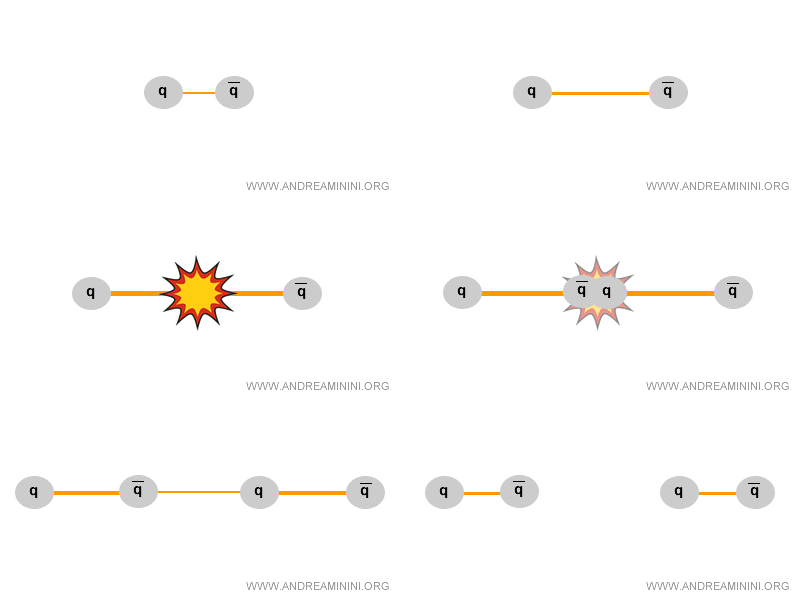
This is why, in nuclear reactions and particle decays, mass may appear to “vanish” or “emerge,” while the overall energy balance always remains intact.
Note. Alongside energy, other quantities are conserved in fundamental interactions - momentum, electric charge, color charge in QCD, lepton and baryon numbers (under specific conditions), total spin, and more.
Energy Conservation in the Universe
The principle of energy conservation holds reliably in all local physical contexts, from nonrelativistic quantum mechanics to quantum field theory (QFT).
In general relativity, however, the situation is subtler. In curved spacetime, it is not always possible to define a single, well-defined “total energy” for the entire universe.
This stems from Noether’s theorem, which ties energy conservation to time-translation invariance. In an expanding universe, there is no global time symmetry.
A classic example is cosmic expansion: the energy density of radiation decreases faster than that of matter because space itself is stretching. This is not an “exchange” of energy between sectors but a geometric consequence of expanding spacetime.
For this reason, many cosmologists argue that speaking of “conservation of the universe’s total energy” is misleading. What remains valid is local conservation: within any given physical process described in a chosen reference frame.
Globally, the question is still unresolved and is tied to the open problem of defining energy consistently within general relativity.
Theoretical Foundations
Energy conservation follows directly from the invariance of physical laws under time translations: the laws do not change whether an experiment is carried out today, tomorrow, or centuries from now.
It is therefore not merely an empirical rule based on observation.
It arises from a fundamental symmetry of nature.
In physics, “symmetry” does not refer to geometry in the everyday sense, but to a transformation that leaves the behavior of a physical system unchanged.
For example, if a system behaves identically today, tomorrow, or a hundred years from now, the laws governing it are independent of time - they are invariant under time shifts.
This time invariance ensures that a system’s total energy remains constant as time passes.
The deep link between symmetries and conserved quantities was formalized in 1918 by Emmy Noether. According to Noether’s theorem:
Every continuous symmetry of a physical system corresponds to a conserved quantity.
In the case of energy conservation, the relevant symmetry is invariance under time translation: if the laws of physics do not change with time, then energy is conserved.
This principle applies across the spectrum of physics - from classical mechanics to the most advanced frameworks of quantum theory.
And so on.