
States of Matter
Matter can exist in different physical forms depending on how its particles interact with one another. Under ordinary conditions, it is commonly found in three main states of matter: solid, liquid, and gas.
Each state has distinct properties that determine a substance's shape, volume, and behavior.
- Solid. Solids have a definite shape and a definite volume. The attractive forces between particles are strong.
- Liquid. Liquids have a definite volume but no fixed shape. They take the shape of their container.
- Gas. Gases have neither a definite shape nor a definite volume. The attractive forces between particles are weak, allowing them to spread throughout the available space.
Why is it called molecular aggregation? The physical state of matter depends on how strongly its molecules attract one another. For this reason, physicists and chemists often refer to the state of aggregation of matter. These attractive interactions, known as cohesive forces, play a key role in determining whether a substance behaves as a solid, liquid, or gas.
Which intermolecular forces govern the states of matter?
The state of matter is determined by the balance between two competing factors: the kinetic energy of the particles, which tends to keep them moving, and the intermolecular forces, which tend to hold them together.
The most important intermolecular forces include Van der Waals interactions, dipole-dipole interactions, and hydrogen bonding.
The Main States of Matter
The three classical states of matter differ in the arrangement and mobility of their particles.
- Solid
In a solid, particles are packed closely together and can move only within a limited range around fixed positions. Strong intermolecular forces give solids a definite shape and a constant volume. Many solids have an ordered crystalline structure, although some, known as amorphous solids, do not. - Liquid
In a liquid, particles remain relatively close together but can move past one another. As a result, liquids have a constant volume but no fixed shape. They flow and take the shape of the container that holds them. - Gas
In a gas, particles are widely separated and move freely in all directions. Because intermolecular forces are very weak, gases have neither a definite shape nor a definite volume. They expand to fill any available space and can be compressed easily.
When matter changes from one state to another, the process is known as a phase transition.
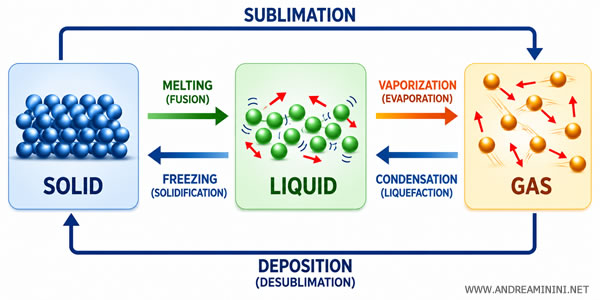
The most common phase transitions are melting, freezing, liquefaction, condensation, boiling, evaporation, and sublimation.
What Determines the State of Matter?
The physical state of a substance depends primarily on the forces acting between its particles.
These forces are strongly influenced by environmental conditions, particularly temperature and pressure.
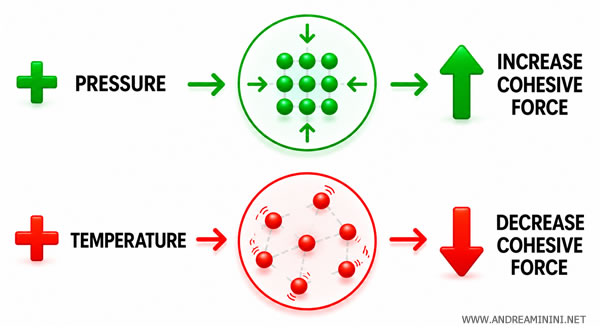
In general, increasing the temperature promotes particle motion and disorder, while increasing the pressure tends to push particles closer together and favors denser states of matter.
The Effect of Pressure
As pressure increases, molecules are forced closer together. The distance between particles decreases, and intermolecular attractions become more effective.
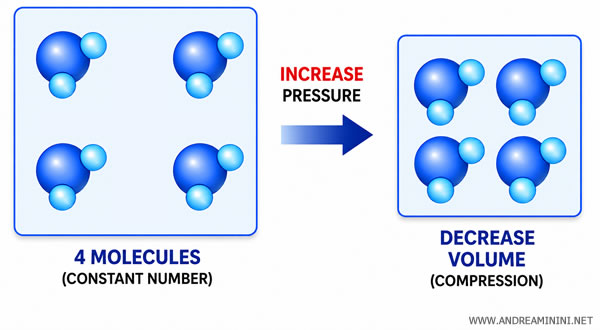
Because the particles occupy less space, the overall volume of the substance decreases.
Example. If a gas is subjected to sufficiently high pressure, it can condense into a liquid.
Conversely, when pressure decreases, particles move farther apart and intermolecular attractions become weaker.
The Effect of Temperature
Temperature directly affects the motion of particles. As temperature rises, particles gain kinetic energy and move more rapidly.
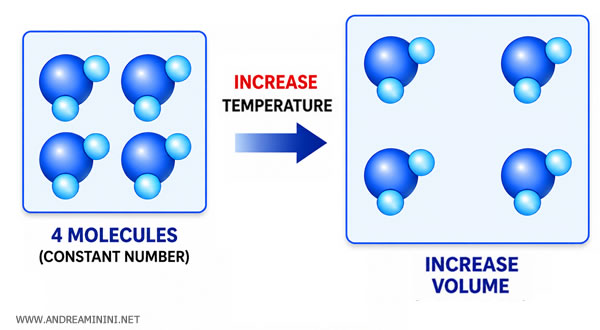
Faster-moving particles are better able to overcome intermolecular attractions. As a result, the average distance between particles increases, and the substance tends to occupy a larger volume.
Example. When water is heated, its molecules gain kinetic energy. As they move faster, they become increasingly able to overcome the hydrogen bonds that hold them together. Some H2O molecules escape into the air as water vapor, producing a transition from the liquid state to the gaseous state.
At lower temperatures, the opposite occurs. Particles move more slowly, intermolecular attractions become more effective, and cohesive forces strengthen.
Example. When water is cooled sufficiently, its molecules arrange themselves into a stable crystalline lattice. The liquid then freezes and becomes solid ice.
Phase Diagrams
Phase diagrams provide a graphical representation of the temperature and pressure conditions under which a substance exists in different phases.
Every pure substance has its own characteristic phase diagram.
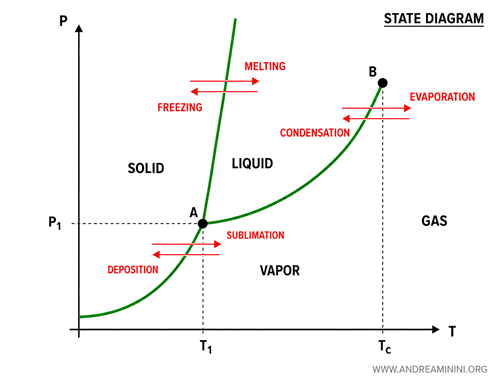
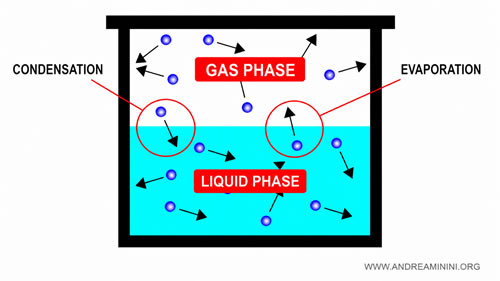
The boundaries between phases represent conditions of dynamic equilibrium, where the rate of one process is exactly balanced by the rate of the reverse process.
Example. Along the boundary between the liquid and gaseous phases, the rate of evaporation is equal to the rate of condensation.
A phase is a region of a substance that has a uniform chemical composition and a uniform physical state, separated from other regions by a phase boundary.
Notes
The following observations help place the states of matter in a broader scientific context.
- There Are More Than Three States of Matter
Although solids, liquids, and gases are the most familiar states, modern physics has identified many others, including plasma, Bose-Einstein condensates, and a variety of quantum states that appear under extreme conditions. - Particles in Solids Are Always Moving
Even in a solid, particles are never completely motionless. They continuously vibrate about their equilibrium positions, and these vibrations become more pronounced as temperature increases. - Metastable States Can Exist
Under certain conditions, a substance may temporarily remain in a state that is not fully stable. Well-known examples include supercooled water and superheated liquids. - The Critical Point Marks a Fundamental Transition
Above the critical point, the distinction between liquid and gas disappears. The substance enters a supercritical fluid state, which combines properties of both liquids and gases. - States of Matter Are Thermodynamic Phases
In modern physics, states of matter are described as thermodynamic phases characterized by specific microscopic properties. Changes between phases are known as phase transitions. - Macroscopic Properties Emerge from Microscopic Behavior
Properties such as density, viscosity, and pressure arise from the collective behavior of enormous numbers of particles. Understanding this connection is one of the main goals of statistical mechanics.
And so on.


