
Matter
What Is Matter?
Matter is any physical entity characterized by mass and inertia, regardless of its shape or size.
Everything we see around us, from grains of sand to planets and stars, is made of matter. Ordinary matter is composed of the atoms of chemical elements and exists across an enormous range of scales, from microscopic molecules to massive celestial bodies.
The Classical Definition of Matter and Its Limits
In classical physics, matter is traditionally defined as anything that has mass and occupies space. Modern physics, however, has shown that this definition is only partially accurate.
For example, a physical field occupies a region of space but is not itself considered matter. This means that not everything that exists physically in the Universe can be classified as matter in the traditional sense.
Current cosmological models also suggest that ordinary matter represents only a small fraction of the Universe.
Most of the matter in the cosmos is believed to consist of an invisible and still poorly understood form known as dark matter.
Note. Matter and energy are deeply connected, as expressed by Einstein's famous equation $$ E = mc^2 $$ According to this relationship, mass and energy can be transformed into one another.
Atomic Structure of Matter
Ordinary matter is made up of atoms, extremely small particles consisting of a central nucleus surrounded by electrons.
The nucleus contains protons, which carry a positive electric charge, and neutrons, which are electrically neutral. Electrons, by contrast, carry a negative electric charge and move around the nucleus.
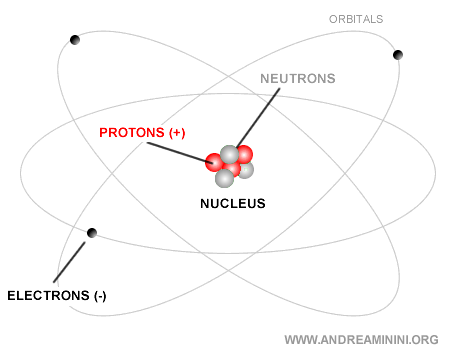
Chemical elements are distinguished primarily by the number of protons in their nuclei. Hydrogen, for example, contains one proton, while carbon contains six.
Atoms can bond together to form molecules and chemical compounds, giving rise to the enormous variety of substances found in nature.
Physical States of Matter
The physical state of matter depends on the strength of the interactions between particles and on their energy.
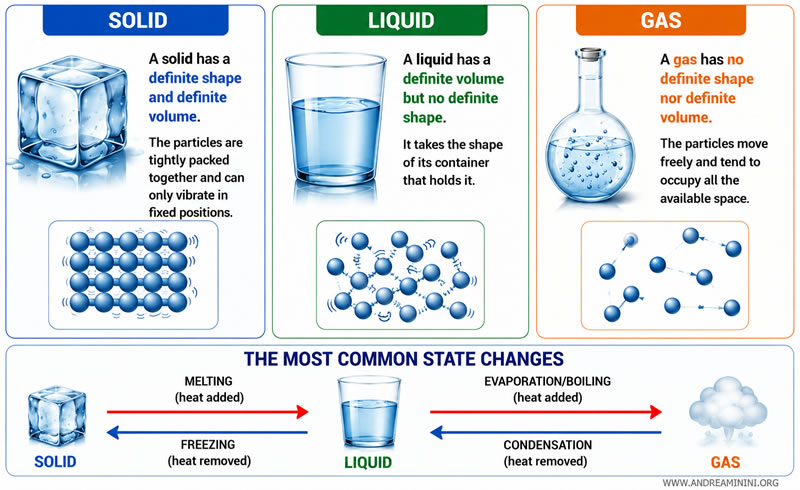
The three main states of matter are:
- Solid
A solid has both a definite shape and a definite volume. Its particles are tightly bound together and can move only within limited positions. - Liquid
A liquid has a definite volume but no fixed shape. Instead, it takes the shape of its container. - Gas
A gas has neither a definite shape nor a definite volume. Its particles move freely and tend to spread out to occupy all available space.
Other states of matter also exist, including plasma and the Bose-Einstein condensate, which can appear under extreme or highly specialized physical conditions.
The state of matter can change as temperature and pressure vary. These transformations are known as changes of state.
Difference Between Organic and Inorganic Matter
In chemistry, substances are commonly classified as either organic or inorganic.
- Organic matter
Organic substances consist primarily of carbon atoms bonded to elements such as hydrogen, oxygen, and nitrogen. This category includes many molecules essential to life, including proteins, sugars, and fats. - Inorganic matter
Inorganic substances include compounds such as water, mineral salts, metals, and many other substances that are not based on carbon chemistry.
However, this distinction does not correspond exactly to the difference between living and nonliving matter.
There are organic substances that are not alive, such as plastics and petroleum, as well as inorganic substances found inside living organisms, including water and mineral salts.
Note. From an atomic perspective, there is no fundamental difference between the matter that composes a living organism and the matter that forms inanimate objects. The chemical elements are the same. What changes is the way atoms are arranged and interact with one another.
Difference Between Matter and Antimatter
Every particle of matter has a corresponding antiparticle with the same mass but opposite properties, such as electric charge. The collection of antiparticles forms antimatter.
For example, the electron, which carries a negative charge, has an antiparticle called the positron, which carries a positive charge. Likewise, the proton has an antiparticle called the antiproton.
Antimatter can also form anti-atoms similar to ordinary atoms. An antihydrogen atom, for instance, consists of an antiproton and a positron.

Antimatter is a real physical phenomenon and has even been produced in laboratories. However, it is extremely rare in the observable Universe compared with ordinary matter.
When a particle of matter comes into contact with its corresponding antimatter particle, the two annihilate each other, producing energy and additional particles, often in the form of gamma radiation.
Scientists still do not know why the Universe contains far more matter than antimatter.
Physics and Chemistry
Matter is studied by both chemistry and physics, although each discipline approaches it from a different perspective.
What Does Chemistry Study?
Chemistry focuses on the composition of matter and on the transformations that modify the bonds between atoms and molecules, leading to the formation of new substances.
For example, during combustion the original substances undergo chemical reactions, producing new substances and releasing energy in the form of heat and light.
What Does Physics Study?
Physics studies the general properties of matter and energy, including motion, forces, heat, light, electricity, and interactions between particles.
For example, water can change from a liquid into ice or vapor without altering its chemical composition. In all these cases, the molecules remain the same ( $ H_2O $ ). Only the physical state changes, together with the way the molecules move and interact with one another.
Conservation of Matter
In physical and chemical transformations, matter is neither created nor destroyed. It simply changes form.
During a chemical reaction, atoms rearrange themselves to form new substances, but the total number of atoms remains unchanged.
Modern physics also shows that mass and energy can be transformed into one another, as described by Einstein's theory of relativity.


