
Antimatter
Antimatter refers to all particles that share the same mass as their counterparts but have opposite properties, such as electric charge. These are called antiparticles.
Who discovered antimatter?
The first physicist to propose the theoretical existence of antimatter was the British scientist Paul Dirac in the early 20th century. Experimental confirmation came just a few years later.
What are antiparticles?
Matter is made up of atoms, and every atom is built from the same elementary particles.
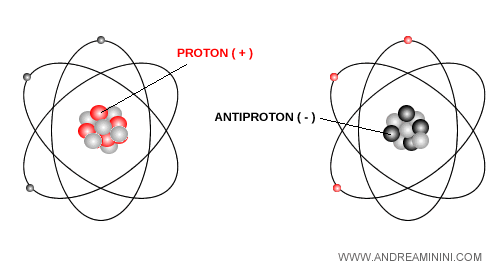
An atom of matter consists of negatively charged particles (electrons) orbiting around a central nucleus, which itself is made of positively charged particles (protons) and neutral ones (neutrons).

Each of these subatomic particles - electrons, protons, and neutrons - has a corresponding antiparticle.
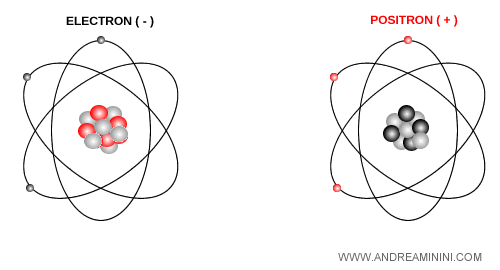
1] The Antielectron (or Positron)
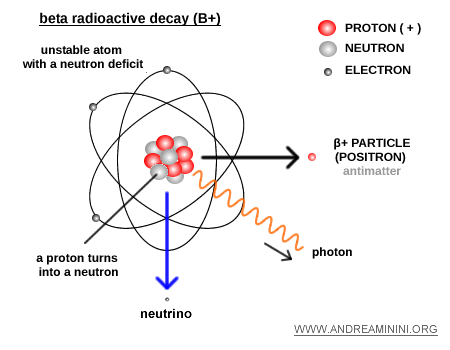
The antielectron has the same mass as the electron but carries a positive electric charge instead of a negative one. It’s commonly known as the positron. It was discovered in 1932 by American physicist Carl David Anderson. In experiments, positrons are produced in beta radioactive decay processes (the β+ particle).
2] The Antiproton
The antiproton has the same mass as the proton but a negative electric charge instead of a positive one. It is the proton’s antiparticle and was discovered in 1956.
3] The Antineutron
The antineutron has the same mass as the neutron but differs in having the opposite magnetic properties.
Every elementary particle has a counterpart
Up to this point, we’ve only discussed subatomic particles to highlight the contrast between matter and antimatter. In theory, though, every elementary particle has its own antiparticle counterpart.
Matter and antimatter cancel each other out
Matter and antimatter cannot coexist in the same space because they destroy one another on contact. This process is known as annihilation.
When a particle meets its antiparticle, they annihilate and turn into two high-energy photons.
In an annihilation event, the two particles are converted into electromagnetic radiation (photons). In that moment, both particles cease to exist.

This is why naturally occurring antimatter is absent in our universe - or at least extremely difficult to observe.
Why is the universe mostly made of matter?
In the earliest moments after the Big Bang, matter and antimatter were likely created in almost equal amounts.
For reasons still not entirely clear, matter ended up dominating. Perhaps there was a slight initial excess of matter, or maybe some as-yet undiscovered particle - possibly the Higgs boson, sometimes nicknamed the “God particle” - gave matter the upper hand.
How is antimatter produced?
On Earth, antimatter can only be created artificially in laboratories and particle accelerators, primarily through the process of beta radioactive decay (β+).
What is beta decay? In simple terms, the nucleus of a heavy atom becomes unstable when it doesn’t have enough neutrons to keep the protons apart (a neutron deficit). In such cases, a proton transforms (decays) into a neutron to restore the atom’s stability. During β+ decay, the nucleus emits several particles outward: a photon, a neutrino, and a positron (the antielectron, i.e. antimatter).
An antiparticle’s lifetime is extremely short
As soon as an antiparticle is created, it quickly collides with a particle in space, and both are annihilated.
Where can antimatter be found?
Theoretically, our universe might contain pockets or even whole regions of antimatter - stars, galaxies, or isolated zones - so long as they remain separated from regular matter.
Note. Some speculative multiverse theories even suggest the existence of an “anti-universe” or multiple antimatter universes.
Antimatter follows the same physical laws as ordinary matter. The only difference is that it carries the opposite electric charge.


