W and Z Bosons
The $W$ and $Z$ bosons are the force carriers of the weak interaction, one of the four fundamental forces of nature.
Unlike the photon - which is massless and allows the electromagnetic force to extend over infinite range - the weak bosons are extremely heavy. This large mass confines the weak interaction to subnuclear distances, smaller than the size of an atomic nucleus.
The weak interaction involves two kinds of bosons:
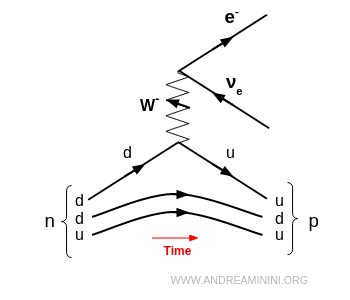
- The $W$ boson mediates charged currents. It governs processes where electric charge changes and, in quarks, where flavor changes as well. The $ W^+ $ boson carries a positive charge of +1, while the $ W^- $ boson carries a negative charge of - 1. In effect, they can raise or lower a particle’s charge by one unit and also change its quark flavor.
A textbook case is beta decay: a neutron transforms into a proton while emitting an electron and an electron antineutrino: $ n \to e^- + \bar{\nu}_e $
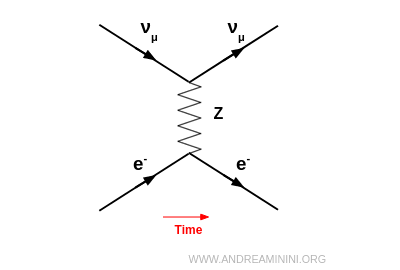
- The $Z$ boson mediates neutral currents, interactions in which no particle changes charge. The $ Z^0 $ boson is electrically neutral and does not alter either the charge or the flavor of the particles involved.
For example, in a scattering event a neutrino exchanges a virtual $Z^0$ boson with an electron. Both particles emerge unchanged in charge and flavor: $ \nu_\mu + e^- \;\to\; \nu_\mu + e^- $.
Key properties
- Types: $W^+$ and $W^-$ (positively and negatively charged), and $Z^0$ (neutral).
- Spin: 1, making them vector bosons (so-called intermediate bosons).
- Mass: about 80 GeV/$c^2$ for the $W$, and 91 GeV/$c^2$ for the $Z$ - more than 80 times the mass of a proton.
- Lifespan: extremely short, roughly $10^{-25}$ seconds - so they can never be observed directly, only inferred from their decay products.
History
The $ W $ and $ Z $ bosons were predicted in the late 1960s by the electroweak theory developed by Glashow, Weinberg, and Salam.
The central challenge was to explain how the $W$ and $Z$ could acquire such large masses without breaking the mathematical consistency of gauge theory.
The breakthrough came with the Higgs mechanism, a spontaneous symmetry breaking process that endows the $W$ and $Z$ bosons with mass while leaving the photon massless.
Experimental discovery
Neutral currents were first detected in 1973 at CERN in the Gargamelle experiment, providing indirect evidence for the $ Z^0 $ boson.
Direct observation of the $W$ and $Z$ bosons came a decade later, in 1983 at CERN, in the UA1 and UA2 experiments at the Super Proton Synchrotron.
This was a landmark confirmation of electroweak theory and earned Carlo Rubbia and Simon van der Meer the 1984 Nobel Prize in Physics.
Detailed studies of $Z$ boson decays established that nature contains exactly three families of neutrinos - and thus three generations of fundamental fermions.
This result remains one of the pillars of our modern understanding of the Standard Model.
Self-interactions of $W$ and $Z$ bosons
One of the most striking aspects of the weak interaction is that its carriers don’t just transmit the force - they also interact with one another.
This feature, called self-interaction, arises naturally from the mathematical structure of electroweak theory.
Note. Quantum electrodynamics (QED) is an abelian theory: the photon carries no charge and therefore does not interact with itself. The weak force, however, is based on the non-abelian gauge group $SU(2)_L \times U(1)_Y$. Because the $W$ bosons themselves carry weak charge, they can interact directly with one another and with other bosons in the theory.
Self-interactions come in different forms:
A] Trilinear interactions
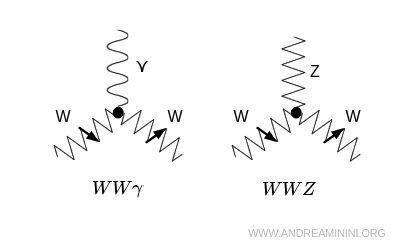
Trilinear vertices involve three vector bosons meeting at a single Feynman point. In the Standard Model, the most important are $WW\gamma$ and $WWZ$. The first shows that the charged $W^\pm$ bosons couple to the photon; the second demonstrates their direct connection with the neutral $Z^0$ boson.
- $WW\gamma$: charged $W^\pm$ bosons couple to the photon.
- $WWZ$: $W$ bosons also interact with the neutral $Z$ boson.
These vertices are a hallmark of the non-abelian nature of electroweak theory.
B] Quartic interactions
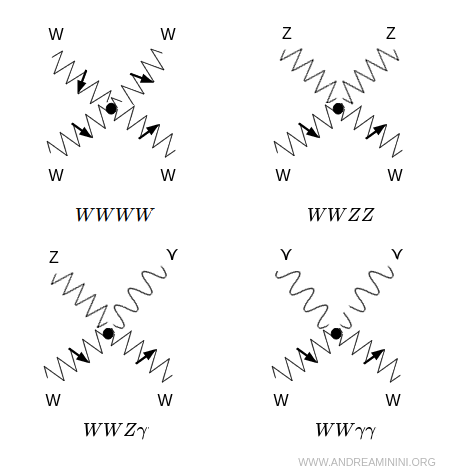
Quartic vertices involve four bosons at once - for instance $WW\gamma\gamma$, $WWZZ$, and $WWZ\gamma$. While less common, they are essential for maintaining unitarity of scattering amplitudes at high energies.
- $WWWW$: four $ W $ bosons interacting with each other.
- $WW\gamma\gamma$: two $W$ bosons coupled to two photons.
- $WWZZ$: two $W$ bosons coupled to two $Z$ bosons.
- $WWZ\gamma$: mixed combinations.
These self-interactions are not a minor detail - they are critical to the internal consistency of the theory (ensuring unitarity at high energies) and distinguish the weak interaction from QED, where the photon remains “passive.”
They also open the door to striking phenomena such as multiple vector boson production in high-energy collisions.
Note. These self-interactions were tested extensively in the 1990s at LEP (CERN), where $W^+W^-$ pair production was observed. Later experiments at the Tevatron and the Large Hadron Collider confirmed the Standard Model predictions, measuring trilinear and quartic vertices with remarkable precision.
And so on.