
Leptons
Leptons are elementary particles that do not interact via the strong nuclear force, but are subject to the weak force, the electromagnetic force (if electrically charged), and gravity. They belong to the family of fermions, as they have half-integer spin (spin 1/2).
Unlike quarks, leptons do not participate in all four fundamental forces.
The word “lepton” comes from the Greek "leptós" (λεπτός), meaning “light” or “small.”
Note. The name was originally chosen to reflect the low mass of the first known lepton - the electron. The term was introduced in the 20th century to distinguish these particles from heavier ones, such as baryons (protons and neutrons), which were already well known in early nuclear physics. The electron’s much smaller mass made it stand out. Today, we recognize six types of leptons, grouped into three generations, each consisting of one charged lepton and a corresponding neutrino. Interestingly, not all leptons are light - for example, the tau lepton (τ) is far heavier than the proton. Still, the name "lepton" has stuck for historical and conventional reasons.
Leptons play a vital role in many physical processes, such as beta decay and the nuclear fusion reactions that power the Sun.
Categories
Leptons are divided into two main categories:
- Charged leptons
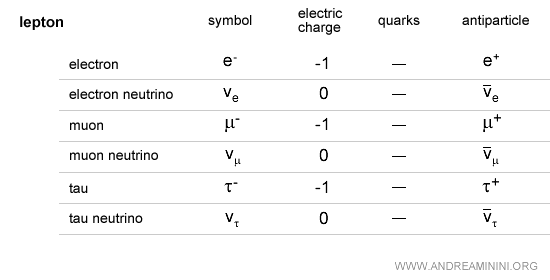
This group includes the electron (e⁻), muon (μ⁻), tau (τ⁻), and their corresponding antiparticles. Charged leptons experience the electromagnetic force, in addition to the weak and gravitational forces. They all carry a negative electric charge but differ in mass and stability. Only the electron is stable.- The electron (e⁻) has a mass of about 0.511 MeV/c². It is stable and forms the outer shell of atoms.
- The muon (μ⁻) has a mass of roughly 105 MeV/c² - about 200 times that of the electron. It is unstable and decays into an electron and two neutrinos in approximately 2.2 μs.
- The tau (τ⁻) is even more massive, at about 1777 MeV/c² - roughly 17 times the muon's mass. It is highly unstable and decays within a mere ~10⁻¹³ s.
- Neutral leptons
Each charged lepton has an associated neutrino: the electron neutrino (νₑ), the muon neutrino (νμ), and the tau neutrino (ντ), along with their antiparticles. Neutrinos are electrically neutral leptons with extremely small mass. For many years, they were thought to be massless, but we now know they possess a tiny, yet nonzero, mass.
Lepton Generations
Charged and neutral leptons are organized into three generations. Each generation pairs a charged lepton with its matching neutrino.
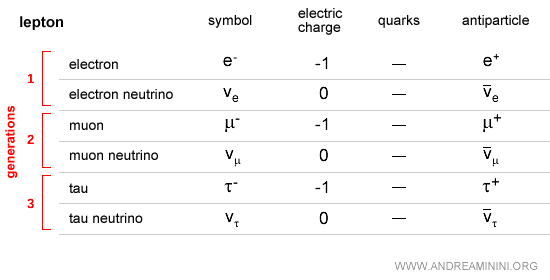
For instance, the electron and electron neutrino make up one generation; the muon and muon neutrino form another.
The second and third generations (muon and tau) are unstable and appear only in high-energy environments - such as those created in large particle accelerators.
Lepton Number
There are three types of lepton numbers, each associated with a lepton family. These numbers are conserved in particle interactions:
- Electron lepton number (Le)
- Muon lepton number (Lμ)
- Tau lepton number (Lτ)
Each lepton has a lepton number of +1; each antilepton has - 1.

Lepton numbers track the presence of leptons (such as electrons, muons, and taus) in a reaction.
In most interactions, the total number of leptons of each type remains unchanged - this is known as lepton number conservation.
This rule always holds in electromagnetic and strong interactions.
Note. In weak interactions, however, neutrinos can change type - a phenomenon known as neutrino oscillation. In such cases, the individual family lepton numbers may not be conserved, but the overall total of leptons and antileptons remains constant.
All other particles - quarks, bosons, hadrons - carry zero lepton number.
How Leptons Differ from Quarks
Both leptons and quarks are fundamental fermions, meaning they have spin 1/2 and obey Fermi-Dirac statistics and the Pauli exclusion principle.
The key distinction is that quarks feel the strong nuclear force, while leptons do not.
As a result, quarks combine to form larger composite particles (like hadrons and mesons), whereas leptons exist as free particles in nature.
| Property | Quarks | Leptons |
|---|---|---|
| Strong interaction | Yes (they participate) | No (they don’t) |
| Free state | No (confined within hadrons) | Yes (can exist independently) |
| Role in matter | Form protons and neutrons | Form electrons and neutrinos |
| Composite particles | Yes (e.g., protons, neutrons) | No (they are elementary) |
| Electric charge | Fractional (+2/3 or −1/3) | Whole (−1 or 0) |
| Number of types | 6 (across 3 generations) | 6 (across 3 generations) |
| Spin | 1/2 (fermions) | 1/2 (fermions) |
And so on.


