
Lambda Particle ($ \Lambda $)
The $\Lambda$ particle is a baryon, meaning it consists of three quarks. It is substantially heavier than either the proton or the neutron.
The most familiar member of this family is the neutral lambda, $\Lambda^0$ (uds), first observed in 1950.
Its quark structure is $uds$ (one up quark, one down quark, and one strange quark):
- Up quark (u): charge +2/3
- Down quark (d): charge - 1/3
- Strange quark (s): charge - 1/3
The $\Lambda^0$ belongs to the class of strange hyperons (baryons containing strangeness) because it includes a strange quark $s$.
The charges balance out to zero:
$$ (+\tfrac{2}{3}) + (-\tfrac{1}{3}) + (-\tfrac{1}{3}) = 0 $$
Thus, the $\Lambda^0$ is electrically neutral like the neutron, but significantly heavier, since one of its light quarks is replaced by a strange quark.
As a baryon, it is a fermion and carries half-integer spin, $1/2$.
| Property | Value |
|---|---|
| Quark content | \( uds \) |
| Type | Baryon (hyperon) |
| Electric charge | 0 |
| Spin | \( \tfrac{1}{2} \) |
| Mass | \( \sim 1116 \, \text{MeV}/c^2 \) |
| Decay | \( \Lambda^0 \to p + \pi^- \) |
| Lifespan | \( \sim 2.6 \times 10^{-10} \, \text{s} \) |
| Interaction | Weak |
Decay of $ \Lambda^0 $
The $\Lambda^0$ is unstable. Unlike many other hadrons, it cannot decay through the strong interaction. Instead, it decays via the weak interaction, which gives it a much longer lifetime:
$$ \tau_{\Lambda^0} \approx 2.6 \times 10^{-10} \text{ s} $$
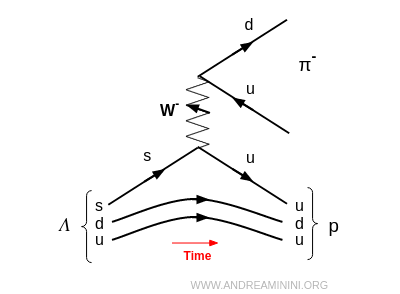
Its dominant decay mode is into a proton ($p$) and a negative pion ($\pi^-$):
$$ \Lambda^0 \;\to\; p + \pi^- $$
This process occurs when the strange quark ($s$) changes into an up quark ($u$):
$$ s \to u + W^- \quad (\text{weak interaction}) $$
The $W^-$ boson then decays into a down quark ($d$) and an anti-up quark ($\bar{u}$), which bind together to form the observed negative pion ($\pi^-$):
$$ W^- \to d + \bar{u} $$
This is a textbook case of a flavor-changing transition, a phenomenon forbidden in both strong and electromagnetic interactions.
A less common channel is the decay of $\Lambda^0$ into a neutron ($n$) and a neutral pion ($\pi^0$):
$$ \Lambda^0 \;\to\; n + \pi^0 $$
In this case, the strange quark ($s$) converts into a down quark ($d$), while the $W^-$ boson decays into a $u\bar{u}$ pair, which forms the $\pi^0$.
Note. Because the $\Lambda^0$ is electrically neutral, it does not leave a direct track in detectors. Instead, the charged decay products seem to “emerge from nowhere” at the decay point - a clear signature of a long-lived neutral particle.
Other members of the lambda family
The lambda family also includes heavier relatives, sometimes called “lambda baryons.” They are not classified as hyperons unless they contain a strange quark:
- $\Lambda_c^+$ ($udc$), containing a charm quark
- $\Lambda_b^0$ ($udb$), containing a bottom quark
And so forth.


