
Omega Particle (Ω)
The Omega baryon (Ω) is a member of the baryon family, composed of three quarks. In its case, all three are strange quarks ($sss$).
The particle was first predicted in 1961 by American physicist Murray Gell-Mann and, independently, by Israeli physicist Yuval Ne'eman.
Its experimental discovery in 1964 at Brookhaven National Laboratory (USA) marked one of the most decisive triumphs of the quark model proposed by Gell-Mann, providing direct confirmation of the baryon decuplet.
It also offered clear evidence for the existence of the strange quark and validated the SU(3) symmetry framework in particle classification.
Properties
The $\Omega^-$ (Omega minus) has the following properties:
- Quark content: three strange quarks ($sss$)
- Electric charge: $-1$, since each strange quark carries $-1/3$
- Spin: $3/2$, placing it within the baryon decuplet
- Mass: roughly 1672 MeV/c²
- Strangeness: $S = -3$, making it an extremely “strange” hyperon (a baryon with strangeness)
- Discovery: 1964, at Brookhaven’s synchrotron, in agreement with Gell-Mann’s quark model and SU(3) symmetry predictions.
Decay
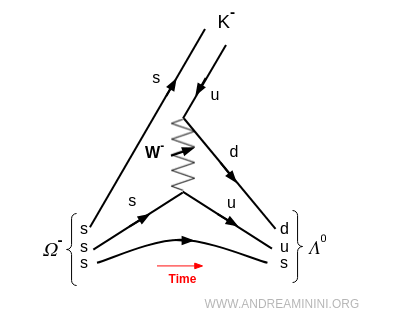
The $\Omega^-$ is unstable and decays through the weak interaction. In this process, one of its strange quarks ($s$) converts into an up quark ($u$) via the emission of a $W^-$ boson.
The $W^-$ boson is itself highly unstable, with a lifetime of only about $10^{-25}\,\text{s}$. In the case of the $\Omega^-$, the $W^-$ produced in the $s \to u$ transition cannot materialize as a real particle, since the available energy is insufficient to create an on-shell $W$.
Instead, it appears as a virtual boson, which promptly decays into a lighter quark - antiquark pair, for example: $ W^-_{\text{virt}} \to \bar u + d $
The system then reorganizes: the two remaining $s$ quarks combine with the new $u$ quark to form a $\Lambda^0 (uds)$ baryon, while the $\bar u$ binds with one of the $s$ quarks to produce a $K^- (\bar u s)$ meson:
$$\Omega^- \;\to\; \Lambda^0 + K^-$$
Below is the corresponding Feynman diagram:
The mean lifetime of the $\Omega^-$ is about $8.2 \times 10^{-11}$ s - shorter than that of the $\Lambda^0$, but still many orders of magnitude longer than strong decays, which occur on the timescale of $\sim 10^{-23}$ s.
Other typical weak decay channels of the Omega baryon include:
- $\Omega^- \;\to\; \Xi^0 + \pi^-$
- $\Omega^- \;\to\; \Xi^- + \pi^0$
These channels further underscore that the $\Omega^-$ decays exclusively through the weak interaction.


