
Delta Particle
The delta baryon (Δ) is part of the baryon family and is relatively light. It is built from three light quarks (up $u$ and down $d$), the same constituents that make up protons and neutrons.
Unlike protons and neutrons, which have spin $1/2$, the Δ baryons carry a spin of $3/2$.
They are usually described as an excited state of the nucleon. Although they share the same quark content ($u$ and $d$), the difference lies in the orientation of their spins: in delta baryons the spins are aligned, giving a total spin of $3/2$.
The delta family forms an isospin quartet ($I = 3/2$) with four possible charge states:
- $\Delta^{++}$ : $uuu$
- $\Delta^{+}$ : $uud$
- $\Delta^{0}$ : $udd$
- $\Delta^{-}$ : $ddd$
This pattern reflects all possible combinations of the two light quark types ($u$, $d$).
Note. The Δ baryon highlights how the internal dynamics of quarks - particularly spin alignment and isospin symmetry - can generate excited states with higher mass than nucleons. It was among the earliest experimental signs pointing to the quark structure of baryons.
Properties
The key features of the Delta particle are:
| Property | Value |
|---|---|
| Type | Baryon (resonance) |
| Family | Non-strange hyperons (only $u$, $d$) |
| Quark content | Combinations of $u$ and $d$ |
| Electric charge | $+2e, +1e, 0, -1e$ |
| Spin | $3/2$ |
| Isospin | $3/2$ |
| Mass | $\sim 1232$ MeV/$c^2$ |
| Lifespan | $\sim 6 \times 10^{-24}$ s (extremely short) |
| Interaction | Strong |
Decay
Delta baryons ($\Delta$) are short-lived resonances. They decay almost immediately through the strong interaction, producing a nucleon (proton $p$ or neutron $n$) together with a pion ($\pi$).
Take, for example, the $ \Delta^0 $, which consists of three quarks: $udd$.
In a strong decay, one of the quarks emits a gluon ($ g $). The gluon then materializes into a quark - antiquark pair, $u\bar u$.
The system now contains the original $u, d, d$ quarks plus the additional $u\bar u$ pair.
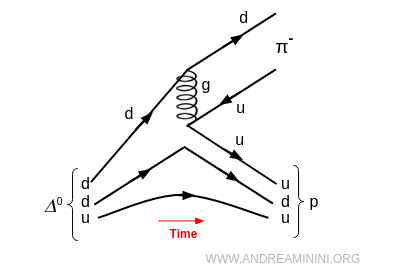
The extra $u$ quark replaces one of the $d$ quarks in the baryon, turning the triplet into $uud$, which is a proton.
The displaced $d$ quark binds with the $\bar u$ from the pair, forming a negative pion ($\pi^- = d\bar u$).
The process can be written as: $$ \Delta^0 (udd) \;\;\longrightarrow\;\; p(uud) + \pi^-(d\bar u).
$$
Note. The gluon is the essential trigger: by generating a quark - antiquark pair, it allows the system to rearrange into stable states, which explains why the strong decay of the $\Delta^0$ is so fast. Interestingly, the $\Delta^0$ has the same quark composition as the neutron ($udd$). Yet the neutron cannot undergo the same strong decay into a proton and pion because it is lighter.
Here are other examples of strong decay channels for delta baryons:
$\Delta^{++} \to p + \pi^+$
$\Delta^{+} \to p + \pi^0 \quad$ or $\quad n + \pi^+$
$\Delta^{0} \to n + \pi^0 \quad$ or $\quad p + \pi^-$
$\Delta^{-} \to n + \pi^-$
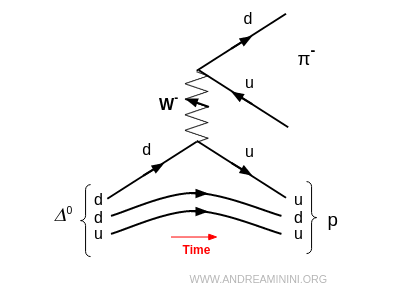
Note. On very rare occasions, a $ \Delta $ baryon can also decay via the weak interaction. This path is heavily suppressed and almost always masked by the dominant strong decay. For instance, the $ \Delta^0 $ can transform into a proton by emitting a $ W^- $ boson, which subsequently decays into a negative pion: $\Delta^{0} \to p + \pi^-$.
And so on.


