
Parity violation
Parity violation refers to the fact that, in nature, not all physical processes have a mirror-reflected counterpart.
What is parity?
Parity is a fundamental symmetry stating that a physical process can occur both in its original form and in its mirror image, without any change in the physical laws that govern it.
In simple terms, it corresponds to observing a physical phenomenon in a mirror, where left and right are exchanged.
If a physical process remains unchanged under this transformation, it is said to conserve parity.
For example, an electron approaching from the right and a positron approaching from the left can annihilate, producing two photons emitted in opposite directions. In the mirror-reflected process, where the electron comes from the left and the positron from the right, the photons are again emitted in opposite directions, but reversed, because the laws of electrodynamics are invariant under spatial inversion. Parity is therefore conserved.
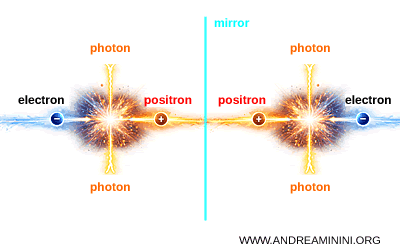
In reality, the true spatial inversion associated with the parity operator corresponds to a central symmetry, that is, a reflection with respect to a single point C. In a genuine parity transformation, the two photons also exchange their spatial positions.
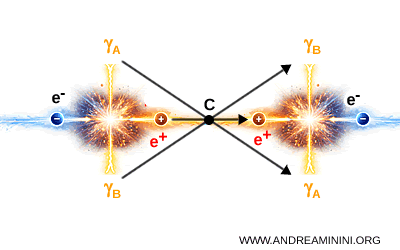
However, for the sake of clarity and intuitive understanding, it is common to describe parity using the mirror analogy, namely an axial symmetry. In these notes, I will therefore adopt this simplified representation, while keeping in mind that it is a conceptual approximation of the true geometric transformation involved.
For a long time, it was believed that all the laws of physics were invariant under parity.
This belief stemmed both from everyday experience and from the fact that the interactions known at the time, such as gravitation and electromagnetism, fully respect this symmetry.
In the second half of the twentieth century, however, it became clear that parity is not a universal principle, because the weak interaction violates parity.
Note. To simplify the discussion, spin is described here as a clockwise or counterclockwise “rotation”. In reality, spin is not a classical rotation in physical space, but an intrinsic quantum property of a particle, with no direct classical analogue.
The discovery of parity violation
In the 1950s, theoretical work by Tsung-Dao Lee and Chen-Ning Yang showed that there was no experimental evidence supporting the conservation of parity in weak interactions.
Shortly thereafter, in 1957, Chien-Shiung Wu carried out a landmark experiment on the beta decay of cobalt-60, demonstrating unambiguously that parity is not conserved in weak processes.
In her experiment, cobalt nuclei were aligned using a magnetic field and cooled to very low temperatures.
It was observed that, during beta decay, electrons are preferentially emitted in the direction opposite to the nuclear spin, revealing a clear statistical violation of spatial symmetry.
As a result, the mirror-reflected version of the phenomenon does not occur with the same probability.
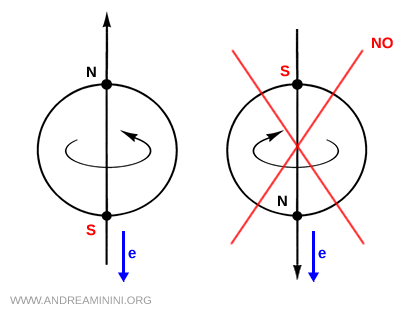
Note. In the figure on the left, the physically observed process is shown: the electron is emitted downward and the rotation is counterclockwise, with the N - S polarity pointing upward. In the figure on the right, the mirrored configuration is shown: the electron is still emitted downward, but the mirrored rotation is now clockwise, so the N - S polarity points downward. This reflected configuration does not correspond to a physically realizable process, indicating that mirror symmetry, and therefore parity, is violated in weak interactions.
This experiment demonstrated that the weak interaction distinguishes between left and right, a property not shared by the other fundamental interactions.
Central Symmetry
As mentioned earlier, the mirror analogy, that is, axial symmetry, is often used because it offers an intuitive way to visualize the phenomenon.
In a strict physical sense, however, the true parity operation corresponds to a central symmetry, namely a reflection with respect to a single point in space.
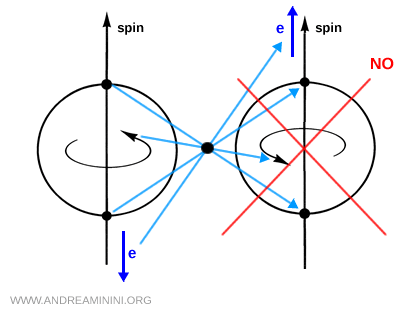
From a physical standpoint, the outcome is the same: the mirrored configuration is not observed in weak interactions, or at least not with the same probability. This asymmetry is precisely what is meant when we say that parity is violated.
Why is parity violated?
The reason lies in the nature of spin, which is a pseudovector. Unlike ordinary (polar) vectors, a pseudovector does not change sign under spatial inversion.
As a result, when the direction of motion of the electron is reversed by a parity transformation, the direction of its spin remains unchanged.
In the mirrored configuration, the spin therefore still points upward and remains aligned with the electron's direction of motion. This configuration, however, is not realized in weak interactions.
Note. Expressed in more intuitive terms, and continuing with the polarity analogy, the sense of rotation remains counterclockwise even in the mirrored configuration. As a consequence, the spin continues to point upward. In weak interactions, however, nature does not realize this mirrored configuration with the same probability, which is precisely why parity is not conserved.
What are the implications of parity violation in physics?
Parity violation implies that a physical process and its mirror image are not equivalent.
In other words, there exist phenomena that occur in nature but cannot occur in their mirror-reflected form.
This asymmetry does not affect all fundamental interactions, but only the weak interaction. Electromagnetic, strong, and gravitational interactions all respect parity symmetry.
The discovery of parity violation had a profound impact on theoretical physics. It showed that symmetries are not absolute principles of nature, but properties that must be tested experimentally.
Moreover, it paved the way for the development of the electroweak theory, in which parity violation is naturally embedded in the mathematical structure of the fundamental interactions.
More broadly, parity violation reveals that the universe possesses a preferred handedness in certain physical phenomena.
Example of neutrinos
Neutrinos provide one of the clearest and most compelling examples of parity violation.
Until the 1950s, it was widely believed that neutrinos, like photons, could exist in two mirror-related states, one right-handed and one left-handed, occurring in equal proportions. This assumption reflected the prevailing view that the laws of physics were symmetric under the interchange of left and right.
Subsequent discoveries, however, revealed a striking property. Neutrinos participate exclusively in the weak interaction, and precisely for this reason they exhibit a pronounced asymmetry:
- all observed neutrinos are left-handed
- all observed antineutrinos are right-handed
This is a firmly established experimental fact, confirmed by numerous independent observations.
What remains unknown is the deeper origin of this asymmetry. We know that it occurs, but we do not yet understand why nature has selected this particular configuration.
What does it mean for a particle to be right-handed or left-handed? A particle is said to be right-handed when its spin is aligned with the direction of its momentum. Conversely, a particle is left-handed when its spin is oriented opposite to its momentum. This distinction therefore does not refer to any absolute notion of “right” or “left” in physical space, but is defined entirely with respect to the particle’s direction of motion.
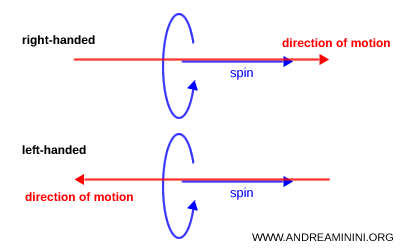
It is crucial to emphasize that the assignment of “right-handed” or “left-handed” character depends on the reference frame. For example, in a reference frame $ S $ we may observe the particle moving to the left while its spin points to the right. Based on this observation, we classify the particle as left-handed.
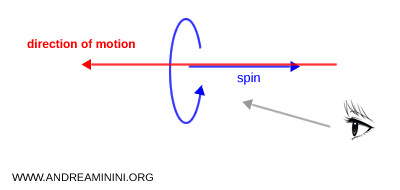
If we now switch to another inertial reference frame $ S' $ that moves in the same direction but at a higher speed than the particle, the particle appears to move in the opposite direction as a result of relative motion. Before overtaking it, the particle appears to approach the observer; after overtaking it, the particle appears to recede. In this frame, the apparent direction of the particle’s momentum coincides with the direction of its spin. Under these conditions, the particle is observed to be right-handed. In other words, a particle that is left-handed in one inertial frame can appear right-handed in another simply by changing the reference frame, because helicity is not invariant under Lorentz transformations for massive particles.
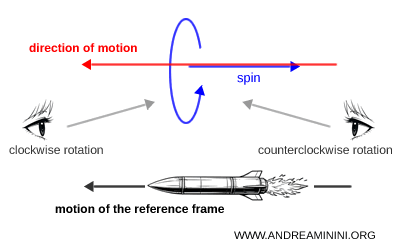
This analysis makes clear that helicity is not an absolute property: it can change when passing from one inertial reference frame to another. The situation is fundamentally different for massless particles, such as idealized neutrinos. A massless particle always propagates at the speed of light, and no inertial observer can ever overtake it. As a result, there is no reference frame in which the direction of the particle’s momentum can be reversed relative to its spin. For this reason, in the case of massless particles such as ideal neutrinos, helicity becomes an invariant property. It does not depend on the observer’s reference frame, but instead constitutes an intrinsic feature of the particle itself. In other words, the helicity of a neutrino, or of any other massless particle, is invariant under Lorentz transformations.
This means that the mirror image of a neutrino does not exist in nature. If it did, it would interact like an ordinary particle, but this is not observed.
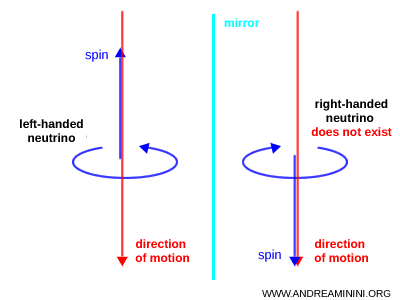
Note. In the figure on the left, the motion, counterclockwise rotation, and spin of a left-handed neutrino are shown. In the figure on the right, the mirror image is shown, in which the rotation is clockwise and the spin therefore points downward. This mirrored configuration would correspond to a right-handed neutrino, because the spin is aligned with the direction of motion, but such a particle does not exist in nature. For this reason, neutrinos are always left-handed.
This fact represents one of the most profound violations of parity symmetry observed in nature.
Because neutrinos travel at the speed of light, their helicity, that is, the orientation of the spin relative to the direction of motion, is absolute and invariant.
No reference frame can move faster than a massless particle, and therefore it is impossible to reverse the direction of its motion by changing frames of reference.
Note. We now know that neutrinos do possess a small but nonzero mass. This implies that, in principle, right-handed neutrino states must also exist. However, these hypothetical right-handed neutrinos do not participate in the weak interaction and are therefore inaccessible to current experiments. For this reason, they are commonly referred to as sterile neutrinos. Their possible existence does not contradict the observed violation of parity. One of the deepest open questions in particle physics remains: why do only left-handed neutrinos and right-handed antineutrinos participate in the weak interaction, while right-handed neutrinos remain hidden?
Chirality and helicity
Parity violation is closely connected to the distinction between chirality and helicity.
- Helicity describes whether the spin of a particle is aligned with its direction of motion (helicity +1) or opposite to it (helicity -1). A particle is said to be right-handed if its spin is parallel to its momentum, and left-handed if it is antiparallel. Helicity therefore depends on the particle’s motion and is not an absolute property.
- Chirality is an intrinsic property related to how a particle couples to interactions. In particular, only the weak interaction distinguishes between left- and right-chiral states: only left-chiral particles and right-chiral antiparticles participate in weak interactions. Chirality does not depend on the particle’s motion, but on the structure of the underlying quantum field.
For massive particles, helicity and chirality do not necessarily coincide. A particle may have left-handed chirality but right-handed helicity, or vice versa, depending on the observer’s frame of reference.
The situation changes radically for massless particles, such as idealized neutrinos. Because they propagate at the speed of light, no reference frame can overtake them and reverse the direction of their motion. As a result, for massless particles, helicity becomes an invariant quantity and coincides with chirality.
And so on.


