
Wu Experiment
The Wu experiment provided the first direct experimental evidence that parity is not conserved in weak interactions. This phenomenon is known as parity violation.
Until the 1950s, it was widely assumed that all the laws of physics were invariant under spatial reflection, meaning that they remained unchanged when left and right were exchanged.
In other words, it was believed that a physical process and its mirror image were equally allowed by nature.
This property is known as parity invariance or parity symmetry.
For example, an electron and a positron can annihilate, producing two photons emitted in opposite directions. If one considers the mirror version of this process, in which the positions of the electron and the positron are exchanged, the phenomenon remains physically allowed and follows the same physical laws. This shows that electron - positron annihilation preserves parity: both the process and its mirror image are physically realizable in nature.
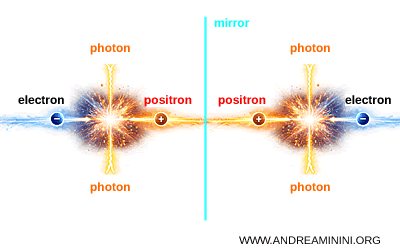
From Newton to Dirac, the idea that nature "shows no preference" was often regarded as self evident rather than as a hypothesis requiring experimental verification.
This belief was rooted in an almost Platonic vision of the universe, conceived as an intrinsically harmonious and symmetric structure.
In 1956, however, Tsung-Dao Lee and Chen-Ning Yang made a crucial observation: no experiment had ever tested whether parity is conserved in weak interactions. They therefore proposed a concrete experimental test.
The experiment was carried out in 1957 by the American physicist Chien-Shiung Wu, who investigated the beta decay of cobalt-60:
\[ ^{60}\text{Co} \rightarrow ^{60}\text{Ni} + e^- + \bar{\nu}_e \]
The central idea was to align the spins of the cobalt nuclei in the same direction using a strong magnetic field, and then observe the direction in which the emitted electrons were preferentially emitted.
To prevent thermal agitation from disrupting the spin alignment, the sample was cooled to extremely low temperatures, close to absolute zero on the Kelvin scale.
The results showed that electrons were emitted preferentially in the direction opposite to the nuclear spin.
The mirror configuration, in which electrons would be emitted along the same direction as the nuclear spin, was never observed, even though such an outcome would be expected if parity were a fundamental symmetry of nature.
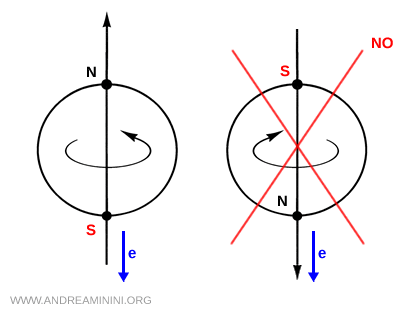
Note. In the figure on the left, the physically observed process is shown: the electron is emitted downward, and its spin rotates counterclockwise, with the N - S polarity oriented upward. In the figure on the right, the mirror configuration is displayed. Here, the electron is still emitted downward, but the rotation, being reflected, now proceeds clockwise, and the N - S polarity is oriented downward. This mirror configuration, however, does not correspond to any physically realizable process. This demonstrates that spatial reflection symmetry is not preserved: in weak interactions, parity is violated.
This observation marked the first direct evidence of parity violation in nature, demonstrating that parity symmetry is not preserved in real physical processes.
The experiment showed that parity is not a symmetry of the weak interaction and that symmetry itself is not an absolute principle, but rather a property that nature may or may not respect.
In practical terms, the universe truly distinguishes between left and right. This is not a subtle asymmetry, but a fundamental feature of the laws of physics.
Subsequent experiments confirmed these results, despite initial skepticism within the scientific community, including that of Wolfgang Pauli, who had considered such a violation impossible.
Note. The violation of parity was not merely an experimental anomaly. It represented a profound challenge to the idea of an inherently symmetric universe. Until then, symmetry had been treated as a fundamental principle rather than as a hypothesis subject to experimental testing. The Wu experiment revealed that this assumption had simply gone unexamined in the context of weak interactions. In this sense, the experiment also exposed a human limitation: scientists, too, can become constrained by their theoretical expectations.
From that moment onward, physics ceased to pursue elegance alone and began to confront a deeper and less reassuring reality, in which symmetry is not universal but a property that nature may choose to violate.
After the Wu experiment, every symmetry began to be regarded with a degree of skepticism.
This discovery paved the way for the modern formulation of electroweak theory and earned Lee and Yang the Nobel Prize in Physics in 1957 for their theoretical interpretation of the phenomenon. The decisive experimental confirmation, however, was provided by Chien-Shiung Wu, whose contribution remains fundamental in the history of physics.
Subsequent studies further demonstrated that the weak interaction violates parity in other physical processes as well.
For example, neutrinos are always left-handed, whereas antineutrinos are always right-handed. This fact has been confirmed experimentally. Why nature has made this choice, however, remains unknown.
And so on.


