
Elementary Particles
Elementary particles lie at the core of modern physics. They are the most fundamental constituents of the universe - everything, from matter to forces, is ultimately built from them. These particles represent the indivisible units of matter.
What Are Elementary Particles?
In the 19th century, atoms were believed to be the indivisible building blocks of matter. But in 1897, J.J. Thomson overturned this idea with a groundbreaking discovery.
Thomson identified negatively charged subatomic particles orbiting the atomic nucleus - these were electrons.
The electron was the first subatomic particle ever discovered by humans.
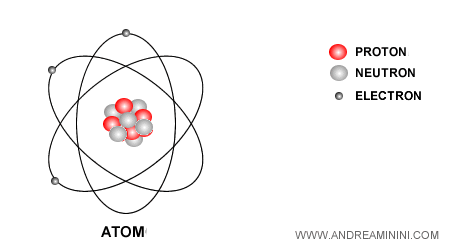
Since electrons accounted for only a small fraction of an atom’s mass - and atoms are overall neutral - it became evident that other, heavier positively charged particles had to exist.
In 1911, Ernest Rutherford, one of Thomson’s students, discovered the atomic nucleus and the proton. In 1932, neutrons were added to the picture, thanks to the work of James Chadwick.
By the early 20th century, electrons, protons, and neutrons were considered the fundamental components of atoms.
The list of elementary particles expanded again with the introduction of the photon, the particle responsible for carrying light. The photon is massless and qualifies as an elementary particle.
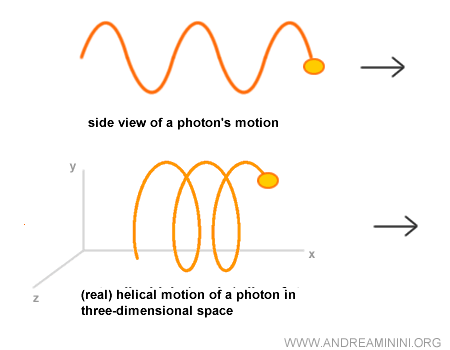
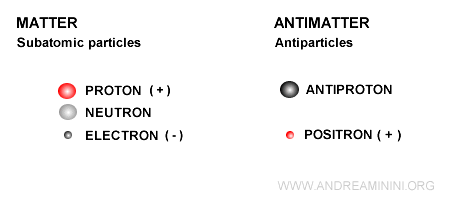
Another breakthrough came with Carl Anderson’s discovery of the positron - the electron’s antiparticle - which provided the first experimental evidence for antimatter.
Antiparticles
In the 1930s and 1940s, both the anti-electron (or positron) and the anti-proton were observed, ushering in the concept of antimatter.
In the following decades, physicists predicted and discovered many more elementary particles, giving rise to the field we now know as particle physics.
Quarks
By the 1960s, scientists had begun to suspect that even so-called elementary particles might be made of smaller constituents.
To probe this inner structure, researchers accelerated charged particles - such as protons or electrons - to near-light speeds and smashed them together. These high-energy collisions allowed them to break matter apart and glimpse its more fundamental layers.
This led to the creation of the first particle accelerators - both linear and circular - and ever-larger, more powerful machines have followed.

This is how scientists uncovered the true building blocks of matter: quarks, also known as subparticles.
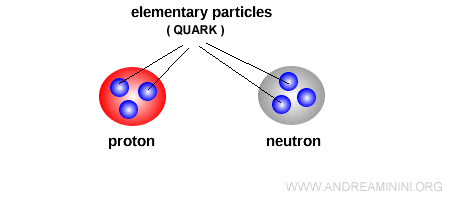
Quarks are much lighter than protons and neutrons, which makes them far more elusive. It takes tremendous energy to overcome the strong interaction that binds them together.
Fundamental Particles
The term "fundamental particles" was introduced to distinguish indivisible particles - like electrons - from those that are composite, such as protons and neutrons.
Families of Elementary Particles
Elementary particles are classified into three broad families:
- Hadrons
Hadrons are composite particles made of quarks, bound by the strong force, which is mediated by gluons. They fall into two main categories: - Leptons
Leptons are truly elementary particles, meaning they’re not made of quarks. They include particles like the electron, muon, and tau, each paired with a corresponding neutrino: the electron neutrino, muon neutrino, and tau neutrino. All leptons have half-integer spin, making them fermions. They obey the Pauli exclusion principle and interact via the weak force. Charged leptons also engage in electromagnetic interactions, but unlike hadrons, they do not participate in the strong interaction.What Are Fermions? Fermions are particles with half-integer spin values (e.g. 1/2, 3/2, etc.) and obey the Pauli exclusion principle, which forbids two identical fermions from occupying the same quantum state. Fermions can be elementary (like quarks and leptons) or composite (like protons and neutrons, which are made of three quarks). Unlike bosons, which often mediate fundamental forces, fermions make up ordinary matter.
- Force Carriers (or Gauge Bosons)
These particles mediate the four fundamental interactions of nature. They are the quanta of the fields that give rise to each force. Unlike fermions, they have integer spin and can occupy the same quantum state - meaning they do not follow the Pauli exclusion principle.- Photon (γ): The quantum of the electromagnetic field. It is massless, carries no charge, and is responsible for light and all electromagnetic phenomena.
- Gluons (g): These particles mediate the strong nuclear force that holds quarks together within protons, neutrons, and other hadrons.
- W and Z Bosons: Mediators of the weak nuclear force, which governs processes such as beta decay. These particles are massive, which limits the range of the weak force.
- Higgs Boson (H): Discovered in 2012 at the Large Hadron Collider, the Higgs boson is responsible for the mechanism that gives mass to fundamental particles.
- Graviton (hypothetical): The proposed quantum carrier of the gravitational field. Although predicted by theory, it has not yet been detected experimentally.

In summary, hadrons - especially baryons - make up the bulk of visible matter, while leptons include some of the most fundamental constituents, such as electrons and neutrinos.
Force carriers, meanwhile, are essential for explaining how particles interact and how the universe is held together at the quantum level.
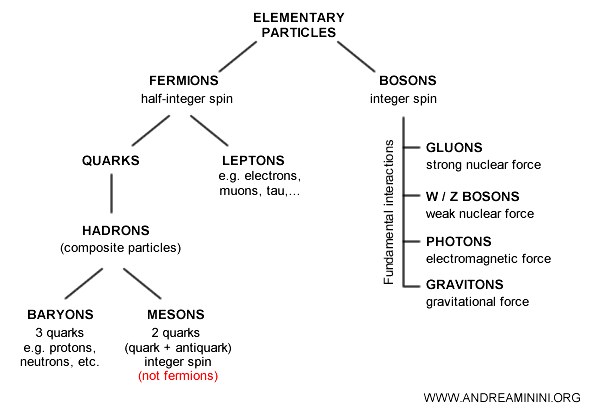
This information can also be clearly summarized using a two-way classification table.
| Fermions (half-integer spin) |
Bosons (integer spin) |
|
|---|---|---|
| Leptons | Examples: electron, neutrino (elementary particles) |
❌ No bosonic leptons exist |
| Hadrons | Examples: proton, neutron (baryons: 3 quarks) |
Examples: mesons (quark - antiquark pairs) |
| Fundamental Bosons | ❌ No fundamental boson is a fermion | Examples: photon, gluon, W, Z, Higgs (force carriers) |
The following table highlights how these particles participate in the four fundamental interactions.
| Category | Spin | Statistics | Elementary? | Gravitational | Electromagnetic | Strong | Weak |
|---|---|---|---|---|---|---|---|
| Leptons | 1/2 | Fermi - Dirac | Yes | Yes | Only if charged | No ❌ | Yes |
| Hadrons (baryons) | 1/2 | Fermi - Dirac | No ❌ | Yes | Only if charged | Yes | Yes |
| Hadrons (mesons) | 0 or 1 | Bose - Einstein | No ❌ | Yes | Only if charged | Yes | Yes |
| Gauge Bosons | 1 | Bose - Einstein | Yes | No ❌ | Photon, W only | Gluon only | W and Z |
| Higgs Boson | 0 | Bose - Einstein | Yes | Yes | No ❌ | No ❌ | Couples indirectly |
Note. Leptons and force carriers are classified as elementary particles because they have no known internal structure. Hadrons, by contrast, are composite particles - made of two or three quarks - so they are not considered elementary.
The Standard Model
According to the Standard Model of particle physics, all elementary particles fall into one of two broad categories:
- Fermions, which make up matter
- Bosons, which mediate the fundamental forces
What is an elementary particle? An elementary particle is a subatomic entity with no known substructure - meaning it is not made of smaller constituents. Examples include fermions like electrons and quarks, the building blocks of ordinary matter. Bosons, on the other hand, such as photons and gluons, are responsible for mediating the fundamental forces of nature. For instance, protons and neutrons - though they form atomic nuclei - are not elementary because they consist of up and down quarks held together by gluons via the strong interaction.
A key property that distinguishes particle types is their intrinsic spin:
- Fermions have half-integer spin (e.g. 1/2)
- Bosons have integer spin (e.g. 0, 1, or hypothetically 2 in the case of the graviton)
This difference in spin determines their quantum behavior: fermions obey the Pauli exclusion principle and follow Fermi - Dirac statistics, while bosons can occupy the same quantum state and follow Bose - Einstein statistics.
The Fundamental Particles
The Standard Model describes 17 known fundamental particles:
- 12 fermions, consisting of 6 types of quarks (up, down, charm, strange, top, bottom) and 6 leptons (electron, muon, tau, plus their corresponding neutrinos)
- 5 bosons, including the force carriers for the electromagnetic, strong, and weak interactions (photon, gluons, W and Z bosons), and the Higgs boson, which explains how particles acquire mass. While there are eight types of gluons, they are collectively treated as a single category of boson.
Elementary particles and the Standard Model together form the foundation of modern particle physics.
That said, the model remains incomplete. As experimental technologies advance - especially with next-generation particle accelerators - our understanding of the universe continues to deepen and evolve.
It is likely that future discoveries will lead us toward a more unified and comprehensive theory of fundamental physics.
Beyond the Standard Model. Despite its accuracy and predictive power, the Standard Model has important limitations. It does not account for gravity, dark matter, or dark energy. Several theoretical frameworks aim to extend or replace it:
- Supersymmetry (SUSY): posits a corresponding “superpartner” for every known particle
- String Theory: envisions particles as tiny vibrating strings rather than point-like objects
- Graviton: a hypothetical particle, not yet observed, that would mediate the gravitational force
And so the search continues.


