Comparing Fractions
There are several practical ways to compare two fractions and determine whether one is greater than, less than, or equal to the other. The method you choose depends on the form of the fractions and what makes the comparison easier to carry out.
Fractions with the Same Denominator
If two fractions share the same denominator, the comparison is immediate: you only need to compare their numerators.
This is the simplest situation.
Example
The following fractions have the same denominator
$$ \frac{3}{5} \ , \ \frac{7}{5} $$
Comparing the numerators, we have 3<7
So, the first fraction is less than the second.
$$ \frac{3}{5} \ < \ \frac{7}{5} $$
Fractions with Different Denominators
When the denominators are different, you can use two standard methods to compare the fractions.
A] Reduction to the Least Common Denominator
A common approach is to rewrite both fractions with a common denominator. This is done by computing the least common multiple of the denominators.
Once the fractions are expressed with the same denominator, you can compare their numerators directly.
Example
Consider the fractions
$$ \frac{6}{5} \ , \ \frac{7}{4} $$
The least common multiple of 5 and 4 is 20
Using the invariance property of fractions, rewrite both fractions with denominator 20
$$ \frac{6 \cdot 4}{5 \cdot 4} \ , \ \frac{7 \cdot 5}{4 \cdot 5} $$
$$ \frac{24}{20} \ , \ \frac{35}{20} $$
Now the denominators are equal, so we compare the numerators 24 and 35.
Since 24 < 35, the first fraction is less than the second.
$$ \frac{24}{20} \ < \ \frac{35}{20} $$
This result also applies to the original equivalent fractions
$$ \frac{6}{5} \ < \ \frac{7}{4} $$
Note. When numerators and denominators are large, computing the least common multiple can be time-consuming. In such cases, it is often more convenient to use cross multiplication.
B] Cross Multiplication
Another effective method is cross multiplication.
Given two fractions $$ \frac{a}{b} \ , \ \frac{c}{d} $$ multiply across the diagonals: compute a·d and b·c.
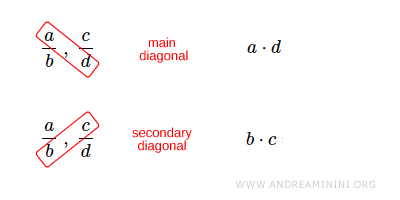
If the product a·d is greater than b·c, then the first fraction is greater than the second.
$$ a \cdot d > b \cdot c \Longrightarrow \frac{a}{b} > \frac{c}{d} $$
If it is smaller, the first fraction is less than the second.
Warning. When working with negative fractions, always place the minus sign in the numerator before applying cross multiplication. $$ - \frac{a}{b} \ , \ \frac{c}{d} \Longrightarrow \frac{-a}{b} \ , \ \frac{c}{d} $$
Example 1
Consider the same fractions as before
$$ \frac{6}{5} \ , \ \frac{7}{4} $$
Compute the diagonal products
$$ 6 \cdot 4 \ , \ 5 \cdot 7 $$
$$ 24 \ , \ 35 $$
Since 24 < 35, the first fraction is less than the second.
$$ \frac{6}{5} \ < \ \frac{7}{4} $$
Example 2
Now consider a negative fraction
$$ -\frac{4}{3} \ , \ \frac{6}{5} $$
Rewrite the negative fraction by placing the minus sign in the numerator
$$ \frac{-4}{3} \ , \ \frac{6}{5} $$
Compute the diagonal products
$$ -4 \cdot 5 \ , \ 3 \cdot 6 $$
$$ -20 \ , \ 18 $$
Since -20 < 18, the first fraction is less than the second.
$$ -\frac{4}{3} \ < \ \frac{6}{5} $$
Example 3
Finally, consider two negative fractions
$$ -\frac{4}{3} \ , \ - \frac{6}{5} $$
Place the minus signs in the numerators
$$ \frac{-4}{3} \ , \ \frac{-6}{5} $$
Compute the diagonal products
$$ -4 \cdot 5 \ , \ 3 \cdot (-6) $$
$$ -20 \ , \ -18 $$
Since -20 < -18, the first fraction is less than the second.
$$ -\frac{4}{3} \ < \ - \frac{6}{5} $$
Note. Cross multiplication is often the quickest way to compare two fractions. Just remember to handle negative signs carefully by assigning them to the numerator.
And so on.