
Fractions
A fraction is an ordered pair of numbers a and b, with the condition that the second number is not zero. $$ \frac{a}{b} \ \ \ with \ b \ne 0 $$
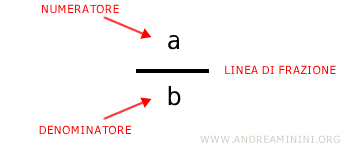
The two numbers are separated by the fraction bar.
The number above the fraction bar is called the numerator.
The number below the fraction bar is called the denominator, and it must always be different from zero.
Here is a simple example of a fraction
$$ \frac{5}{2} $$
In this example, 5 is the numerator and 2 is the denominator.
A fraction represents the quotient obtained by dividing the numerator by the denominator
$$ \frac{a}{b} = a:b $$
For example, the fraction above corresponds to the division 5:2, which equals 2.5
$$ \frac{5}{2} = 5:2 $$
$$ \frac{5}{2} = 2.5 $$
Note. The denominator can never be zero. If the denominator were zero, the expression would involve a division by zero, which is undefined in mathematics. Therefore, fractions with a zero denominator are not defined. For example $$ \frac{2}{0} = \frac{3}{0} = ... = \text{undefined} $$ The expression 0/0 is also not defined, but for a different reason: it is an indeterminate form. $$ \frac{0}{0} = \text{indeterminate} $$ In general, any fraction with zero in the denominator is meaningless because it does not represent a valid mathematical operation.
When two fractions with different numerators and denominators have the same value, they are called equivalent fractions.
$$ \frac{a}{b} = \frac{c}{d} $$
For example, the fractions 4/2 and 10/5 are equivalent fractions because they both evaluate to 2
$$ \frac{4}{2} = \frac{10}{5} = 2 $$
Depending on the relationship between the numerator and the denominator, fractions are classified as follows
- Proper fractions
Proper fractions have a numerator smaller than the denominator (a< b). Their value lies strictly between 0 and 1. $$ \frac{2}{3} \ \Longleftrightarrow \ 2 < 3 $$ - Improper fractions
Improper fractions have a numerator greater than the denominator (a>b). Their value is greater than 1. $$ \frac{5}{2} \ \Longleftrightarrow \ 5 > 2 $$ - Apparent fractions
In apparent fractions, the numerator is equal to the denominator (a=b) or is a multiple of it (a = b \cdot k). They are called "apparent" because they simplify to an integer. $$ \frac{6}{2} = \frac{2 \cdot 3}{2} = 3 $$
Reducing fractions to lowest terms
If the numerator and denominator share at least one common divisor k, the fraction can be reduced to an equivalent fraction by dividing both by that common divisor. $$ \frac{a}{b} = \frac{a:k}{b:k} $$
If the numerator and denominator have no common divisors other than 1, the fraction is said to be in lowest terms.
Example
In the fraction 16/6, both the numerator and the denominator are divisible by 2
$$ \frac{16}{6} $$
We can therefore reduce the fraction by dividing both the numerator and the denominator by 2
$$ \frac{16}{6} = \frac{16:2}{6:2} = \frac{8}{3} $$
The result is the equivalent fraction 8/3, which has the same value.
$$ \frac{16}{6} = \frac{8}{3} $$
In this case, 8/3 is also in lowest terms because 8 and 3 have no common divisors.
$$ \frac{8}{3} $$
Note. When two integers have no common divisors other than 1, they are called coprime or relatively prime. This does not mean that both numbers are prime. For example, in the fraction 8/3, the number 8 is not a prime number.
Additional remarks
Some additional remarks about fractions
- Integers and natural numbers as special cases of fractions
Any integer or natural number \( n \) can be written as a fraction with denominator equal to 1. $$ n = \frac{n}{1} \ \ \ \forall \ n \in \mathbb{Z} \ ∨ \ n \in \mathbb{N} $$For example: $$ 5 = \frac{5}{1} \ \ , \ \ -3 = \frac{-3}{1} \ \ , \ \ 0 = \frac{0}{1} $$
This representation shows that integers and natural numbers are special cases of rational numbers, since they can be written in the form \(\frac{a}{b}\), with \(b \neq 0\).
And so on.


