Decimal Fractions vs Common Fractions
Fractions can be grouped into two main types: decimal fractions and common fractions. The difference between them depends on the form of the denominator and how the number is represented in decimal notation.
Decimal fractions
A decimal fraction is a fraction whose denominator is a power of 10 with a nonzero exponent. $$ \frac{n}{10^m} \ \text{with} \ m \ne 0 $$
Typical examples include
$$ \frac{3}{10} \ , \ \frac{43}{100} \ , \ \frac{23}{1000} \ , \ ... $$
One useful feature of decimal fractions is that they can be broken down according to place value. Each digit in the numerator contributes to the final number based on its position.
$$ \frac{143}{100} = \frac{100}{100} + \frac{40}{100} + \frac{3}{100} $$
Evaluating each term gives the decimal form
$$ \frac{143}{100} = \frac{100}{100} + \frac{40}{100} + \frac{3}{100} = 1 + 0.4 + 0.03 = 1.43 $$
In decimal notation, each digit has a value determined by its position.
The part before the decimal point is the integer part.
The part after the decimal point is the fractional part.

Note. You can also convert a decimal fraction into its decimal form by directly dividing the numerator by the denominator. $$ \frac{143}{100} = 143:100 = 1.43 $$
Every decimal fraction corresponds to a terminating decimal, that is, a decimal number with a finite number of digits.
Example. We can turn this fraction into a decimal fraction by rewriting the denominator as a power of 10 using the invariance property of fractions. $$ \frac{3}{4} = \frac{3 \cdot 25}{4 \cdot 25} = \frac{75}{100} = 0.75 $$ The result is the terminating decimal 0.75, whose fractional part has two digits.
So, decimal fractions represent only part of the rational numbers.
What about the others?
Some rational numbers cannot be written as decimal fractions. Their decimal representation never ends and follows a repeating pattern. These are called repeating decimals.
To represent them, we use common fractions.
Common fractions
A common fraction is any fraction that is not a decimal fraction.
Common fractions are associated with repeating decimals.
These decimals have infinitely many digits, and after a certain point, the digits repeat in a regular pattern.
- The repeating block of digits is called the period.
- The digits between the decimal point and the period that do not repeat form the non-repeating part.
Example. This fraction cannot be expressed as a terminating decimal because it is not possible to obtain a power of 10 in the denominator. $$ \frac{6}{7} = 0.85714285714 $$ It is a repeating decimal. The repeating part is written with a bar over the digits. $$ \frac{6}{7} = 0.\overline{857142} $$ Example 2. This fraction also cannot be expressed as a terminating decimal $$ \frac{5}{12} = 0.41666666666 = 0.41\overline{6} $$ Here, the period is a single digit (6), and there is a non-repeating part (41) between the decimal point and the period.
Every repeating decimal can be converted into a fraction. This fraction is called the generating fraction.
To find the generating fraction
- write in the numerator the difference between the full number without the decimal point and the number without the decimal point and without the repeating part
- write in the denominator as many 9s as there are digits in the period and as many 0s as there are digits in the non-repeating part.
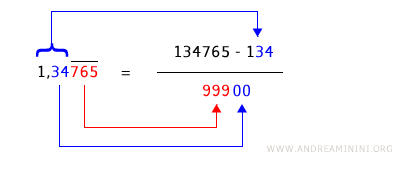
Example. Convert the repeating decimal $$ 0.41\overline{6} = \frac{n}{d} $$ The numerator is obtained by subtracting 41 from 416 $$ 0.41\overline{6} = \frac{416 - 41}{d} = \frac{375}{d} $$ The denominator is formed by one 9, because the period has one digit, and two 0s, because the non-repeating part has two digits $$ 0.41\overline{6} = \frac{416 - 41}{d} = \frac{375}{900} $$ This fraction generates the repeating decimal. We can simplify it by dividing numerator and denominator by their common divisors, or directly by their greatest common divisor. $$ 0.41\overline{6} = \frac{416 - 41}{d} = \frac{375:5}{900:5} = \frac{75:5}{180:5} = \frac{15:3}{36:3} = \frac{5}{12} $$ Therefore, the generating fraction in lowest terms is $$ 0.41\overline{6} = \frac{5}{12} $$
And so on.