
Divergent Sequences
A sequence an is called divergent (or infinite) if its limit is equal to +∞. $$ \lim_{ n \rightarrow +\infty } a_n = +\infty $$ In other words, for every M > 0, there exists a natural number v such that an > M for all n > v. $$ \forall M > 0, \exists v : a_n > M \:\: \forall n > v $$
Similarly, a sequence is also considered divergent if its limit equals -∞.
A sequence an is said to be negatively divergent if its limit is -∞. $$ \lim_{ n \rightarrow +\infty } a_n = -\infty $$ This means that for every M > 0, there exists a natural number v such that an < -M for all n > v. $$ \forall M > 0, \exists v : a_n < -M \:\: \forall n > v $$
Some Practical Examples
Example 1
Consider the sequence x2:
$$ a_n = x^2 $$
This sequence diverges to positive infinity because its limit as n approaches infinity is +∞:
$$ \lim_{n \rightarrow +\infty} x^2 = +\infty $$
The first few terms of the sequence are: $$ a_n = \{ 1, 4, 9, 16, \dots , +\infty \} $$
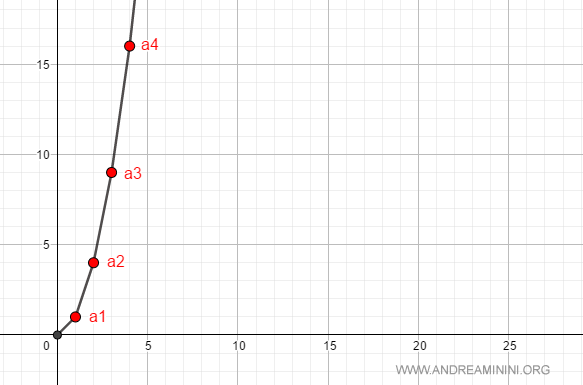
For instance, if we choose M = 10, there exists a natural number v = 3 (since av = a3 = 9) such that for all n > 3, we have an > 10.
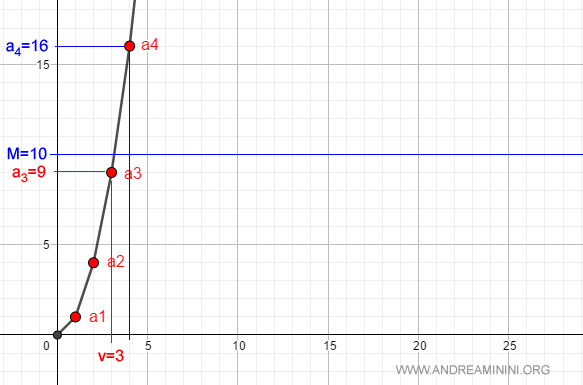
This holds true for any other value of M > 0.
Example 2
Consider the sequence 1 - x2:
$$ a_n = 1 - x^2 $$
This sequence diverges to negative infinity because its limit as n approaches infinity is -∞:
$$ \lim_{n \rightarrow +\infty} 1 - x^2 = -\infty $$
The first few terms of the sequence are: $$ a_n = \{ 0, -3, -8, -15, \dots , -\infty \} $$
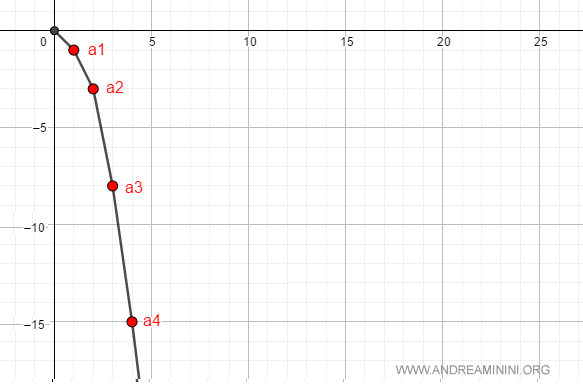
For example, if we pick M = 10, there exists a natural number v = 3 (where av = a3 = -9) such that for all n > 3, we have an < -M; in other words, an < -10.
For instance, a4 = -15 < -10.
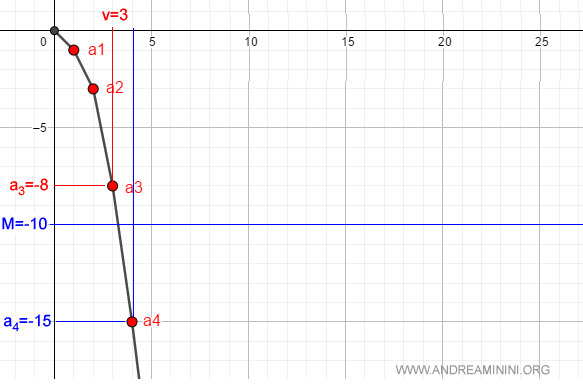
And so on.


