
Monotone Sequences
A sequence is called monotone if one of the following conditions holds for every n ∈ N
- increasing
if each term is greater than or equal to the preceding one $$ a_{n+1} \ge a_n $$ - strictly increasing
if each term is strictly greater than the preceding one $$ a_{n+1} > a_n $$ - decreasing
if each term is less than or equal to the preceding one $$ a_{n+1} \le a_n $$ - strictly decreasing
if each term is strictly less than the preceding one $$ a_{n+1} < a_n $$ - constant
if each term is equal to the preceding one $$ a_{n+1} = a_n $$
These definitions may vary slightly depending on the convention adopted in a given textbook.
For instance, some authors use the terms non-decreasing and non-increasing in place of increasing and decreasing.
Note. A sequence is constant if each term equals the preceding one $$ a_{n+1} = a_n $$ Constant sequences can be viewed as a special case of both increasing and decreasing sequences.
Examples
Example 1
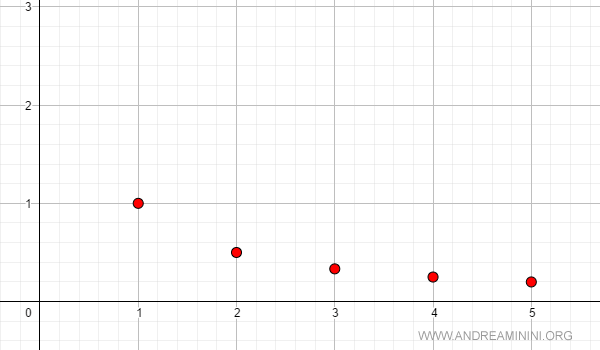
The following sequence is strictly decreasing
$$ a_n = \frac{1}{n} $$
since for every n ∈ N
$$ a_{n+1} < a_n $$
$$ \frac{1}{n+1} < \frac{1}{n} $$
The graph of the sequence is shown below.
Example 2
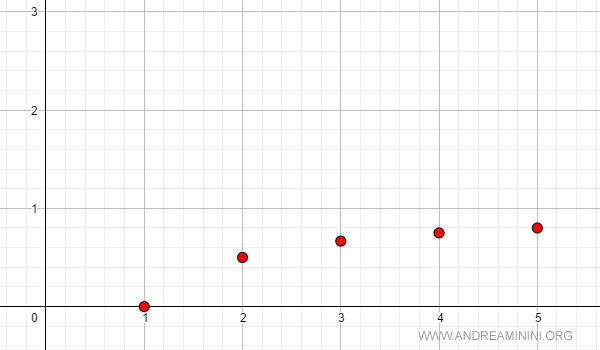
The following sequence is strictly increasing
$$ a_n = \frac{n-1}{n} $$
since for every n ∈ N
$$ a_{n+1} > a_n $$
that is
$$ \frac{n-1+1}{n+1} > \frac{n-1}{n} $$
$$ \frac{n}{n+1} > \frac{n-1}{n} $$
$$ \frac{1}{n(n+1)} > 0 $$
The graph of the sequence is shown below.
Monotone Convergence Theorem
Every bounded monotone sequence converges to a finite limit. Conversely, every monotone sequence that is unbounded diverges to \( +\infty \) or to \( -\infty \).
Two fundamental cases arise.
1] Bounded monotone sequence
If a sequence is monotone and bounded, then it converges. More precisely:
- If it is increasing and bounded above, it converges to a finite limit.
- If it is decreasing and bounded below, it converges to a finite limit.
2] Unbounded monotone sequence
If a monotone sequence is not bounded, then it diverges. In particular:
- If it is increasing and not bounded above, it diverges to \( +\infty \)
- If it is decreasing and not bounded below, it diverges to \( -\infty \)
In other words, a sequence that increases while remaining bounded above must converge, whereas a sequence that increases without bound necessarily diverges.
This result is known as the Monotone Convergence Theorem.
Note. This theorem is fundamental because it allows us to determine the behavior of a sequence without explicitly computing its limit.
Example
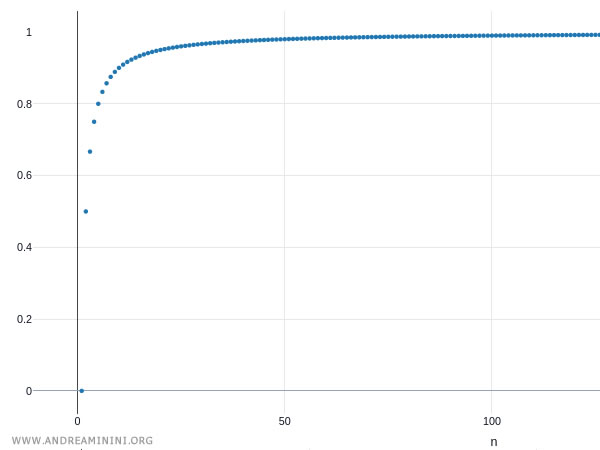
Consider the sequence
\[ a_n = 1 - \frac{1}{n} \]
This sequence is increasing because \( \frac{1}{n} \) decreases as $ n \to \infty $.
Moreover, it is bounded above by 1.
$$ \lim_{n \to \infty} 1 - \frac{1}{n} = 1 $$
Therefore, the sequence converges.
Example 2
Now consider an unbounded monotone sequence.
\[ b_n = n \]
This sequence is increasing and not bounded above.
\[ \lim_{n \to \infty} n = +\infty \]
Therefore, it is a divergent sequence.
And so on.


