Infinitesimal Sequences
A bounded sequence an is called infinitesimal if it converges to zero: $$ \lim_{n \rightarrow \infty} a_n = 0 $$
A Practical Example
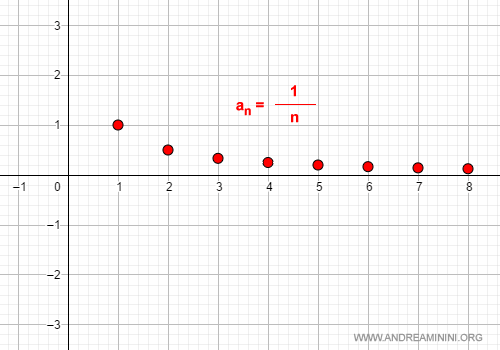
Consider the sequence:
$$ a_n = \frac{1}{n} $$
This sequence approaches zero as n tends to infinity:
$$ \lim_{n \rightarrow \infty} \frac{1}{n} = 0 $$
Therefore, it qualifies as an infinitesimal sequence.
Properties of Infinitesimal Sequences
A sequence an converges to zero if and only if its absolute value |an| also converges to zero: $$ \lim_{n \rightarrow \infty} a_n = 0 \Rightarrow \lim_{n \rightarrow \infty} |a_n| = 0 $$
Example
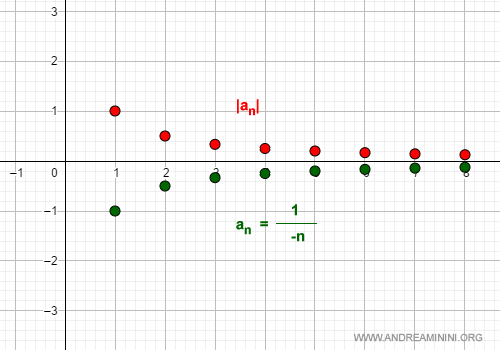
The following sequence an is infinitesimal:
$$ a_n = \frac{1}{-n} $$
because it converges to zero as n approaches infinity:
$$ \lim_{n \rightarrow \infty} \frac{1}{-n} = 0 $$
Its absolute value |an| likewise converges to zero:
$$ \lim_{n \rightarrow \infty} \left| \frac{1}{-n} \right| = 0 $$
Proof
Let’s define the absolute value of the sequence an as a separate sequence bn:
$$ b_n = |a_n| $$
According to the definition of a limit, a sequence converges if:
$$ \forall \epsilon > 0, \exists v : |b_n - l| < \epsilon \quad \forall n > v $$
In the case of an infinitesimal sequence, l = 0, so this condition becomes:
$$ \forall \epsilon > 0, \exists v : |b_n| < \epsilon \quad \forall n > v $$
Since |bn| = ||an|| = |an|,
it follows that the convergence of the absolute value of an to zero is equivalent to the sequence itself being infinitesimal.
And so on.