
Integer Exponents
The nth power of a real number k is obtained by multiplying the number k by itself n times $$ k^n = \underbrace{k \cdot \ k \cdot k \cdot ... \cdot k}_{n \ times} $$ The real number k is called the base, while the integer n is called the exponent.
For example, the power 43 is obtained by multiplying the number 4 by itself three times. It is read as "four to the third power" or "four cubed".
$$ 4^3 = 4 \cdot 4 \cdot 4 = 64 $$
Instead of writing the factor 4 several times, we use the exponential notation 43.
A power with an integer exponent is defined for every real number k when the exponent is a positive integer n>0.
If the exponent is positive n>0, the power kn is the product of n factors equal to the base k. $$ k^n = \underbrace{k \cdot \ k \cdot k \cdot ... \cdot k}_{n \ times} $$
The expression is not defined when both the base and the exponent are zero (00), because this case has no defined value.
Note. If the exponent is n=2, the power is called the square, because the value k2 corresponds to the area of a square whose side length is k. If the exponent is n=3, the power is called the cube, because the value k3 corresponds to the volume of a cube whose edge length is k.
If the exponent n is equal to one k1, the power is equal to the base itself k.
$$ k^1 = k $$
For example, the power 41 is equal to 4, and the same holds for any number.
$$ 1^1=1 \\ 2^1=2 \\ 3^1=3 \\ 4^1=4 \\ 5^1=5 \\ \vdots $$
By convention, a power with exponent zero k0 is equal to 1 for any nonzero base (k≠0).
$$ k^0 = 1 \ \ \ \ \forall \ k \ne 0 $$
For example
$$ 1^0=1 \\ 2^0=1 \\ 3^0=1 \\ 4^0=1 \\ 5^0=1 \\ \vdots $$
On a separate page I provide an example that explains why any number raised to the power of zero equals one.
Note. The expression 00, that is zero raised to the power of zero, has no defined value and is considered undefined.
If the exponent is a negative integer k-n, the power is defined as the reciprocal of the corresponding positive power.
$$ k^{-n} = \frac{1}{k^n} $$
For example, the power 4-3 is the reciprocal of 43.
$$ 4^{-3} = \frac{1}{4^3} = \frac{1}{4 \cdot 4 \cdot 4} = \frac{1}{64} $$
Useful observations
Here are some useful observations about powers with integer exponents.
- If the base is positive k>0, the power kn is always positive.
- If the base is positive and greater than one (k>1), the powers kn increase as the exponent n increases.
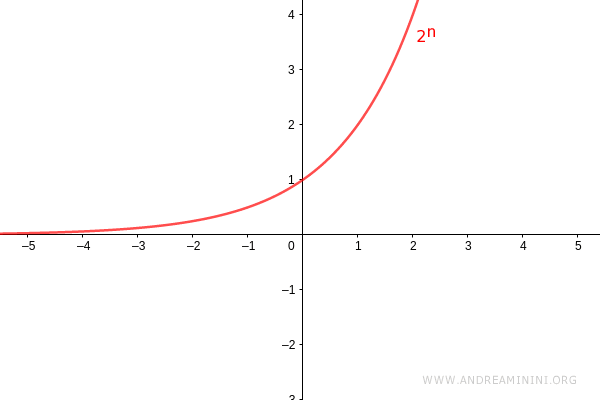
- If the base is positive and between zero and one (0<k<1), the powers kn decrease as the exponent n increases.
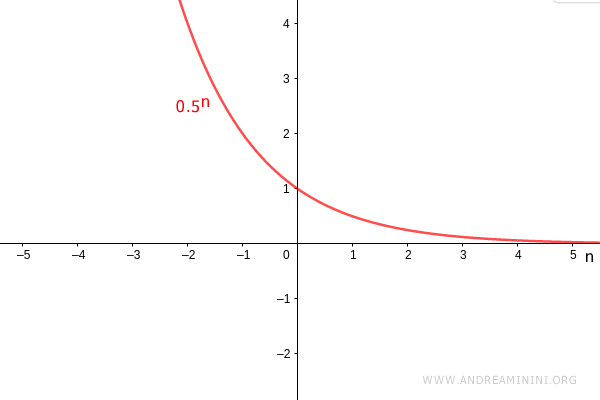
- If the base is equal to one (k=1), the power kn is always equal to one for any exponent n.
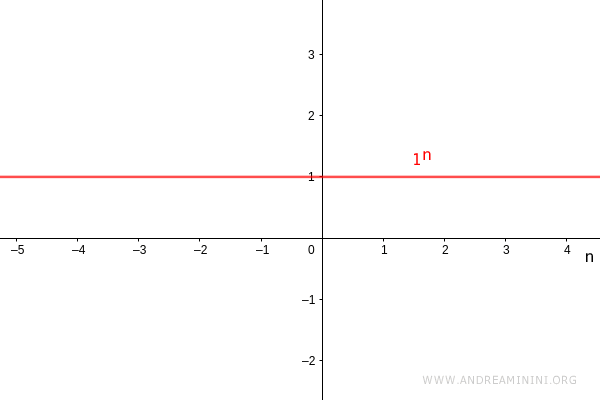
- If the base is negative (k<0), the powers kn are positive when the exponent n is even and negative when the exponent n is odd. Therefore successive powers alternate in sign. For example $$ (-2)^1 = -2 \\ (-2)^2 = +4 \\ (-2)^3 = -8 \\ (-2)^4 = +16 \\ (-2)^5 = -32 \\ \vdots $$
Note. Powers with a negative base have increasing absolute values |kn| as the exponent n increases when the absolute value of the base satisfies |k|>1. For example $$ |(-2)^1| = |-2|=2 \\ |(-2)^2| = |4|=4 \\ |(-2)^3| = |-8| = 8 \\ |(-2)^4| = |16| = 16 \\ |(-2)^5| = |-32|=32 \\ \vdots $$ The absolute values |kn| decrease instead when the absolute value of the base satisfies 0<|k|<1. $$ |(- \frac{1}{2})^1| = |-\frac{1}{2}|=\frac{1}{2} \\ |(-\frac{1}{2})^2| = |\frac{1}{4}|=\frac{1}{4} \\ |(-\frac{1}{2})^3| = |-\frac{1}{8}| = \frac{1}{8} \\ |(-\frac{1}{2})^4| = |\frac{1}{16}| = \frac{1}{16} \\ |(-\frac{1}{2})^5| = |-\frac{1}{32}|=\frac{1}{32} \\ \vdots $$
And so on.


