
Exponential Expressions
An exponential expression extends the idea of exponentiation to real exponents $$ a^x $$ where a>0 is a positive real number and x can be any real number.
The quantity ax is called a power with real exponent, where a is the base and x is the exponent.
The exponent x is a real number.
Therefore, the exponent may be either a rational number
$$ a^{\frac{n}{m}} $$
or an irrational number
$$ a^{\sqrt[m]{n}} $$
In exponential expressions, the exponent may take any real value, while the base must always be a positive real number.
Why must the base be positive?
The base of an exponential expression cannot be negative because some real exponents would produce expressions that are not defined in the real number system.
For example, if the base is negative and a=-1
$$ (-1)^{\frac{1}{2}} = \sqrt{-1} $$
The square root of a negative number is not defined in the set of real numbers.
Note. Square roots of negative numbers are defined only in the complex numbers, which extend the real number system.
The base also cannot be zero because certain fractional exponents would lead to undefined forms.
$$ 0^{\frac{1}{2}} = \sqrt{0} $$
since every real number multiplied by zero is equal to zero.
Properties of Exponential Expressions
Exponential expressions satisfy several important algebraic properties.
- Product of exponential expressions with the same base
When multiplying exponential expressions with the same base, keep the base and add the exponents $$ a^c \cdot a^d = a^{c+d}$$ - Quotient of exponential expressions with the same base
When dividing exponential expressions with the same base, keep the base and subtract the exponents $$ \frac{a^c}{a^d} = a^{c-d}$$ - Product of exponential expressions with the same exponent
When exponential expressions have the same exponent, multiply the bases and keep the exponent unchanged $$ a^c \cdot b^c = (a \cdot b)^c $$ - Quotient of exponential expressions with the same exponent
When exponential expressions have the same exponent, divide the bases and keep the exponent unchanged $$ \frac{a^c}{b^c} = (\frac{a}{b})^c $$
Other useful properties
- An exponential expression is always positive $$ a^x > 0 $$
- Exponentiation is the inverse operation of the logarithm
- An exponential expression with exponent equal to one is equal to its base $$ a^1 = a $$
- By convention, any nonzero number raised to the zero power is equal to 1 $$ a^0 = 1 $$
- If two exponential expressions ac and bc have the same positive exponent (c>0), they are ordered in the same way as their bases $$ \text{if } a>b \text{ then } a^c>b^c $$
Example $$ 5^{2} > 2^{2} $$ $$ 25 > 4 $$
- If two exponential expressions ac and bc have the same negative exponent (c<0), they are ordered in the opposite way from their bases $$ \text{if } a>b \text{ then } a^c< b^c $$
Example $$ 5^{-2} < 2^{-2} $$ $$ \frac{1}{5^2} < \frac{1}{2^2} $$ $$ \frac{1}{25} < \frac{1}{4} $$
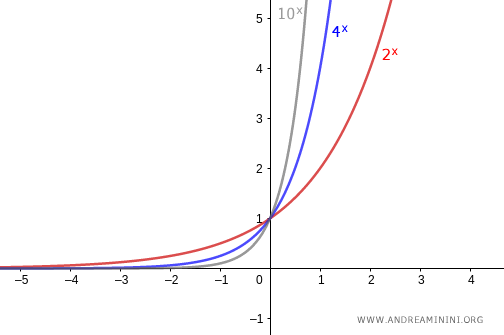
- If the base satisfies a>1, then the exponential function ax increases as the exponent x increases
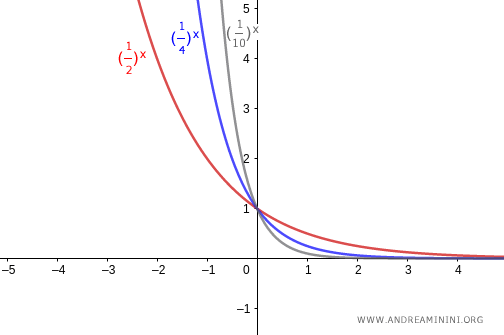
- If the base satisfies 0<a<1, then the exponential function ax decreases as the exponent x increases
These properties are fundamental in algebra, calculus, and many areas of applied mathematics.


