Newton’s Binomial Formula
Newton’s binomial formula offers a precise and efficient method for expanding the nth power of a binomial through the use of binomial coefficients: $$ (A + B)^n = \sum_{k=0}^{n} \binom{n}{k} A^{n-k} B^k $$
Whenever I need to expand an expression of the form \( (A + B)^n \), there are two possible approaches.
- Multiply the binomial by itself n times. $$ (A + B)^n = \underbrace{ (A+B) \cdot (A+B) \cdot ... \cdot (A+B) }_{n \ volte} $$
- Use Newton’s binomial formula. $$ (A + B)^n = \sum_{k=0}^{n} \binom{n}{k} A^{ n-k} B^{ k} $$ $$ (A + B)^n = \binom{n}{0} A^n B^0 + \binom{n}{1} A^{n-1} B^{1} + \ldots + \binom{n}{n-1} A^{1} B^{n-1} + \binom{n}{n} A^0 B^n $$ The numerical factors preceding each term are the binomial coefficients, the same values that appear in the Pascal Tartaglia triangle.
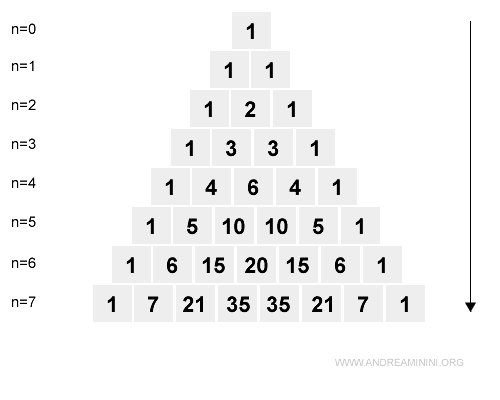
As soon as the exponent grows, Newton’s formula becomes the clearly superior choice in terms of practicality and clarity.
A Worked Example
Consider a binomial raised to the fourth power:
$$ (a + b)^4 $$
We rewrite it using Newton’s formula:
$$(a + b)^4 = \sum_{k=0}^{4} \binom{4}{k} a^{4-k} b^{k} $$
$$(a + b)^4 = \binom{4}{0} a^4 + \binom{4}{1} a^3 b + \binom{4}{2} a^2 b^2 + \binom{4}{3} a b^3 + \binom{4}{4} b^4 $$
Evaluate the coefficients:
- \( \binom{4}{0} = 1 \)
- \( \binom{4}{1} = 4 \)
- \( \binom{4}{2} = 6 \)
- \( \binom{4}{3} = 4 \)
- \( \binom{4}{4} = 1 \)
Substituting them yields the complete expansion:
$$ (a + b)^4 = a^4 + 4a^3b + 6a^2b^2 + 4ab^3 + b^4 $$
The sequence 1, 4, 6, 4, 1 matches exactly the fourth row of Pascal’s triangle.
Notes
Some key remarks about Newton’s formula:
- The sum of the binomial coefficients equals a power of 2
Setting \( A = 1 \) and \( B = 1 \) reduces all powers to 1, so the binomial expansion collapses to the sum of its coefficients: $$ (1 + 1)^n = 2^n = \sum_{k=0}^{n} \binom{n}{k} \cdot 1 \cdot 1 = \binom{n}{0} + \binom{n}{1} + \ldots + \binom{n}{n} $$ Consequently, the sum of the entries in the nth row of Pascal’s triangle is: $$ \binom{n}{0} + \binom{n}{1} + \ldots + \binom{n}{n} = 2^n $$ This identity reflects a fundamental principle in combinatorics: the binomial coefficients enumerate all subsets of a set with n elements. It also explains why each row of the Pascal Tartaglia triangle sums to a power of 2, specifically $ 2^n $ for the row indexed by $ n $.
And so on.