
Nonnegative integers
The nonnegative integers are defined as the set obtained by adjoining zero to the natural numbers. This set is denoted by N0. $$ N_0 = N \cup \{ 0 \} $$
It consists of all integers that are greater than or equal to zero.
$$ N_0 = \{ \ 0 \ , \ 1 \ , \ 2 \ , \ 3 \ , \ ... \ \} $$
The set of nonnegative integers N0 contains the set of natural numbers N.
$$ N_0 ⊂ N $$
Consequently, the set N0 satisfies the five axioms of the natural numbers.
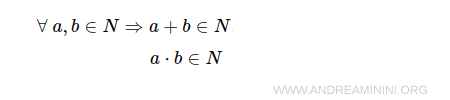
- The natural numbers are closed under addition and multiplication
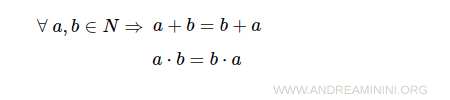
- Commutative property of addition and multiplication
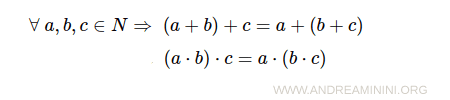
- Associative property of addition and multiplication
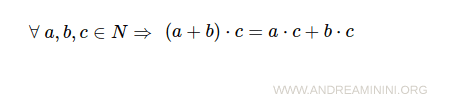
- Distributive property of multiplication over addition
- Existence of a multiplicative identity

To fully characterize the set of nonnegative integers, one additional axiom is required.
- Axiom of the additive identity.
Adding zero to any nonnegative integer leaves the number unchanged. $$ \exists \ 0 \in N_0 \ | \ \forall \ a \in N_0 \Rightarrow a+0=a $$Example. The sum 5+0 equals 5. $$ 5+0 = 5 $$
Useful observations
Some useful remarks concerning the nonnegative integers.
- The additive identity is zero
Every nonnegative integer added to zero remains unchanged. $$ \forall \ a \in N_0 \Rightarrow a + 0 = a $$ - The additive identity is unique
No element other than zero serves as an additive identity.Proof. We establish the uniqueness of the additive identity by contradiction. There are two possible cases:
1) the additive identity is unique
2) the additive identity is not unique
Assume that there exists a second additive identity ε, distinct from zero. Then the condition $$ \exists \ \epsilon \in N_0 \ | \ \forall \ a \in N_0 \Rightarrow a + \epsilon = a $$ would hold, together with $$ \exists \ 0 \in N_0 \ | \ \forall \ a \in N_0 \Rightarrow a + 0 = a $$ Since both are assumed to be additive identities, adding zero to any element of N yields the same element: $$ a+0=a $$ Similarly, adding ε to any element of N also yields the same element: $$ a+ \epsilon = a $$ Now consider a=ε and add zero: $$ a+0=\epsilon + 0 = \epsilon $$ Next, consider a=0 and add ε: $$ a+\epsilon = 0 + \epsilon = 0 $$ By the commutative property of addition for the natural numbers, x+y=y+x, and therefore $$ \epsilon + 0 = 0 + \epsilon $$ Since ε+0=ε and 0+ε=0, it follows that $$ \underbrace{ \epsilon + 0 }_{\epsilon} = \underbrace{0 + \epsilon}_0 $$ which implies $$ \epsilon = 0 $$ Hence ε coincides with zero. Therefore, in the set of nonnegative integers N0, zero is the unique additive identity. This completes the proof. - Any nonnegative integer multiplied by zero equals zero $$ \forall \ a \in N_0 \Rightarrow a \cdot 0 = 0 $$
Proof. By the fifth axiom of the natural numbers, multiplying any natural number by 1 leaves it unchanged, since 1 is the multiplicative identity. $$ a = a \cdot 1 $$ Using the sixth axiom for N0, we rewrite 1 as 1+0. $$ a = a \cdot 1 = a \cdot (1 + 0) $$ Applying the distributive property (fourth axiom), we obtain $$ a = a \cdot 1 = a \cdot (1 + 0) = a \cdot 1 + a \cdot 0 $$ Since 1 is the multiplicative identity (fifth axiom), we have a·1=a. $$ a = a \cdot 1 = a \cdot (1 + 0) = a \cdot 1 + a \cdot 0 = a + a \cdot 0 $$ This yields $$ a = a + a \cdot 0 $$ For the equality a=a to hold, the term a·0 must act as the additive identity. $$ a = a+\underbrace{a \cdot 0}_0 $$ Because the additive identity is unique and equal to zero, it follows that $$ a \cdot 0 = 0 $$ Therefore, any nonnegative integer multiplied by zero is equal to zero. $$ \forall \ a \in N_0 \Rightarrow a \cdot 0 = 0 $$
And so on.


