Principle of Communicating Vessels
Communicating vessels are interconnected containers in which a liquid, at hydrostatic equilibrium, settles at the same level in all branches, provided that the pressure at the free surface is the same and the liquid is homogeneous, that is, it has the same density.
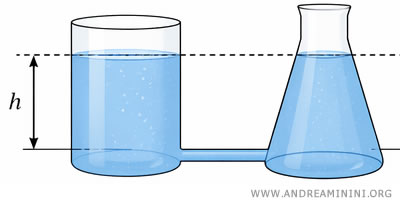
Consider two containers connected by a tube and filled with the same liquid of density \( d \).
When the containers are open to the atmosphere, the pressure at the free surface \( p_0 \) is the same in both, and the liquid settles at the same height \( h \).
Why does this happen?
The pressure in a liquid at rest depends on depth according to the hydrostatic relation:
\[ p = p_0 + dgh \]
Here, \( p_0 \) is the pressure at the free surface, \( d \) is the density of the liquid, \( g \) is the acceleration due to gravity, and \( h \) is the depth measured from the free surface.
The liquid reaches the same level because, at a given depth \( h \), the pressure at the bottom is the same in both branches.
As a result, there is no net force acting on the fluid in the connecting tube, so the liquid remains at rest.
What happens if the levels are different?
If the two branches have different levels, then the depths \( h \) are different.
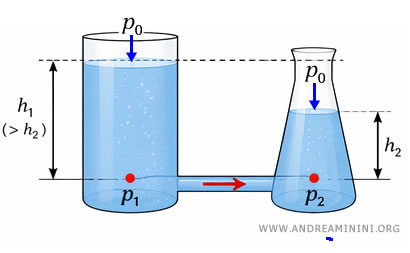
In this case, the pressure at the bottom is no longer the same ( \( p_1 > p_2 \) ). In the branch with the higher level ( \( h_1 > h_2 \) ), the pressure is greater.
\[ p_1 = p_0 + dgh_1 \]
\[ p_2 = p_0 + dgh_2 \]
This pressure difference generates a net force that drives the liquid from the branch with the higher level toward the one with the lower level.
The flow continues until the levels become equal and hydrostatic equilibrium is restored ( \( p_1 = p_2 \) ).
\[ p_0 + dgh_1 = p_0 + dgh_2 \]
Since the liquid is the same in both containers, the density \( d \) is identical. The acceleration due to gravity \( g \) and the pressure at the free surface \( p_0 \) are also the same.
\[ \require{cancel} \cancel{p_0} + \cancel{dg}h_1 = \cancel{p_0} + \cancel{dg} h_2 \]
Equilibrium is reached when the pressure is the same at the same depth in both branches.
\[ h_1 = h_2 \]
In other words, when the liquid reaches the same level in both containers.
Note. The principle of communicating vessels accounts for many everyday phenomena. For example, aqueduct systems distribute water based on this principle, fluid levels in pipelines naturally equalize, and interconnected tanks maintain the same liquid level.
Practical example
Consider two containers of different shapes connected by a tube at the base.
In the first container, the water level is 20 cm, while in the second it is 10 cm.
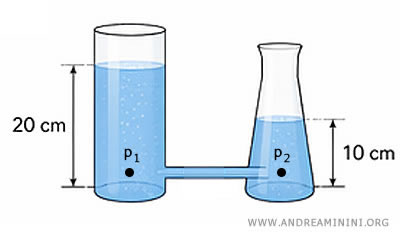
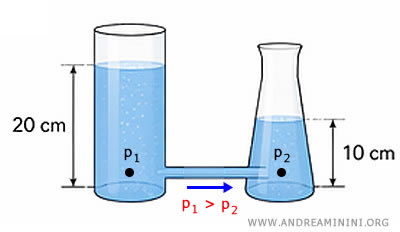
The pressure at the bottom of the first container is greater ( \( p_1 > p_2 \) ), so the water flows toward the second container.
The flow stops only when both containers reach the same level, for example 17 cm.
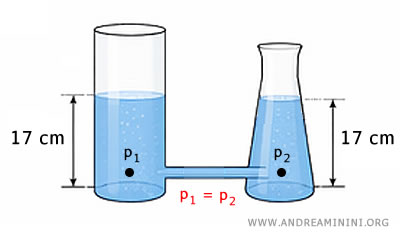
This shows that the shape of the container does not affect the final level, which depends only on the balance of pressures.
Note. The final level depends on the total amount of liquid and on the geometry of the containers. It coincides with the average of the initial levels only if the two containers have the same cross-sectional area. In this example, the container that initially has the higher level is also larger, so the final level (17 cm) is closer to 20 cm than to 10 cm. If the containers were identical, the final level would be 15 cm, that is, the average of the initial levels.
Principle of Communicating Vessels (Immiscible Liquids)
In communicating vessels containing immiscible liquids at equilibrium, the heights of the liquid columns are inversely proportional to their densities. $$ \frac{h_1}{h_2} = \frac{d_2}{d_1} $$
This implies that, when immiscible liquids are present, the fluid levels in the communicating vessels do not align.
It is important to note that this relationship holds only for immiscible liquids, such as water and oil.
When the liquids are miscible, they merge into a single homogeneous fluid. In that situation, it is no longer meaningful to treat the system as consisting of two distinct columns with different densities and, at equilibrium, the free surface of the fluid is at the same level in both branches of the communicating vessels.
Example
Consider two communicating vessels filled with water. Since the same liquid occupies both branches, the levels are identical.
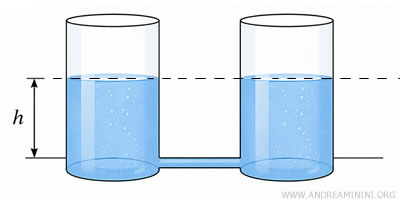
Now suppose oil is poured into one of the vessels. The levels will no longer be equal.
The vessel into which the oil is poured rises by $ h_2 = 5.00 \ cm $, whereas the other vessel, containing only water, rises by a smaller amount ( $ h_1 < h_2 $ ).
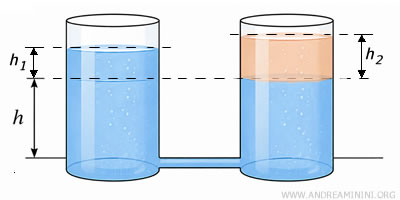
By how much does the level $ h_1 $ increase, given that the densities of water and oil are:
$$ d_{acqua} = 1.00 \cdot 10^3 \ kg/m^3 $$
$$ d_{olio} = 9.20 \cdot 10^2 \ kg/m^3 $$
To determine this, apply the principle of communicating vessels:
$$ \frac{h_1}{h_2} = \frac{d_2}{d_1} $$
Solving for $ h_1 $:
$$ h_1 = h_2 \cdot \frac{d_2}{d_1} $$
Since the oil level is $ h_2 = 5.00 \ cm $, that is $ h_2 = 0.05 \ m $:
$$ h_1 = (0.05 \ m) \cdot \frac{d_2}{d_1} $$
Substituting the density values for water $ d_1=d_{acqua} $ and oil $ d_2=d_{olio} $:
$$ h_1 = (0.05 \ m) \cdot \frac{9.20 \cdot 10^2 \ kg/m^3}{1.00 \cdot 10^3 \ kg/m^3} $$
Simplifying:
$$ h_1 = (0.05 \ m) \cdot \frac{9.20}{1.00 \cdot 10} $$
$$ h_1 = (0.05 \ m) \cdot 0.92 $$
$$ h_1 = 0.046 \ m $$
Thus, the level in the vessel containing water rises by 4.6 cm, which is lower than the oil level (5 cm).
Derivation
Consider two communicating vessels containing immiscible liquids.
Select two points A and B at the same height in the two branches. Under equilibrium conditions, the pressure at these points must be equal:
$$ p_1 = p_2 $$
The pressure in a fluid depends on the depth ( $ h $ ), the density ( $ d $ ), the gravitational acceleration ( $ g $ ), and the atmospheric pressure ( $ p_0 $ ), according to the relation
$$ p = p_0 + dgh $$
Therefore:
$$ p_1 = p_0 + d_1 h_1 g $$
$$ p_2 = p_0 + d_2 h_2 g $$
Substituting these expressions into the equation $ p_1 = p_2 $:
$$ p_0 + d_1 h_1 g = p_0 + d_2 h_2 g $$
The atmospheric pressure is the same on both sides, so subtract $ p_0 $ from each member:
$$ p_0 + d_1 h_1 g - p_0 = p_0 + d_2 h_2 g - p_0 $$
$$ d_1 h_1 g = d_2 h_2 g $$
The gravitational acceleration ( $ g $ ) is also identical in both cases, so divide both sides by $ g $:
$$ \frac{d_1 h_1 g}{g} = \frac{d_2 h_2 g}{g} $$
$$ d_1 h_1 = d_2 h_2 $$
Rearranging, with heights on the left and densities on the right, yields the principle of communicating vessels:
$$ \frac{h_1}{h_2} = \frac{d_2}{d_1} $$
As required.
And so on.