
Stevin’s Law (Hydrostatic Pressure Law)
In a fluid at rest, pressure increases with depth $$ p = p_{at} + \rho g h $$ where \( p \) is the pressure at depth \( h \), \( p_{at} \) is the atmospheric pressure, \( \rho \) is the fluid density, \( g \) is the acceleration due to gravity, and \( h \) is the depth.
Stevin’s law describes how pressure varies within a fluid at rest.
Pressure increases linearly with depth, depends on the fluid density, and is independent of the shape of the container.
This is because pressure arises from two contributions: the atmospheric pressure acting on the fluid surface and the weight of the fluid itself.
Pressure does not depend on the shape of the container. This law establishes a fundamental result: pressure depends only on depth and density, not on the container’s shape. As a consequence, the behavior of the fluid is independent of the geometry of the container. For example, consider two containers, one wide and shallow, the other narrow and tall. If the liquid level is the same ( $ h $ ), the pressure at the bottom is the same in both cases. What matters is only the height of the fluid column, not the total volume of fluid or the shape of the container.
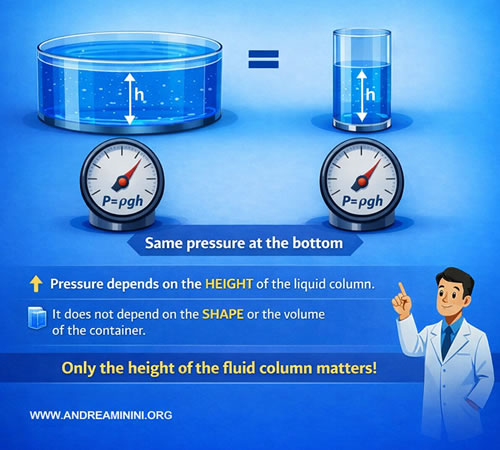
Pressure increases with depth because the weight of the fluid above increases. Greater depth means a larger mass of fluid above, and therefore a greater force and higher pressure.
Derivation
A fluid exerts pressure because it has mass and therefore weight.
At any point within the liquid, the pressure is due to the column of fluid above that point, which exerts a downward force.
Thus, the total pressure at a given point in the fluid is the sum of two contributions:
- the atmospheric pressure acting on the surface
- the weight of the fluid above the point considered
Consider a cylindrical column of fluid with base \( A \) and height \( h \).
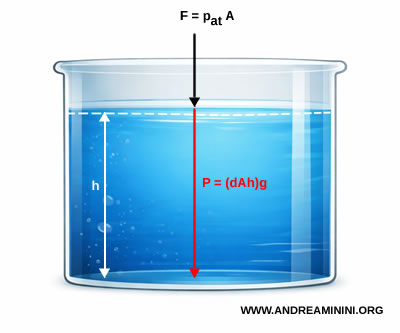
The volume of the fluid is
$$ V = A h $$
Since volume is related to mass and density by $ V = \frac{m}{\rho} $, it follows that the mass of the fluid is
$$ m = \rho V = \rho A h $$
Since weight is the product of mass ( $ m $ ) and gravitational acceleration ( $ g $ ), that is $ W = m g $, the weight of the fluid is
$$ W = m g = \rho A h g $$
Therefore, the force acting on the base is the sum of the atmospheric force on the surface and the weight of the fluid.
$$ F = p_{at} A + \rho A h g $$
Dividing the force ( $ F $ ) by the area ( $ A $ ), we obtain the pressure inside the container \( p = \frac{F}{A} \):
$$ \frac{F}{A} = \frac{ p_{at} A + \rho A h g}{A} $$
$$ p = \frac{F}{A} = p_{at} + \rho g h $$
As required.
Practical example
A diver descending in water experiences an increase in pressure.
As a rule of thumb, for every 10 meters of depth, pressure increases by approximately \( +1 \) atmosphere ( \( atm \) ).
At the water surface, the pressure is equal to 1 atmosphere \( 1 \ atm \), which corresponds to atmospheric pressure, that is, the pressure exerted by the air on the water surface.
$$ 1 \ atm \approx 1.013 \cdot 10^5 \ Pa $$
Thus, at a depth of 10 meters the pressure is about 2 atmospheres, at 20 m about 3 atmospheres, at 30 m about 4 atmospheres, and so on.
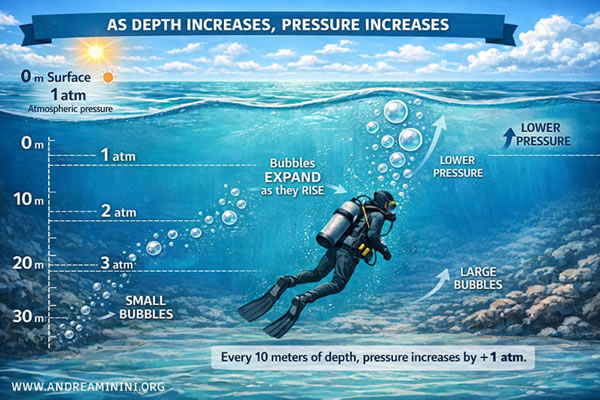
When the diver releases air bubbles, they rise toward the surface.
Their volume, however, does not remain constant. At greater depths, the bubbles have a smaller volume because they are subjected to higher external pressure.
As they rise, the volume of the bubbles increases because the external pressure decreases and the gas expands.
Pressure difference between two points separated by Δh
The pressure difference between two points at different heights is proportional to the fluid density and the height difference $ \Delta h $ $$ p_2 - p_1 = \rho \cdot g \cdot \Delta h $$ where \( \rho \) is the fluid density and \( g \) is the acceleration due to gravity.
This result describes how pressure varies within a fluid at rest when considering two points at different depths.
Derivation
Consider two points in the fluid at different depths.
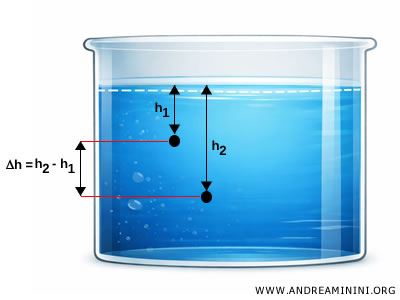
If point 2 is deeper than point 1, then the pressure \( p_2 \) is greater than \( p_1 \), because the deeper point is subjected to the weight of a taller column of fluid.
$$ p_1 = p_{at} + \rho g h_1 $$
$$ p_2 = p_{at} + \rho g h_2 $$
The pressure difference between these two points is:
$$ p_2 - p_1 = ( p_{at} + \rho g h_2 ) - ( p_{at} + \rho g h_1 ) $$
$$ p_2 - p_1 = p_{at} + \rho g h_2 - p_{at} - \rho g h_1 $$
$$ p_2 - p_1 = \rho g (h_2 - h_1) $$
Since the depth difference is $ \Delta h = h_2 - h_1 $
$$ p_2 - p_1 = \rho g \Delta h $$
As required.
Example
Consider a container filled with water. Water has a density of \( \rho = 1000 \ kg/m^3 \).
At a depth of 10 meters, the pressure is:
$$ p_1 = \rho g h \approx 1000 \ kg/m^3 \cdot 9.8 \ N/kg \cdot 10 \ m = 98000 \ N/m^2 = 98000 \ Pa $$
At a depth of 30 meters, the pressure is:
$$ p_2 = \rho g h \approx 1000 \ kg/m^3 \cdot 9.8 \ N/kg \cdot 30 \ m = 294000 \ N/m^2 = 294000 \ Pa $$
Therefore, the pressure difference is
$$ p_2 - p_1 = 294000 \ Pa - 98000 \ Pa = 196000 \ Pa $$
The same result can be obtained directly using the formula, noting that the depth difference between the two points is $ \Delta h = 30 - 10 = 20 \ m $
$$ p_2 - p_1 = \rho \cdot g \cdot \Delta h $$
$$ p_2 - p_1 = 1000 \ kg/m^3 \cdot 9.8 \ N/kg \cdot 20 \ m = 196000 \ N/m^2 = 196000 \ Pa $$
Example 2
A sphere with a radius of 20 cm is fully immersed in a liquid. The pressure at the top of the sphere is $ p_1 = 105.2 \ kPa $, while at the bottom it is $ p_2 = 107.2 \ kPa $. Determine the density of the liquid.
In a fluid at rest, pressure increases with depth according to the relation:
$$ p_2 - p_1 = \rho g \Delta h $$
Solving for the density gives:
$$ \rho = \frac{p_2 - p_1}{g \cdot \Delta h} $$
In this case, the pressure difference is:
$$ \Delta p = p_2 - p_1 = (107.2 - 105.2) \ kPa = 2 \ kPa = 2 \cdot 10^3 \ Pa $$
The acceleration due to gravity is:
$$ g = 9.81 \ N \, kg^{-1} $$
Since the sphere has a radius of 20 cm, its diameter is 40 cm. Therefore, the vertical distance between the two points is:
$$ \Delta h = 40 \ cm = 0.4 \ m $$
Substituting the values into the equation:
$$ \rho = \frac{p_2 - p_1}{g \cdot \Delta h} $$
$$ \rho = \frac{2 \cdot 10^3 \ Pa}{(9.81 \ N \, kg^{-1}) \cdot (0.4 \ m)} $$
$$ \rho = \frac{2 \cdot 10^3}{9.81 \cdot 0.4} \ \frac{Pa}{m \, N \, kg^{-1}} $$
$$ \rho = 509 \ \frac{kg \, Pa}{m \, N} $$
Now convert the pressure unit using $ Pa = N/m^2 = N \, m^{-2} $:
$$ \rho = 509 \ \frac{kg \, (N \, m^{-2})}{m \, N} $$
$$ \rho = 509 \ kg \, m^{-3} $$
The density of the liquid is therefore approximately:
$$ \rho \approx 5.1 \cdot 10^2 \ kg/m^3 $$
This value is about half the density of water ( $ \rho_{water} = 1000 \ kg/m^3 $ ), which indicates that the liquid is significantly less dense, for instance it could be comparable to an oil.
And so on.


