
Solved exercises on rings
Some worked exercises on rings
Exercise 1
We aim to determine whether the set of integers Z5 = {0, 1, 2, 3, 4}, equipped with addition and multiplication modulo 5, forms a ring:
$$ (Z_5 ,+_5, \cdot_5) $$
Since Z5 is a finite set, we can explicitly construct its addition table:
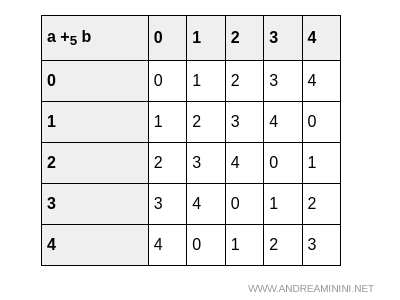
And similarly, the multiplication table:
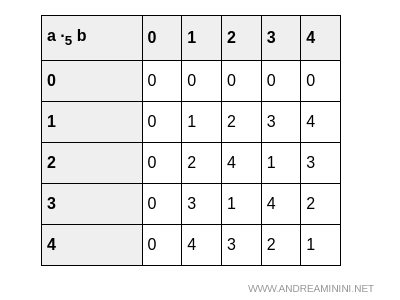
Both operations are closed on Z5, fulfilling the first requirement for a ring.
We now proceed to verify whether the remaining ring axioms are satisfied.
The First Operation: Addition (+5)
Modulo 5 addition on Z5 is commutative:
$$ a +_5 b = b +_5 a \quad \forall \ a, b \in Z_5 $$
It is also associative:
$$ (a +_5 b) +_5 c = a +_5 (b +_5 c) \quad \forall \ a, b, c \in Z_5 $$
The additive identity is 0:
$$ a +_5 0 = 0 +_5 a = a \quad \forall \ a \in Z_5 $$
Every element in Z5 has an additive inverse. For example:
0 + 0 = 0, 1 + 4 = 0, 2 + 3 = 0, and so on.
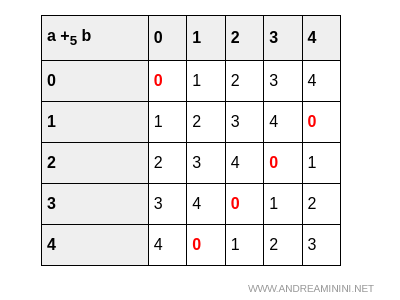
Therefore, all the axioms for the additive structure of a ring are satisfied.
Note: The structure (Z5, +) forms a group since Z5 is non-empty, addition modulo 5 is closed and associative, has an identity element (0), and each element has an inverse. Furthermore, because addition is commutative, (Z5, +) is an abelian group, satisfying the first fundamental requirement for a ring.
The Second Operation: Multiplication (·5)
Modulo 5 multiplication on Z5 is associative:
$$ (a \cdot_5 b) \cdot_5 c = a \cdot_5 (b \cdot_5 c) \quad \forall \ a, b, c \in Z_5 $$
It also distributes over addition, both from the left and from the right:
$$ (a +_5 b) \cdot_5 c = a \cdot_5 c +_5 b \cdot_5 c \quad \forall \ a, b, c \in Z_5 $$
$$ a \cdot_5 (b +_5 c) = a \cdot_5 b +_5 a \cdot_5 c \quad \forall \ a, b, c \in Z_5 $$
Thus, all the ring axioms pertaining to multiplication are satisfied.
Conclusion
Since both operations satisfy the required axioms, we conclude that:
The algebraic structure (Z5, +, ·) is a ring.
Exercise 2
We wish to determine whether the function \( f(x) = |x| \) defines a ring homomorphism between the rings \( (\mathbb{Z}, +, \cdot) \) and \( (\mathbb{Z}', +, \cdot) \), where \( \mathbb{Z} = \mathbb{Z}' \).
We begin by checking whether \( f \) preserves multiplication, as required for a ring homomorphism:
$$ f(a \cdot b) = f(a) \cdot f(b) $$
$$ |a \cdot b| = |a| \cdot |b| $$
This equality always holds, since the absolute value of a product equals the product of the absolute values.
Note: On the left-hand side, the absolute value of the product is always non-negative. On the right-hand side, the product of two non-negative numbers (i.e., the absolute values) is also non-negative. Therefore, the two expressions agree.
Next, we examine whether \( f \) preserves addition:
$$ f(a + b) = f(a) + f(b) $$
$$ |a + b| = |a| + |b| $$
This identity does not hold in general - specifically, it fails whenever \( a \) and \( b \) have opposite signs.
For instance, consider \( a = 2 \) and \( b = -3 \):
$$ |2 + (-3)| \ne |2| + |-3| $$
$$ |-1| \ne 2 + 3 $$
$$ 1 \ne 5 $$
Since the function fails to preserve addition, it does not satisfy the defining properties of a ring homomorphism.
We conclude that the function \( f(x) = |x| \) is not a ring homomorphism from \( (\mathbb{Z}, +, \cdot) \) to \( (\mathbb{Z}', +, \cdot) \).
Exercise 3
Is the set of integers Z6 = {0, 1, 2, 3, 4, 5} a ring, with addition defined as modulo 6 addition and multiplication defined as modulo 6 multiplication?
$$ (Z_6 ,+_6, \cdot_6) $$
Since Z6 is a finite set, we begin by constructing the addition table:
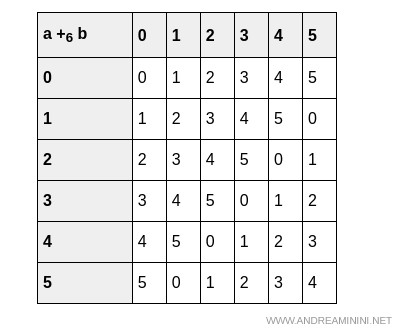
And now the multiplication table:
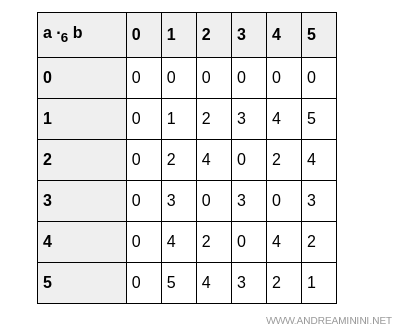
Both addition and multiplication are binary operations that are closed on Z6, so the first requirement for a ring is satisfied.
Let’s now verify whether the remaining ring axioms hold.
The First Operation (+6)
Addition modulo 6 is commutative on Z6:
$$ a +_6 b = b +_6 a \quad \forall \ a, b \in Z_6 $$
It is also associative:
$$ (a +_6 b) +_6 c = a +_6 (b +_6 c) \quad \forall \ a, b, c \in Z_5 $$
The additive identity is 0:
$$ a +_5 0 = 0 +_5 a = a \quad \forall \ a \in Z_5 $$
Moreover, every element in Z6 has an additive inverse.
For example: 0 + 0 = 0, 1 + 5 = 0, 2 + 4 = 0, 3 + 3 = 0, etc.
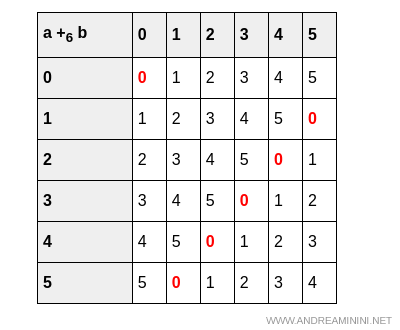
Therefore, the addition operation satisfies all the axioms required of a ring.
Note. The structure (Z6, +) forms a group, as Z6 is non-empty, addition modulo 6 is closed and associative, there exists an identity element (0), and each element has an inverse. Since addition is also commutative, (Z6, +) is in fact an abelian group.
The Second Operation (·6)
Multiplication modulo 6 is associative over Z6:
$$ (a \cdot_6 b) \cdot_6 c = a \cdot_6 (b \cdot_6 c) \quad \forall \ a, b, c \in Z_6 $$
It also satisfies the distributive laws with respect to addition:
$$ (a +_6 b) \cdot_6 c = a \cdot_6 c +_6 b \cdot_6 c \quad \forall \ a, b, c \in Z_6 $$
$$ a \cdot_6 (b +_6 c) = a \cdot_6 b +_6 a \cdot_6 c \quad \forall \ a, b, c \in Z_6 $$
Hence, the multiplication operation meets all the ring requirements.
Conclusion
To conclude, both binary operations satisfy the axioms of a ring.
Therefore, we can affirm that the algebraic structure (Z6, +, ·) is a ring.
Exercise 4
We want to determine whether the function f(x) = 3x defines a ring homomorphism between the rings (Z6, +, *) and (Z6', +, *), where both addition and multiplication are taken modulo 6.
As a first step, let’s construct the addition table modulo 6.
Now let’s build the multiplication table modulo 6.
We now verify whether the function satisfies the first condition for being a ring homomorphism:
$$ f(a + b) = f(a) + f(b) $$
Since f(x) = 3x, we have:
$$ 3 \cdot (a + b) = 3a + 3b $$
This identity holds true modulo 6, so the function preserves addition.
Next, we test whether f(x) also preserves multiplication:
$$ f(a \cdot b) = f(a) \cdot f(b) $$
Substituting again:
$$ 3 \cdot (a \cdot b) = 3a \cdot 3b $$
By associativity and modular arithmetic, the equality is verified.
Therefore, the function f(x) = 3x is a ring homomorphism from (Z6, +, *) to itself.
Verification
Since we are working with a small, finite ring, it’s useful to explicitly display the tables for the homomorphism to confirm the result.
For addition, both 3(a + b) and 3a + 3b yield the same table:
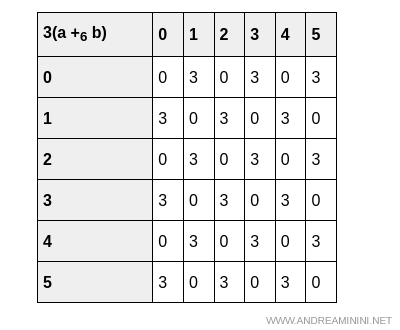
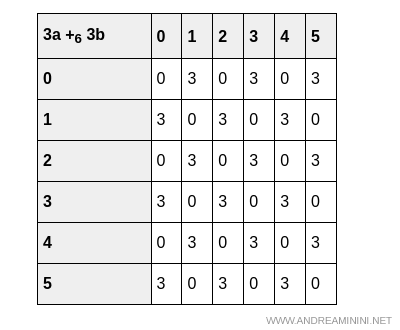
Even in the case of multiplication, the two tables $3(a \cdot b)$ and $(3a) \cdot (3b)$ yield the same result.
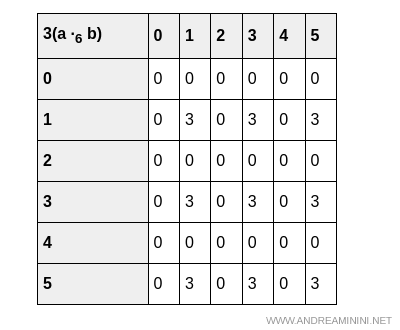
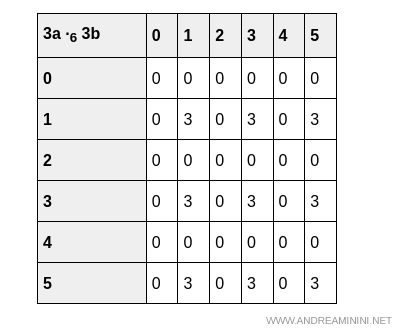
This thorough verification fully confirms the previous solution.
The mapping $f(x) = 3x$ defines a ring homomorphism between the rings $(\mathbb{Z}_6, +, \cdot)$ and $(\mathbb{Z}_6, +, \cdot)$.


