
Exponential Function Analysis Exercise 11
In this exercise, we analyze the behavior of the exponential function
$$ f(x) = \frac{x}{e^x} $$
We begin by determining its domain.
Domain
The exponential function \( e^x \) is never zero for any real number. Therefore, the domain of \( f(x) \) is the entire real line:
$$ D_f = ( -\infty , \infty ) $$
Points of Discontinuity
The function is defined and continuous over all real numbers, so it has no points of discontinuity.
Horizontal Asymptotes
We first examine the behavior of the function as \( x \to +\infty \):
$$ \lim_{x \to \infty} \frac{x}{e^x} = \frac{\infty}{\infty} $$
This is an indeterminate form. To evaluate the limit, we apply L’Hôpital’s Rule:
$$ \lim_{x \to \infty} \frac{1}{e^x} = 0^+ $$
Therefore, the function tends to zero as \( x \to +\infty \):
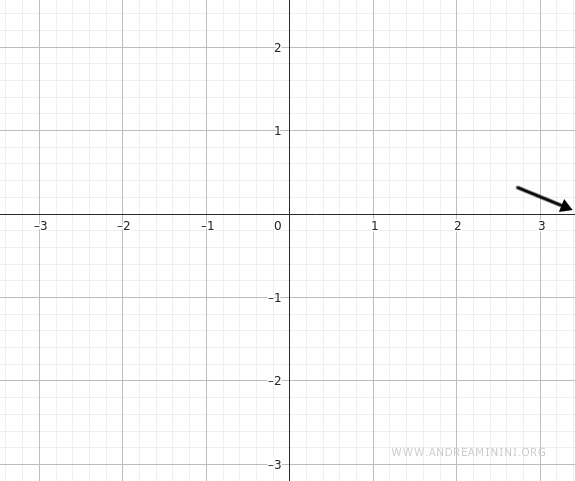
Now we consider the limit as \( x \to -\infty \):
$$ \lim_{x \to -\infty} \frac{x}{e^x} = \frac{-\infty}{0^+} = -\infty $$
So the function diverges to negative infinity as \( x \to -\infty \).
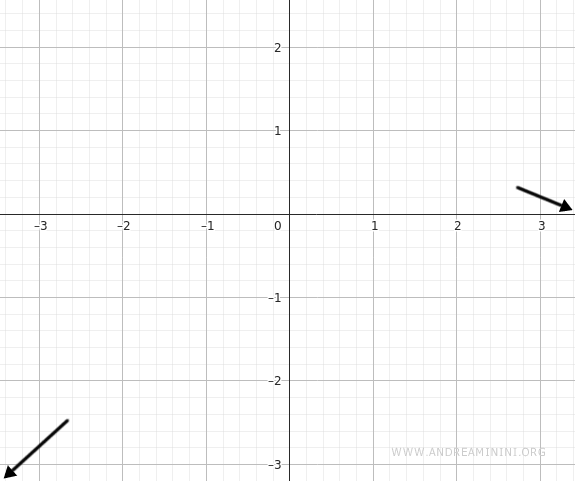
Vertical Asymptotes
Since the function is defined for all real values of \( x \), there are no vertical asymptotes.
Intercepts
To find the y-intercept, we evaluate the function at \( x = 0 \):
$$ f(0) = \frac{0}{e^0} = \frac{0}{1} = 0 $$
Thus, the graph passes through the origin: (0, 0)
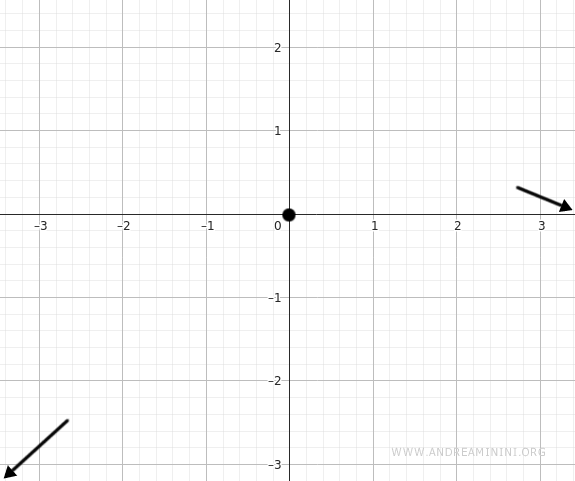
To find any x-intercepts, we solve:
$$ \frac{x}{e^x} = 0 $$
Multiplying both sides by \( e^x \):
$$ x = 0 $$
The function intersects the x-axis only at the origin.
Sign Analysis
We now analyze the sign of the function:
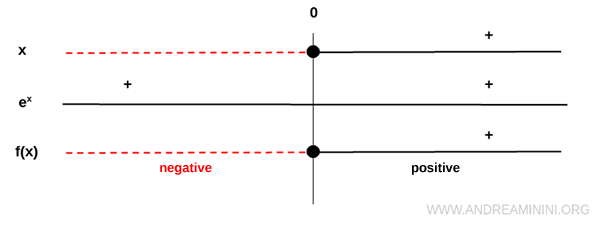
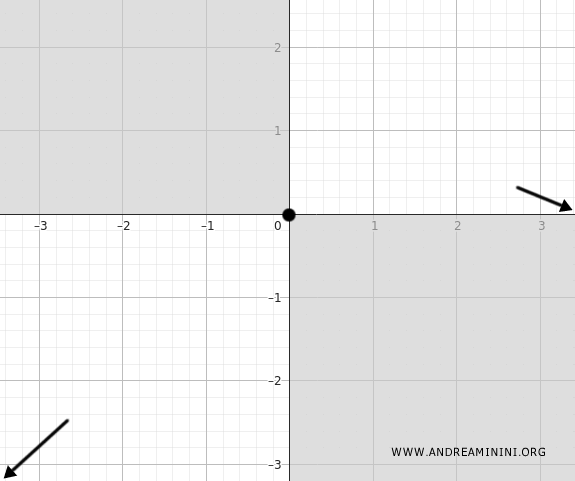
The denominator \( e^x \) is always positive, while the numerator \( x \) is positive only when \( x > 0 \).
Therefore, \( f(x) \) is negative for \( x < 0 \), and positive for \( x > 0 \).
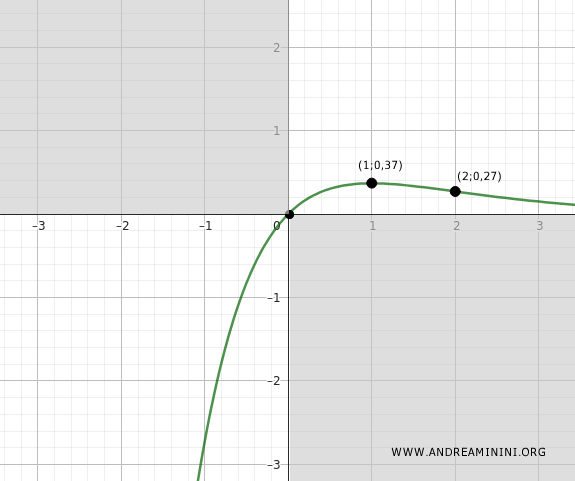
This allows us to exclude the quadrants the function cannot occupy.
Increasing and Decreasing Behavior
To determine where the function is increasing or decreasing, we compute its first derivative:
$$ f'(x) = D_x\left[ \frac{x}{e^x} \right] = \frac{e^x - x e^x}{(e^x)^2} = \frac{1 - x}{e^x} $$
Alternatively, expressing the function as \( f(x) = x \cdot e^{-x} \), we can apply the product rule: $$ f'(x) = D_x[x] \cdot e^{-x} + x \cdot D_x[e^{-x}] = e^{-x} - x e^{-x} = e^{-x}(1 - x) = \frac{1 - x}{e^x} $$
Now we examine the sign of \( f'(x) \):
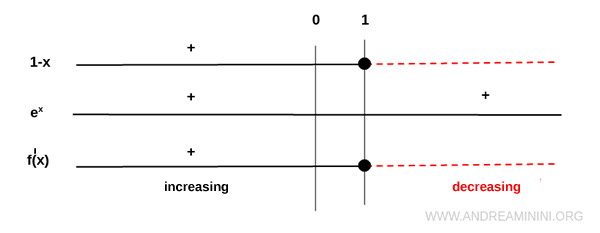
The derivative is positive when \( x < 1 \) and negative when \( x > 1 \), so the function increases on \( (-\infty, 1) \) and decreases on \( (1, \infty) \).
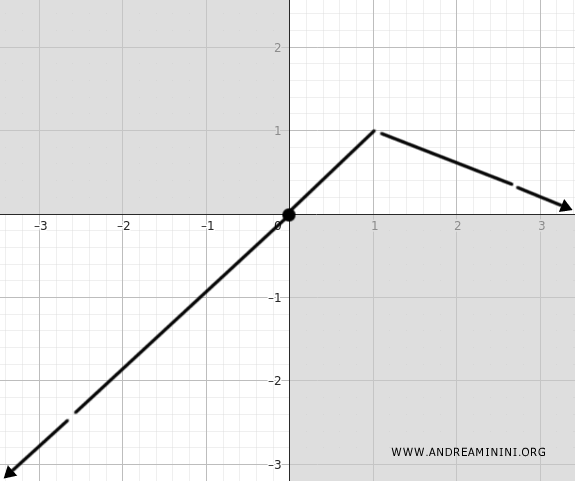
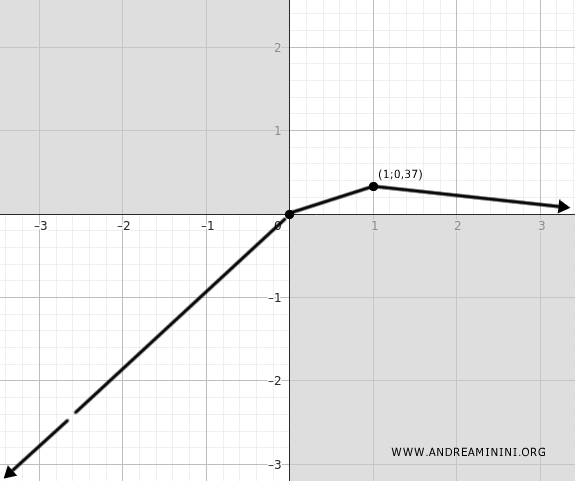
At \( x = 1 \), the derivative vanishes and changes sign from positive to negative. Therefore, the function attains a local maximum at that point.
To find its coordinates, evaluate the function at \( x = 1 \):
$$ f(1) = \frac{1}{e} \approx 0.37 $$
The local maximum occurs at (1, 0.37).
Concavity, Convexity, and Inflection Points
To study the concavity of the function and locate possible inflection points, we compute the second derivative:
$$ f''(x) = D_x\left[ \frac{1 - x}{e^x} \right] = \frac{-e^x - (1 - x) e^x}{(e^x)^2} $$
$$ = \frac{-2e^x + x e^x}{(e^x)^2} = \frac{e^x(x - 2)}{(e^x)^2} = \frac{x - 2}{e^x} $$
We now analyze the sign of the second derivative:
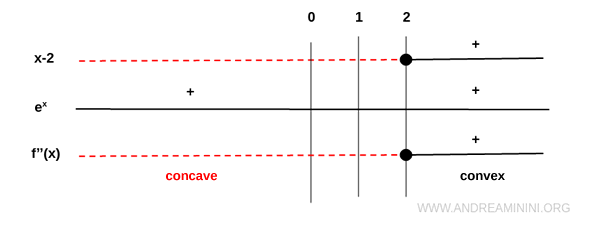
The second derivative is negative for \( x < 2 \) (indicating concavity) and positive for \( x > 2 \) (indicating convexity).

At \( x = 2 \), \( f''(x) = 0 \) and changes sign, so an inflection point occurs there.
To find the y-coordinate, evaluate the function at \( x = 2 \):
$$ f(2) = \frac{2}{e^2} \approx 0.27 $$
The point of inflection is at (2, 0.27).
And the analysis continues.


