Worked Example Function Analysis 3
In this example, we will analyze the following function:
$$ f(x) = \frac{x^2 + 2}{x} $$
Domain
The function is defined for all real numbers except \( x = 0 \), where the denominator vanishes:
$$ D_f = (-\infty, 0) \cup (0, +\infty) $$
Undefined Points
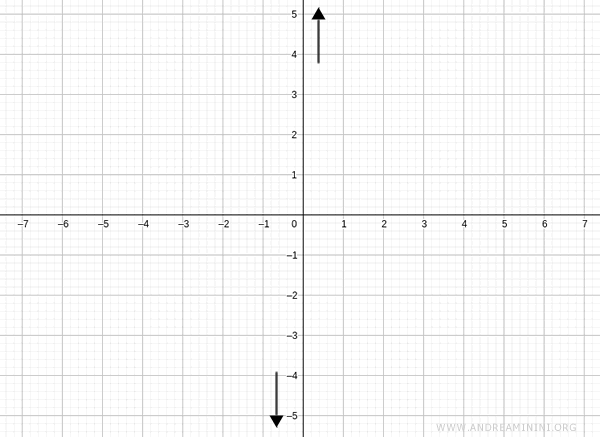
The point \( x = 0 \) is undefined and corresponds to a vertical asymptote.
Let us compute the one-sided limits:
$$ \lim_{x \to 0^+} \frac{x^2 + 2}{x} = +\infty $$
$$ \lim_{x \to 0^-} \frac{x^2 + 2}{x} = -\infty $$
Thus, as \( x \to 0 \), the function tends to \( +\infty \) from the right and \( -\infty \) from the left:
Asymptotic Behavior
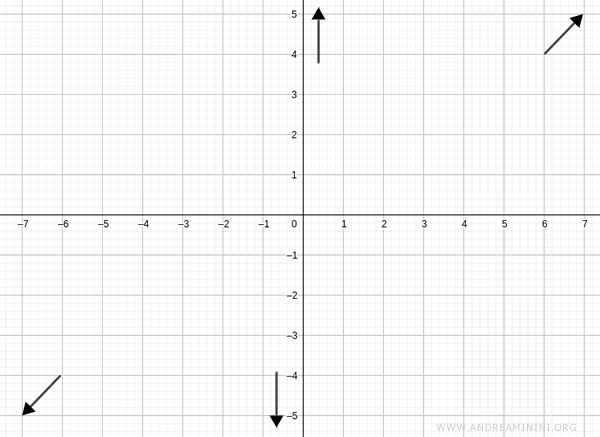
We now examine the limits as \( x \to +\infty \) and \( x \to -\infty \):
$$ \lim_{x \to +\infty} \frac{x^2 + 2}{x} = +\infty $$
$$ \lim_{x \to -\infty} \frac{x^2 + 2}{x} = -\infty $$
Therefore, as \( x \to +\infty \), \( f(x) \to +\infty \), and as \( x \to -\infty \), \( f(x) \to -\infty \):
Intercepts with the Axes
At \( x = 0 \), the function is undefined:
$$ f(0) = \frac{0^2 + 2}{0} $$
To find any x-intercepts, we solve:
$$ \frac{x^2 + 2}{x} = 0 $$
Multiplying both sides by \( x \):
$$ x^2 + 2 = 0 $$
$$ x^2 = -2 $$
This equation has no real solutions. Thus, the graph does not intersect the x-axis.
Sign Analysis
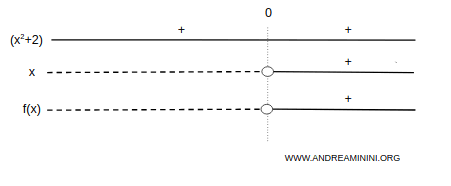
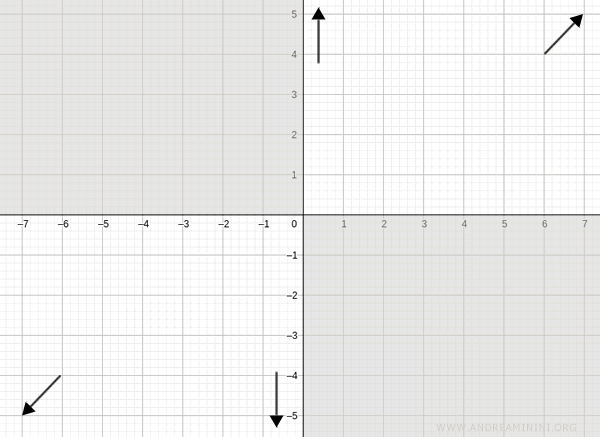
The function is negative on \( (-\infty, 0) \), and positive on \( (0, +\infty) \):
We can therefore exclude regions of the plane where the function does not take any values (shaded regions):
Monotonicity
We compute the first derivative:
$$ f'(x) = D\left[ \frac{x^2 + 2}{x} \right] = \frac{2x \cdot x - (x^2 + 2)}{x^2} = \frac{x^2 - 2}{x^2} $$
We analyze the sign of \( f'(x) \):
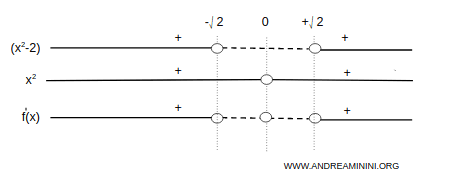
The function is increasing on \( (-\infty, -\sqrt{2}) \) and \( (\sqrt{2}, +\infty) \), and decreasing on \( (-\sqrt{2}, \sqrt{2}) \):
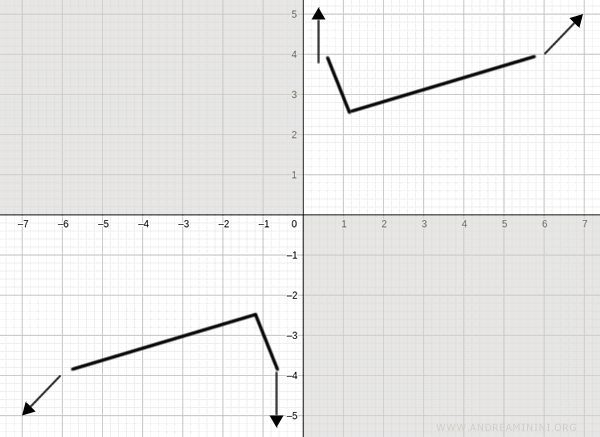
At \( x = -\sqrt{2} \), the function has a local maximum, since \( f'(x) = 0 \) and the derivative changes from positive to negative:
$$ \left( -\sqrt{2}, f(-\sqrt{2}) \right) = \left( -\sqrt{2}, \frac{(-\sqrt{2})^2 + 2}{-\sqrt{2}} \right) = \left( -\sqrt{2}, -\frac{4}{\sqrt{2}} \right) $$
At \( x = \sqrt{2} \), the function has a local minimum, since \( f'(x) = 0 \) and the derivative changes from negative to positive:
$$ \left( \sqrt{2}, f(\sqrt{2}) \right) = \left( \sqrt{2}, \frac{(\sqrt{2})^2 + 2}{\sqrt{2}} \right) = \left( \sqrt{2}, \frac{4}{\sqrt{2}} \right) $$
Concavity and Convexity
We now compute the second derivative:
$$ f''(x) = D\left[ \frac{x^2 - 2}{x^2} \right] $$
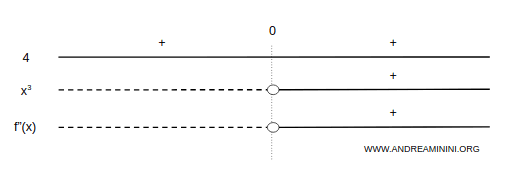
$$ = \frac{2x(x^2) - (x^2 - 2)(2x)}{x^4} = \frac{4x}{x^4} = \frac{4}{x^3} $$
The function is concave on \( (-\infty, 0) \), and convex on \( (0, +\infty) \):
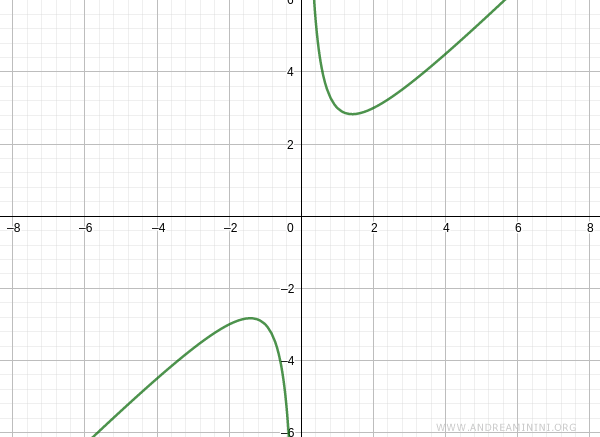
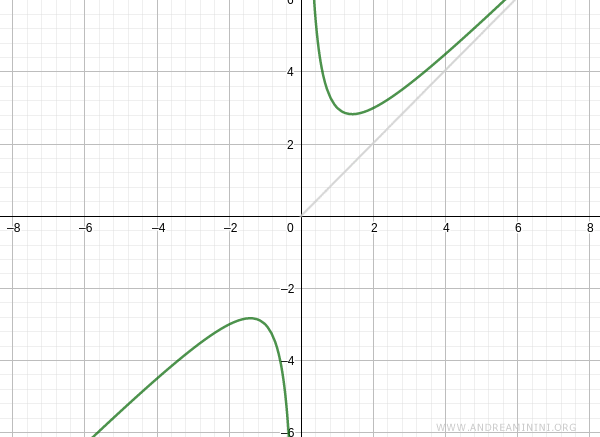
The graph of the function therefore takes the following shape:
Oblique Asymptotes
We now investigate the existence of oblique asymptotes.
First, we compute the slope \( m \):
$$ m = \lim_{x \to +\infty} \frac{f(x)}{x} = \lim_{x \to +\infty} \frac{x^2 + 2}{x^2} = 1 $$
Since \( m \) is finite, we compute \( q \):
$$ q = \lim_{x \to +\infty} \left( f(x) - m x \right) = \lim_{x \to +\infty} \left( \frac{x^2 + 2}{x} - x \right) = \lim_{x \to +\infty} \frac{2}{x} = 0 $$
Thus, the function has an oblique asymptote as \( x \to +\infty \), given by:
$$ y = x $$
Repeating the same analysis as \( x \to -\infty \):
$$ m = \lim_{x \to -\infty} \frac{f(x)}{x} = 1 $$
$$ q = \lim_{x \to -\infty} \left( f(x) - m x \right) = \lim_{x \to -\infty} \frac{2}{x} = 0 $$
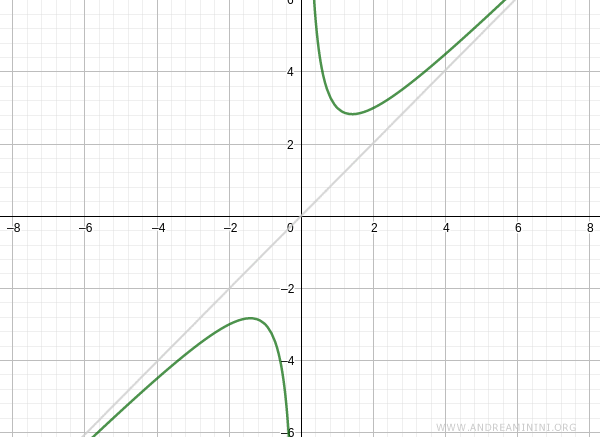
Thus, the oblique asymptote is again:
$$ y = x $$
And so on.