How to Analyze a Function
Analyzing a function f(x) allows us to sketch its graph by examining its domain, sign, and first and second derivatives.
Let’s take the following function as an example:
$$ f(x)= \frac{x}{x-1} $$
To draw its graph, I follow these steps:
Determining the Domain
The first step in analyzing a function is to identify its domain - the set of x-values for which the function is defined.
For the function f(x) = x / (x - 1), the domain is:
$$ ( -\infty, 1) \cup (1, \infty ) \:\:\:\: \forall x \in R $$
This also highlights the points where the function is undefined.
In this case, f(x) = x / (x - 1) is undefined at x = 1:
$$ f(1)= \frac{1}{1-1} |_{x=1} = \frac{1}{0} \:\:\: undefined $$
Such undefined points may indicate the presence of vertical asymptotes.
Symmetry Analysis
I begin by checking whether the function exhibits any symmetry.
For example, whether it is an even function:
$$ f(-x) = f(x) $$
or an odd function:
$$ f(-x) = -f(x) $$
In this case, the function x / (x - 1) does not display any symmetry.
Periodicity
Next, I check whether the function is periodic with period T:
$$ T: f(x+T) = f(x) \:\:\:\: \forall x \in R $$
For instance, the sine function is periodic with period T = 2π.
If the function is periodic, it is sufficient to study its behavior over a single period T, and then extend the results across all intervals (T+1, T+2, ...).
In this particular case, the function x / (x - 1) is not periodic.
Analyzing the Sign of the Function
Next, I determine whether the function is positive or negative within its domain.
Here, the function is positive on the intervals (-\infty, 0) and (1, \infty), and negative on (0, 1).
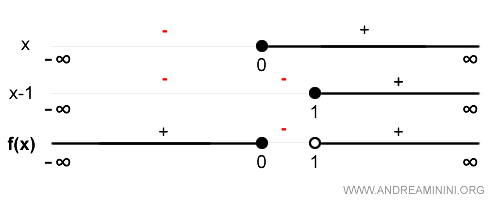
This step reveals which quadrants of the Cartesian plane the function occupies.
Quadrants where the function does not appear can be disregarded.

Horizontal Asymptotes
To find horizontal asymptotes, I calculate the limits of the function as x approaches positive and negative infinity - that is, at the edges of the domain.
$$ \lim_{x \rightarrow \infty}{ \frac{x}{x-1} } = \frac{\infty}{\infty} $$
$$ \lim_{x \rightarrow -\infty}{ \frac{x}{x-1} } = \frac{\infty}{\infty} $$
These are indeterminate forms.
To resolve them, I apply L'Hôpital’s Rule:
$$ \lim_{x \rightarrow \infty}{ \frac{D[x]}{D[x-1]} } = \lim_{x \rightarrow \infty}{ \frac{1}{1} } = 1 $$
$$ \lim_{x \rightarrow -\infty}{ \frac{D[x]}{D[x-1]} } = \lim_{x \rightarrow -\infty}{ \frac{1}{1} } = 1 $$
Since both limits yield finite results, the function has two horizontal asymptotes at y = 1 as x approaches ±∞:
$$ \lim_{x \rightarrow \infty}{ \frac{x}{x-1} } = 1 $$
$$ \lim_{x \rightarrow -\infty}{ \frac{x}{x-1} } = 1 $$
I now add these asymptotes to the graph:
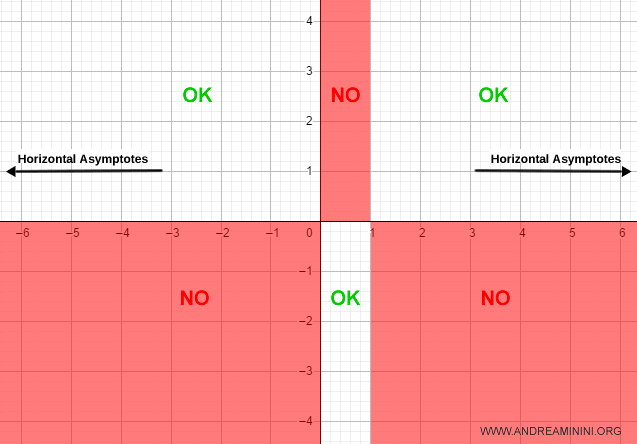
Vertical Asymptotes
For any undefined points within the domain, I calculate the limits as x approaches these points from the left and right.
Here, the function is undefined at x = 1:
$$ \lim_{x \rightarrow 1^+}{ \frac{x}{x-1} } = \frac{1}{0^+} = \infty $$
$$ \lim_{x \rightarrow 1^-}{ \frac{x}{x-1} } = \frac{1}{0^-} = -\infty $$
This means that as x approaches 1 from the right, the function tends toward +∞; from the left, it tends toward -∞.
I add the vertical asymptote to the graph:
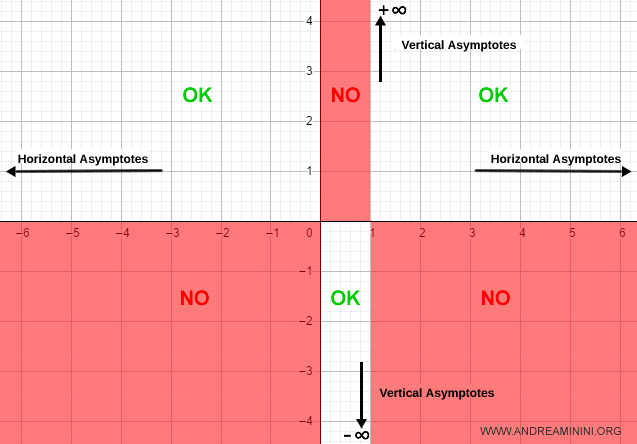
Oblique Asymptotes
When x approaches ±∞, I can check for the presence of an oblique (slant) asymptote of the form mx + q by evaluating the following limits:
$$ m = \lim_{x \rightarrow \infty } \frac{f(x)}{x} =\lim_{x \rightarrow \infty } \frac{\frac{x}{x-1}}{x} = 0 $$
$$ q = \lim_{x \rightarrow \infty } [f(x) - mx] = \lim_{x \rightarrow \infty } \left( \frac{x}{x-1} - 0 \cdot x \right) = 1 $$
If these limits exist and are finite, and m ≠ 0, an oblique asymptote of the form mx + q is present.
In this case, since m = 0, there is no oblique asymptote as x → ±∞.
Note. For this function f(x), the slope m = 0 and q = 1 - a result that matches the previously found horizontal asymptotes. Therefore, no oblique asymptote exists.
Intercepts with the Axes
Finding the x- and y-intercepts provides valuable information for constructing the graph.
Y-intercept
By setting x = 0, I can determine the corresponding y-value:
$$ y = \frac{x}{x-1}|_{x=0} = \frac{0}{0-1} = 0 $$
Thus, the function intersects the y-axis at the origin (0, 0).
X-intercept
If convenient, I also calculate the x-intercept by setting y = 0:
$$ \frac{x}{x-1} = 0 $$
Note. In this case, the x-intercept coincides with the y-intercept at the origin (0, 0). This is not always true - the two intercepts may be distinct, or may not exist at all.
Therefore, the function passes through the point P(0, 0).
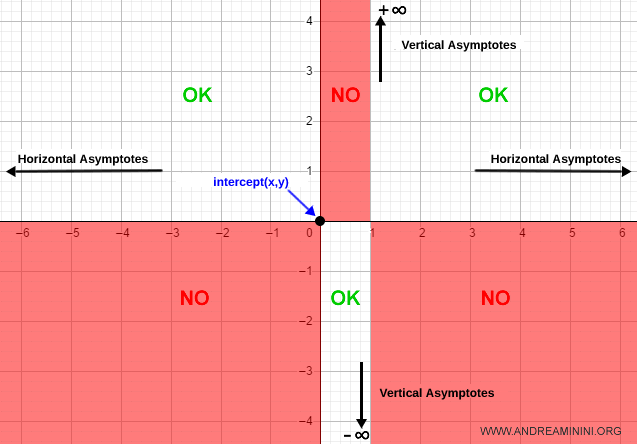
Points of Discontinuity
A point of discontinuity is a point where a function is not continuous (see discontinuous functions). This can happen when the function is undefined at a point or when it is defined but does not satisfy the conditions for continuity.
Discontinuities are commonly classified into three types:
- Jump discontinuity (first kind): both one-sided limits exist and are finite, but they have different values. The graph has a jump at that point.
- Discontinuity of the second kind: at least one of the one-sided limits does not exist as a finite real number. This includes infinite discontinuities, where the function increases or decreases without bound, and oscillatory discontinuities, where the function oscillates without approaching a single value.
- Removable discontinuity (third kind): the two-sided limit exists and is finite, but the function is either undefined at that point or has a value different from the limit. This type of discontinuity can be removed by assigning the function the appropriate value at that point.
Note. The numbering of discontinuities varies across mathematical texts. American calculus textbooks generally use descriptive terms such as jump discontinuity, infinite discontinuity, and removable discontinuity rather than numerical classifications. The terms "first kind" and "second kind" also appear in more formal treatments, but "third kind" is not standard terminology in English-language calculus textbooks.
Consider the function \( f(x)=\frac{x}{x-1} \). At \(x=1\), the denominator is zero, so the function is undefined. But what kind of discontinuity occurs at this point?
To find out, I examine how the function behaves as \(x\) approaches 1 from either side. I calculate the one-sided limits:
\[ \lim_{x\to 1^-}\frac{x}{x-1}=-\infty \]
\[ \lim_{x\to 1^+}\frac{x}{x-1}=+\infty \]
As \(x\) approaches 1 from the left, the function decreases without bound, approaching negative infinity. From the right, it increases without bound, approaching positive infinity.
Since the one-sided limits are infinite, I conclude that \(x=1\) is an infinite discontinuity, also classified as a discontinuity of the second kind. The vertical line \(x=1\) is also a vertical asymptote of the graph.
Note. Not every point where a function is undefined is necessarily a point of discontinuity. In the standard definition, continuity is considered at points in the function's domain. A point outside the domain is generally classified as a discontinuity only when it is a limit point of the domain. Furthermore, a function is automatically continuous at any isolated point within its domain.
Intervals of Increase and Decrease
To determine where the function is increasing or decreasing, I calculate its first derivative:
$$ f'(x) = D\left[ \frac{x}{x-1} \right] = \frac{(x-1)-x}{(x-1)^2} = \frac{-1}{(x-1)^2} $$
I then examine the sign of the first derivative:
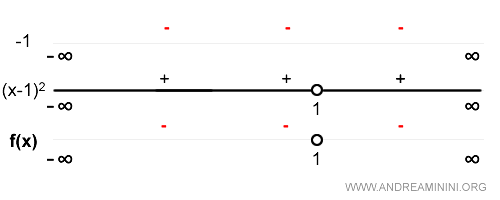
The function is increasing where f'(x) > 0, and decreasing where f'(x) < 0.
In this case, the function is decreasing throughout its entire domain.

On the interval (-\infty, 0), the function decreases from the horizontal asymptote at y = 1 toward the origin.
On the interval (0, 1), the function passes through the origin and decreases toward negative infinity.
On the interval (1, \infty), the function decreases from the vertical asymptote toward the horizontal asymptote at y = 1.
Note. These observations allow me to exclude regions of the Cartesian plane where the function cannot appear.
Local Minima and Maxima
I then look for critical points x₀ where the first derivative is zero, to identify any local minima or maxima:
$$ f'(x_0) = 0 $$
At such points:
- Local maximum: if the function is increasing to the left of x₀ ( f'(x) > 0 ) and decreasing to the right ( f'(x) < 0 ).
- Local minimum: if the function is decreasing to the left of x₀ ( f'(x) < 0 ) and increasing to the right ( f'(x) > 0 ).
In all other cases, the function has neither a local minimum nor a maximum at x₀.
For this function, the first derivative is never zero:
$$ f'(x) = \frac{-1}{(x-1)^2} \ne 0 \:\:\:\: \forall x \in R $$
Therefore, there are no local minima or maxima in the domain.
Inflection Points
I also check for potential inflection points, which occur where the first derivative equals zero:
$$ f'(x_0) = 0 $$
An inflection point occurs if the function is increasing or decreasing on both sides of x₀, with a change in concavity.
To distinguish between an upward and downward inflection point, I calculate the second derivative:
If:
$$ f''(x_0) = 0 $$
Then:
- Upward inflection point: if f''(x) changes from negative to positive near x₀ (from concave down to concave up).
- Downward inflection point: if f''(x) changes from positive to negative near x₀ (from concave up to concave down).
Note. An alternative method is to examine the sign of the third derivative:
- Upward inflection point: if f(3)(x₀) > 0.
- Downward inflection point: if f(3)(x₀) < 0.
For this function, the first derivative is never zero:
$$ f'(x) = \frac{-1}{(x-1)^2} \ne 0 \:\:\:\: \forall x \in R $$
Therefore, there are no inflection points in the domain.
Concavity and Convexity
Finally, I calculate the second derivative to identify intervals of concavity and convexity:
$$ D^2[ f(x) ] = D\left[ \frac{-1}{(x-1)^2} \right] = \frac{ 2(x-1)}{(x-1)^4} = \frac{2}{(x-1)^3} $$
I then analyze the sign of the second derivative:
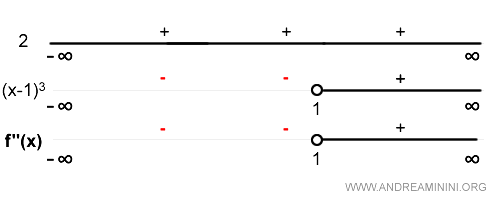
The function is:
- convex where f''(x) ≥ 0,
- concave where f''(x) ≤ 0.
Therefore, the function f(x) = x / (x - 1) is concave on the interval (-\infty, 1), and convex on (1, \infty).
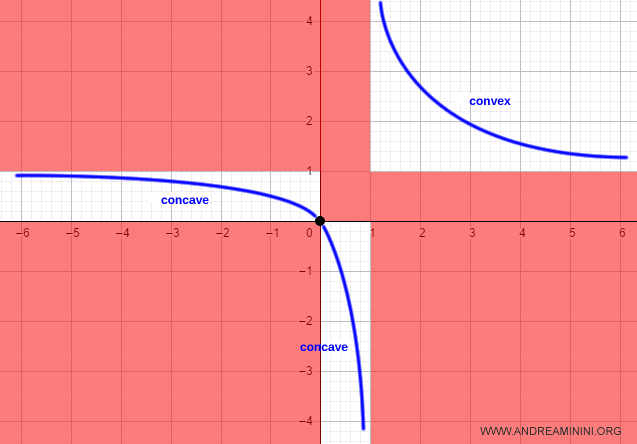
This completes the graph and full analysis of the function.
And so on.