Worked Example Function Analysis 1
In this example, we will analyze the following function:
$$ f(x) = \frac{x+1}{x-1} $$
We begin by sketching an empty Cartesian plane:
Our first step is to determine the domain of the function.
The function is defined for all real numbers except x = 1:
$$ (-\infty, 1) \cup (1, +\infty) $$
Next, we find the intercepts of f(x) with the x- and y-axes.
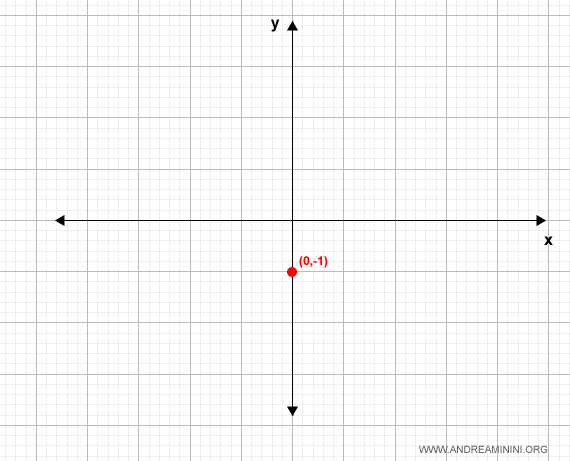
For the y-intercept, set x = 0:
$$ f(0) = \frac{0+1}{0-1} = -1 $$
Thus, the graph passes through the point (0, -1):
To find when f(x) = 0, we solve:
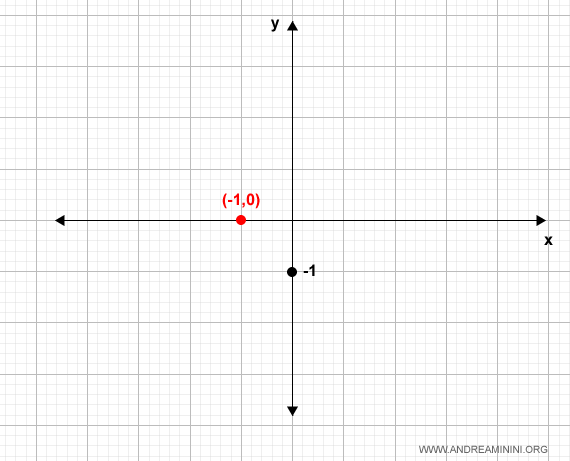
$$ \frac{x+1}{x-1} = 0 $$
This occurs at x = -1, so the graph also passes through (-1, 0):
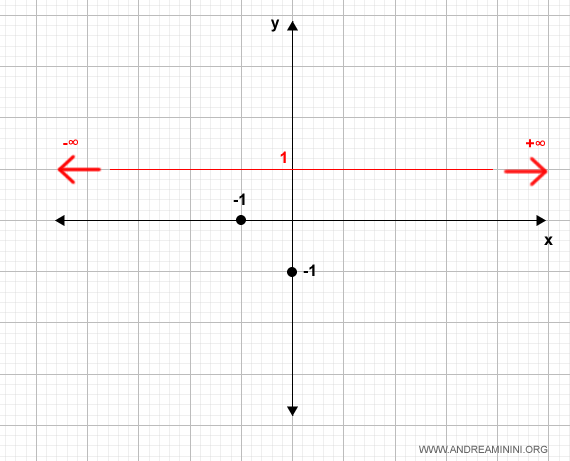
We now examine the behavior of f(x) as x approaches ±∞:
$$ \lim_{x \rightarrow +\infty} \frac{x+1}{x-1} = \frac{\infty}{\infty} $$
$$ \lim_{x \rightarrow -\infty} \frac{x+1}{x-1} = \frac{\infty}{\infty} $$
Since both limits are of the indeterminate form ∞/∞, we apply L'Hôpital’s Rule:
$$ \lim_{x \rightarrow +\infty} \frac{x+1}{x-1} = 1 $$
$$ \lim_{x \rightarrow -\infty} \frac{x+1}{x-1} = 1 $$
The graph is updated with this asymptotic behavior:
We now identify any points where the function is undefined.
Since the denominator equals zero at x = 1, we have:
$$ f(1) = \frac{1+1}{1-1} = \frac{2}{0} $$
This indicates a vertical asymptote at x = 1.
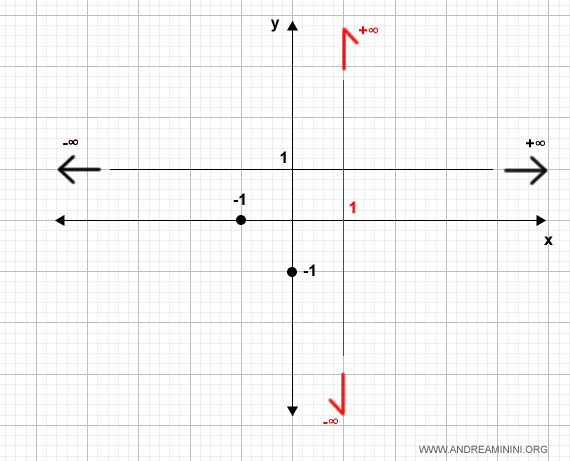
We compute the one-sided limits as x approaches 1:
$$ \lim_{x \rightarrow 1^+} \frac{x+1}{x-1} = +\infty $$
$$ \lim_{x \rightarrow 1^-} \frac{x+1}{x-1} = -\infty $$
Thus, as x → 1, f(x) tends to -∞ from the left and +∞ from the right. We update the graph accordingly:
Next, we analyze the sign of the function over its domain:
$$ (-\infty, 1) \cup (1, +\infty) $$
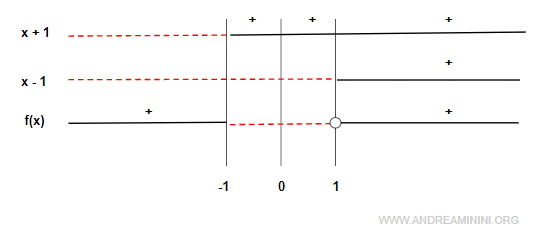
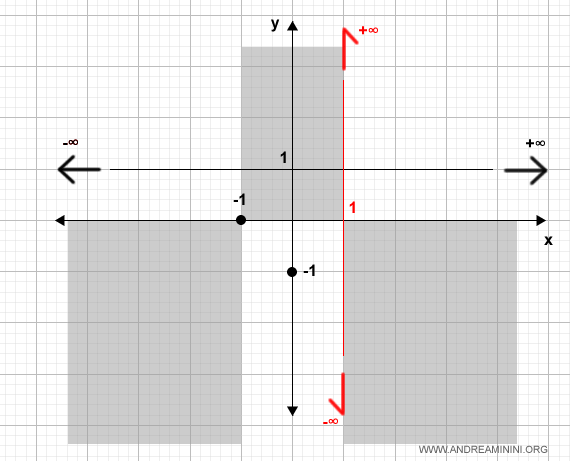
f(x) is positive on (-∞, -1) and (1, +∞), and negative on (-1, 1).
We can now exclude the regions of the plane where the function does not appear (gray areas):
Next, we compute the first derivative of the function:
$$ f'(x) = \frac{(x-1) - (x+1)}{(x-1)^2} = \frac{-2}{(x-1)^2} $$
We analyze the sign of f'(x) across the domain (-∞, 1) ∪ (1, +∞) to determine where the function is increasing or decreasing:
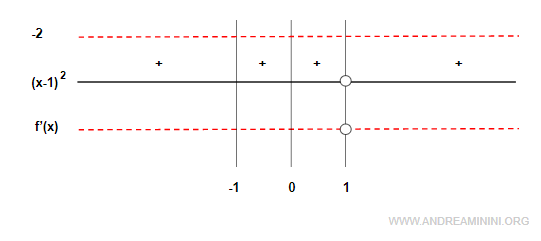
Since f'(x) < 0 throughout the domain, the function is strictly decreasing.
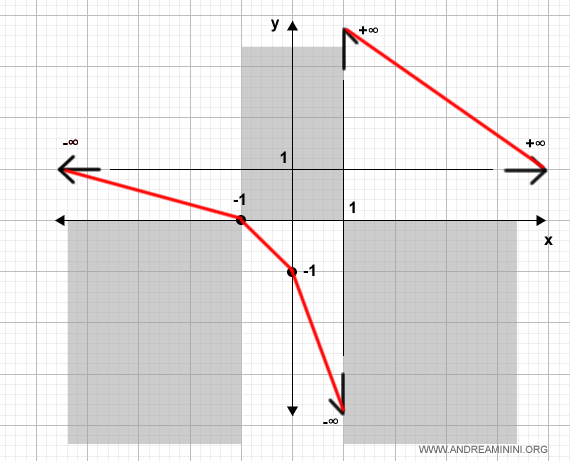
We can now approximate the graph of f(x) by connecting the key points:
We then compute the second derivative of the function:
$$ f''(x) = \frac{0 - (-2)(2(x-1))}{(x-1)^4} = \frac{4(x-1)}{(x-1)^4} = \frac{4}{(x-1)^3} $$
We analyze the sign of f''(x) over the domain (-∞, 1) ∪ (1, +∞), to study concavity and convexity:
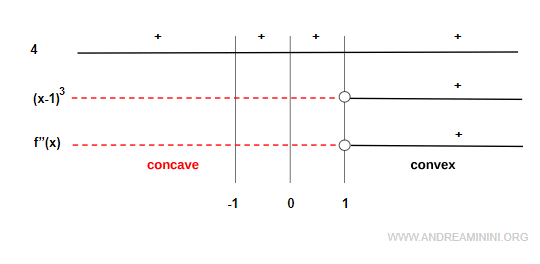
The function is concave on (-∞, 1), where f''(x) < 0, and convex on (1, +∞), where f''(x) > 0.
The final version of the graph, with all this information included, is shown below:
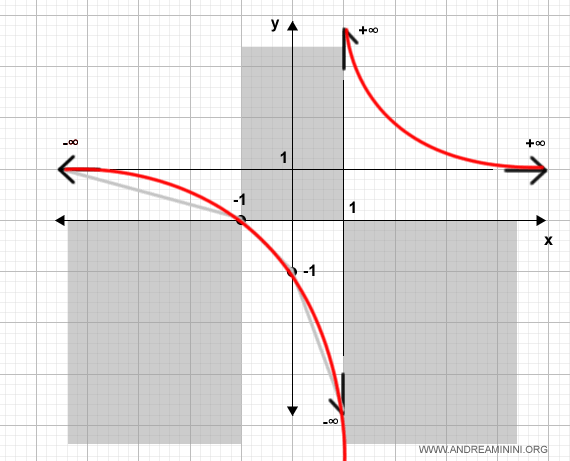
With this, we have completed the full analysis of the function.
The graph is now complete.
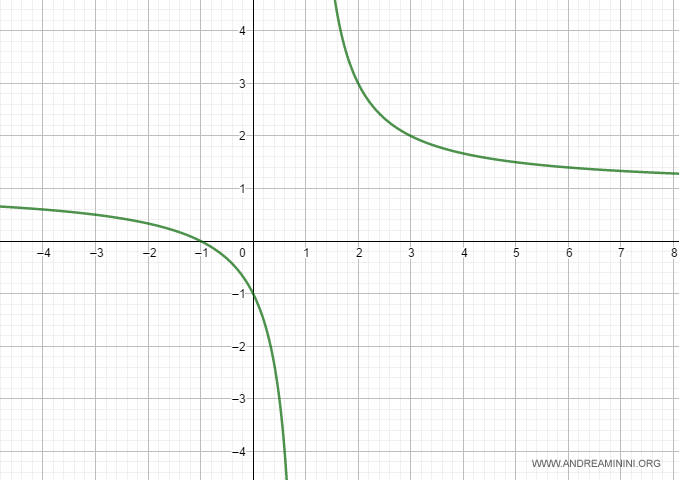
Verification. The graph of the function, generated with GeoGebra:
And so on.