
Worked Example - Function Analysis 4
In this example, we will analyze the following function:
$$ f(x) = \frac{x}{x^2 + 2} $$
Domain
The function is defined for all real numbers:
$$ D_f = (-\infty, +\infty) $$
Undefined Points
The function is defined everywhere, as the denominator \( x^2 + 2 \) has no real roots:
$$ x^2 + 2 = 0 \quad \Rightarrow \quad x^2 = -2 $$
Asymptotic Behavior
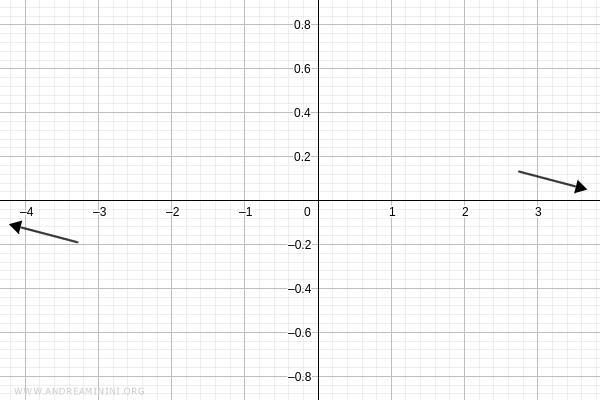
We now analyze the behavior of the function as \( x \to \pm\infty \):
$$ \lim_{x \to +\infty} \frac{x}{x^2 + 2} = 0^+ $$
$$ \lim_{x \to -\infty} \frac{x}{x^2 + 2} = 0^- $$
Thus, the function approaches zero from above as \( x \to +\infty \), and from below as \( x \to -\infty \):
Intercepts with the Axes
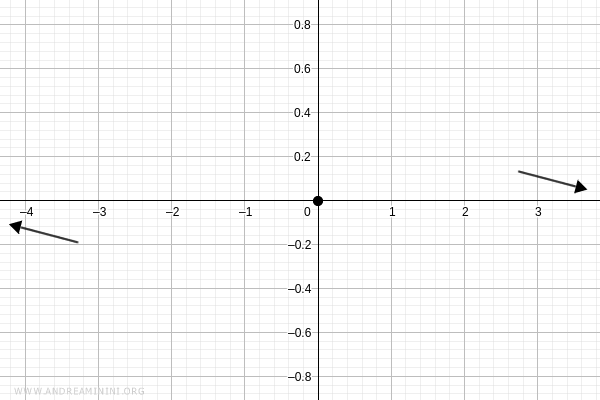
At \( x = 0 \), the function evaluates to:
$$ f(0) = \frac{0}{0^2 + 2} = 0 $$
Thus, the graph passes through the origin \( (0, 0) \):
Sign Analysis
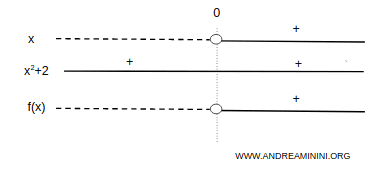
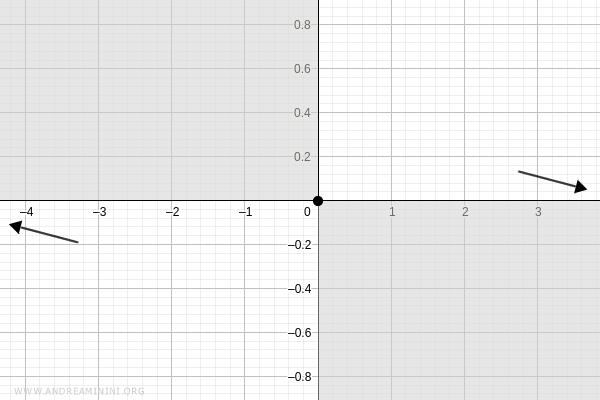
The function is negative on \( (-\infty, 0) \), and positive on \( (0, +\infty) \):
We can therefore exclude from the graph those regions of the plane where the function does not take any values:
Monotonicity
We compute the first derivative:
$$ f'(x) = D\left[ \frac{x}{x^2 + 2} \right] = \frac{(x^2 + 2) - x(2x)}{(x^2 + 2)^2} = \frac{-x^2 + 2}{(x^2 + 2)^2} $$
Analyzing the sign of \( f'(x) \), we find:
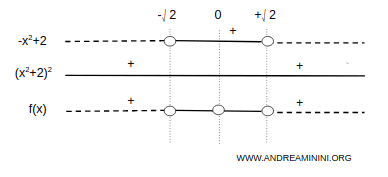
The function is increasing on \( (-\sqrt{2}, \sqrt{2}) \), and decreasing on \( (-\infty, -\sqrt{2}) \) and \( (\sqrt{2}, +\infty) \):
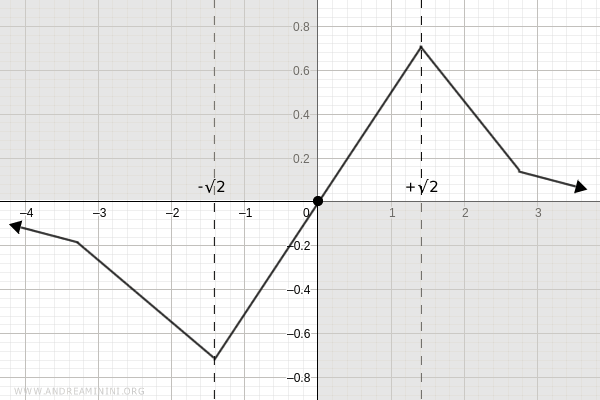
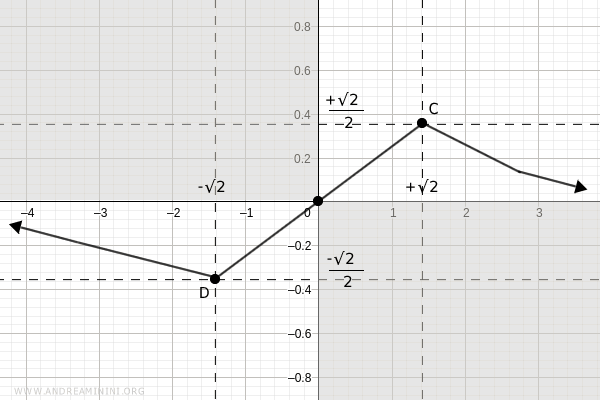
There is a local minimum at \( x = -\sqrt{2} \), and a local maximum at \( x = \sqrt{2} \):
$$ C: \ (x, y) = \left( \sqrt{2}, \frac{ \sqrt{2} }{ (\sqrt{2})^2 + 2 } \right) = \left( \sqrt{2}, \frac{ \sqrt{2} }{4} \right) $$
$$ D: \ (x, y) = \left( -\sqrt{2}, \frac{ -\sqrt{2} }{ (\sqrt{2})^2 + 2 } \right) = \left( -\sqrt{2}, -\frac{ \sqrt{2} }{4} \right) $$
This allows us to refine the graph accordingly:
Concavity and Convexity
Next, we compute the second derivative to analyze the concavity of the graph:
$$ f''(x) = D\left[ \frac{ -x^2 + 2 }{ (x^2 + 2)^2 } \right] $$
$$ = \frac{ -2x(x^2 + 2)^2 - 2(x^2 + 2)(-x^2 + 2)(2x) }{ (x^2 + 2)^4 } $$
$$ = \frac{ -2x(x^2 + 2) - 4x(-x^2 + 2) }{ (x^2 + 2)^3 } $$
$$ = \frac{ -2x^3 - 4x + 4x^3 - 8x }{ (x^2 + 2)^3 } $$
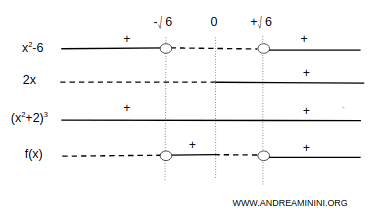
$$ = \frac{ 2x(x^2 - 6) }{ (x^2 + 2)^3 } $$
From this, we see that the function is concave on \( (-\infty, -\sqrt{6}) \) and \( (0, \sqrt{6}) \), and convex on \( (-\sqrt{6}, 0) \) and \( (\sqrt{6}, +\infty) \):
The graph of the function is thus as follows:
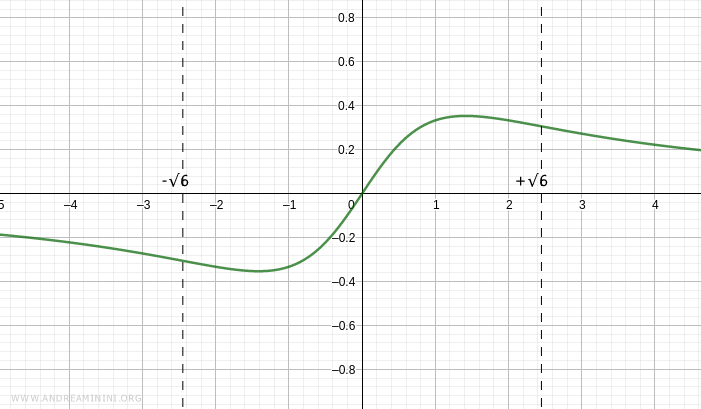
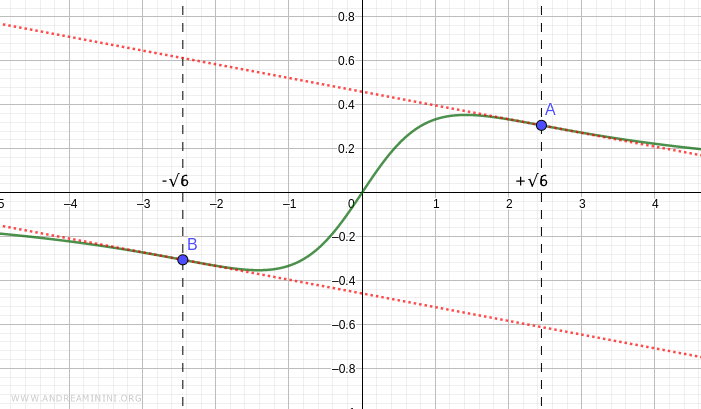
There are two inflection points at \( x = -\sqrt{6} \) and \( x = \sqrt{6} \):
$$ A: \ (x, y) = \left( \sqrt{6}, \frac{ \sqrt{6} }{ (\sqrt{6})^2 + 2 } \right) = \left( \sqrt{6}, \frac{ \sqrt{6} }{8} \right) $$
$$ B: \ (x, y) = \left( -\sqrt{6}, \frac{ -\sqrt{6} }{ (\sqrt{6})^2 + 2 } \right) = \left( -\sqrt{6}, -\frac{ \sqrt{6} }{8} \right) $$
Graphically, these appear as follows:
And so on.


