
Minimum and Maximum of a Function
According to Fermat’s Theorem, if a function is defined on the interval [a, b] and has a local minimum or maximum at the point x0, then its first derivative at that point is zero. $$ f'(x_0)=0 $$
Therefore, to find local minima or maxima, we follow these steps:
- Calculate the first derivative of the function f(x).
- Find the points where the first derivative equals zero, i.e., solve f'(x)=0.
This approach applies only if the function is differentiable on [a, b].
Once we’ve identified the points where the first derivative is zero - say, x0 - we need to determine whether those points correspond to minima or maxima.
How to Determine Whether It’s a Maximum or Minimum
There are several ways to proceed:
- Analyze whether the first derivative f'(x) is increasing or decreasing around x0.
- If the first derivative is increasing near x0, then x0 is a local minimum.
- If the first derivative is decreasing near x0, then x0 is a local maximum.
- Calculate the second derivative f″(x) near x0.
- If the second derivative is greater than or equal to zero, the point is a local minimum. $$ f″(x_0) \ge 0 \Leftrightarrow \text{minimum} $$
- If the second derivative is less than or equal to zero, the point is a local maximum. $$ f″(x_0) \le 0 \Leftrightarrow \text{maximum} $$
Note The derivative test can also be extended to higher even-order derivatives, provided that all the lower-order derivatives vanish. $$ f^{(k)} \ne 0 \quad \text{for even } k $$ $$ f^{(1)} = f^{(2)} = \ldots = f^{(k-1)} = 0 $$ This makes it a powerful tool in mathematical analysis and curve investigation. However, it requires the function to be continuous and differentiable at x0.
The two methods above are equivalent, thanks to the monotonicity criterion.
- If the first derivative f'(x) is increasing around x0, then the second derivative is necessarily nonnegative. $$ f'(x) \text{ increasing } \Leftrightarrow f″(x_0) \ge 0 $$
- If the first derivative f'(x) is decreasing around x0, then the second derivative is necessarily nonpositive. $$ f'(x) \text{ decreasing } \Leftrightarrow f″(x_0) \le 0 $$
A Practical Example
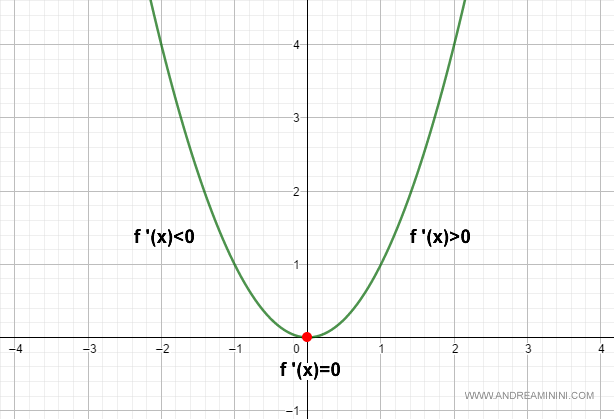
Let’s find the extrema of the following function:
$$ f(x)=x^2 $$
First, we calculate the first derivative:
$$ f'(x)=2x $$
Next, we identify where the first derivative equals zero:
The first derivative is zero only at x=0:
$$ x=0 \rightarrow f'(0)=0 $$
We then compute the second derivative, which is the derivative of the first derivative:
$$ f″(x)=2 $$
Finally, we evaluate the second derivative at x=0:
$$ f″(0)=2 \ge 0 $$
Since the second derivative is positive, the function has a local minimum at x=0.
Proof
Consider a function that is defined and continuous on (a, b).
If its first derivative is zero at some point x0 within (a, b):
$$ f'(x_0)=0 $$
Then, by Fermat’s Theorem, the function f(x) may have either a local minimum or a local maximum at x0.
Note. However, this doesn’t guarantee the existence of a minimum or maximum - it could also be a point of inflection.
If the second derivative at x0 is positive:
$$ f″(x_0) > 0 $$
Since the function is continuous, the theorem of permanence of sign ensures that there exists a neighborhood (x-δ, x+δ) where f″(x) > 0.
Therefore, in this interval, the first derivative f'(x) is increasing, and the function f(x) is convex.
When a function is convex, the tangent line at x0 always lies below the graph of f(x):
$$ f(x) \ge f(x_0) + f'(x_0)(x - x_0) $$
Since f'(x0)=0:
$$ f(x) \ge f(x_0) $$
This demonstrates that x0 is a point of local minimum.
Note. The proof for a local maximum is similar, except that it starts with the assumption that the second derivative at x0 is negative.
And so on.


