
Finding Maxima and Minima Using Derivatives
The maxima and minima of a function f(x) can be analyzed through its derivatives.
- If the first derivative equals zero at x0: $$ f'(x_0) = 0 $$ then the function has:
- a local maximum if the second derivative is negative: $$ f″(x_0) < 0 $$
- a local minimum if the second derivative is positive: $$ f″(x_0) > 0 $$
The General Criterion
The test for determining whether a point is a minimum or maximum can be generalized as follows:
If the k-th derivative is zero at x0 and k is odd:
$$ f^{(k)}(x_0) = 0 \quad \text{where } k \text{ is odd} $$
Then the function has:
- a local maximum if the (k+1)-th derivative is negative: $$ f^{(k+1)}(x_0) < 0 $$
- a local minimum if the (k+1)-th derivative is positive: $$ f^{(k+1)}(x_0) > 0 $$
- neither a maximum nor a minimum if the (k+1)-th derivative is zero but the (k+2)-th derivative is nonzero: $$ f^{(k+1)}(x_0) = 0 \quad \text{and} \quad f^{(k+2)}(x_0) \ne 0 $$ In this case, the function has an inflection point at x0.
Note. If the k-th derivative is zero and k is even, then the function has neither a maximum nor a minimum at x0 if the (k+1)-th derivative is nonzero. In such cases, the function has an inflection point.

Proof
To prove this criterion, we begin with the Taylor expansion of a function that is continuous and differentiable up to order n at x0:
$$ f(x) = \sum_{k=0}^{n} \frac{f^{(k)}(x_0)}{k!} \cdot (x - x_0)^k + R_n(x) $$
Expanded explicitly, this reads:
$$ f(x) = f(x_0) + f^{(1)}(x_0) \cdot \frac{(x - x_0)}{1!} + f^{(2)}(x_0) \cdot \frac{(x - x_0)^2}{2!} + \ldots + f^{(n)}(x_0) \cdot \frac{(x - x_0)^n}{n!} + R_n $$
Suppose all derivatives up to order n-1 vanish at x0:
$$ f'(x_0) = f″(x_0) = f^{(3)}(x_0) = \ldots = f^{(n-1)}(x_0) = 0 $$
Then the Taylor series simplifies to:
$$ f(x) = f(x_0) + f^{(n)}(x_0) \cdot \frac{(x - x_0)^n}{n!} + R_n $$
Suppose further that the n-th derivative at x0 is positive:
$$ f^{(n)}(x_0) > 0 $$
This suggests a local minimum at x0.
Note. The argument is similar if f(n) is negative, in which case the point would be a local maximum instead of a minimum.
Consider the following limit:
$$ \lim_{x \rightarrow x_0} \frac{f(x) - f(x_0)}{(x - x_0)^n} $$
Substituting the Taylor series yields:
$$ \lim_{x \rightarrow x_0} \frac{\left[ f(x_0) + f^{(n)}(x_0) \cdot \frac{(x - x_0)^n}{n!} + R_n \right] - f(x_0)}{(x - x_0)^n} $$
which simplifies to:
$$ \lim_{x \rightarrow x_0} \frac{f^{(n)}(x_0)}{n!} + \lim_{x \rightarrow x_0} \frac{R_n}{(x - x_0)^n} = \frac{f^{(n)}(x_0)}{n!} > 0 $$
Therefore, the original limit is positive:
$$ \lim_{x \rightarrow x_0} \frac{f(x) - f(x_0)}{(x - x_0)^n} > 0 $$
We now distinguish between the cases when n is even or odd:
- If n is even, the denominator (x - x0)n is always positive. Therefore, f(x) > f(x0) for all x in some neighborhood (x0 - δ, x0 + δ). Hence, x0 is a local minimum.
- If n is odd, the denominator (x - x0)n changes sign on either side of x0, so x0 cannot be a local minimum.
In conclusion, x0 is a minimum if and only if f(n) ≠ 0 and n is even.
A Practical Example
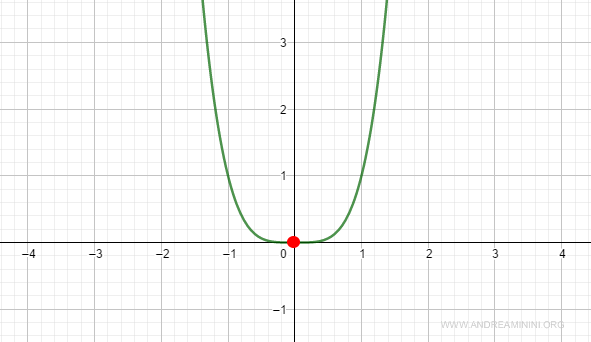
Example 1 (n even)
Consider the function:
$$ f(x) = x^4 $$
At the point x0=0, the first, second, and third derivatives are zero:
$$ f^{(1)}(x_0) = 4x^3 = 4(0)^3 = 0 $$
$$ f^{(2)}(x_0) = 12x^2 = 12(0)^2 = 0 $$
$$ f^{(3)}(x_0) = 24x = 24(0) = 0 $$
The fourth derivative, which is even, is positive at x0:
$$ f^{(4)}(x_0) = 24 > 0 $$
Thus, the function has a local minimum at x0.
Example 2 (n odd)
Consider the function:
$$ f(x) = x^3 $$
At x=0, both the first and second derivatives vanish:
$$ f^{(1)}(x_0) = 3x^2 = 3(0)^2 = 0 $$
$$ f^{(2)}(x_0) = 6x = 6(0) = 0 $$
However, the third derivative, which is odd, is positive:
$$ f^{(3)}(x_0) = 6 > 0 $$
It’s clear in this case that the point is not a minimum.
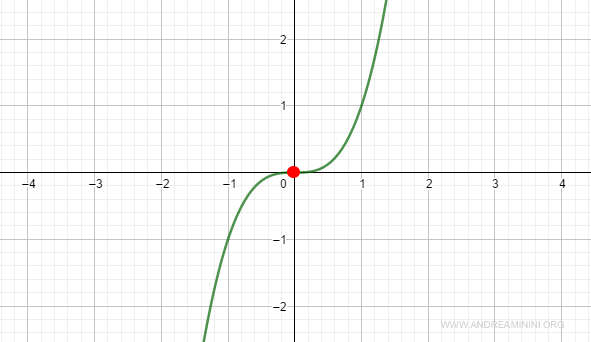
At x0, the function has a point of inflection.
And so on.


