
Differential of a Function
The differential $ dy $ of a differentiable function $ y=f(x) $ is a quantity that estimates how much the function changes when the independent variable $ x $ changes by a small amount. It is defined as $$ dy = f'(x) \cdot dx $$ where $ dx $ represents a very small change in the variable x, and $ f'(x) $ is the derivative of the function.
The differential is one of the key concepts in calculus because it provides a simple way to approximate changes in a function without having to compute the exact value every time.
From the definition of the differential, the derivative can be interpreted as the ratio between the differential of the function and the differential of the independent variable:
$$ f'(x) = \frac{dy}{dx} $$
Differential vs. Function Increment
The differential and the increment of a function are closely related, but they are not the same thing.
The differential is based on the derivative and provides a linear approximation of the function's change near a given point:
$$ dy = f'(x) \cdot dx $$
The actual increment of the function is
$$ \Delta y = f(x+\Delta x)-f(x) $$
Unlike the differential, this quantity measures the exact change in the function.
From a geometric perspective, a differentiable function can be approximated by its tangent line near a point \( x_0 \). The differential represents the change predicted by that tangent line.
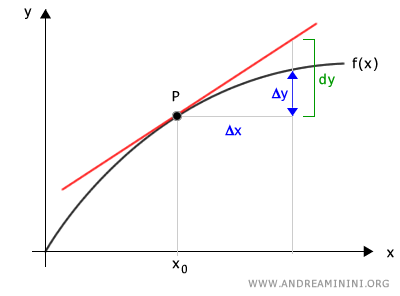
When the change in the independent variable is very small, the differential becomes a very accurate approximation of the actual increment:
$$ \Delta y \approx dy $$
A Practical Example
Consider the function
$$ y=x^2 $$
Its differential is
$$ dy=y' \cdot dx $$
Since the derivative of the function is
$$ y'=\frac{d}{dx}(x^2)=2x $$
substituting into the differential formula gives
$$ dy=2x \cdot dx $$
This expression estimates how much the function changes when x changes by a small amount.
For example, let
$$ x=3 $$
and
$$ dx=\Delta x=0.1 $$
Then the differential is
$$ dy=2 \cdot 3 \cdot 0.1=0.6 $$
Now compute the actual increment of the function:
$$ \Delta y=f(3+0.1)-f(3) $$
$$ \Delta y=(3.1)^2-3^2 $$
$$ \Delta y=9.61-9 $$
$$ \Delta y=0.61 $$
In this example, the differential predicts a change of 0.6, while the actual increment is 0.61.
The values are not identical, but they are very close. This illustrates the main purpose of the differential: providing a simple and effective approximation of the function's actual change.
As the value of \( \Delta x \) becomes smaller, the approximation improves:
$$ \Delta y \approx dy $$
What Does dx Mean?
To better understand the role of \( dx \), consider the simplest possible function:
$$ y=x $$
Its derivative is
$$ y'=1 $$
Applying the differential formula gives
$$ dy=y' \cdot dx=1 \cdot dx $$
which simplifies to
$$ dy=dx $$
If \( \Delta x \) denotes the increment of the independent variable, then
$$ dx=\Delta x $$
By convention, the differential of the independent variable is equal to its increment.
As a result, the differential of a function can also be written as
$$ dy=f'(x)\cdot\Delta x $$
This formula highlights the relationship between the derivative, the increment of the independent variable, and the differential.
It is important, however, to distinguish between the differential and the actual increment.
The actual increment is
$$ \Delta y=f(x+\Delta x)-f(x) $$
whereas the differential is
$$ dy=f'(x)\cdot\Delta x $$
The first expression gives the exact change in the function, while the second provides a linear approximation of that change.
When \( \Delta x \) is sufficiently small, the two values become nearly equal:
$$ \Delta y \approx dy $$
The Differential and the Tangent Line
The geometric meaning of the differential is closely tied to the tangent line of a function.
Let \( y=f(x) \) be a differentiable function, and let \( x_0 \) be a point in its domain. The equation of the tangent line at \( x_0 \) is
$$ y=f(x_0)+f'(x_0)(x-x_0) $$
This line provides the best linear approximation of the function near the point of tangency.
If the independent variable changes by
$$ dx=x-x_0 $$
then the change predicted by the tangent line is
$$ dy=f'(x_0)\cdot dx $$
This quantity is precisely the differential of the function.
In geometric terms, the differential measures the change predicted by the tangent line rather than the exact curve. The closer x is to \( x_0 \), the more accurate this approximation becomes.
For this reason, the differential plays a central role in calculus, numerical methods, and many practical applications where estimating small changes is more useful than computing exact values.


