
Fermat’s Theorem
If a function f(x) defined on the interval [a, b] attains a local maximum or minimum at the point x0, then its first derivative at that point is zero. $$ f'(x_0)=0 $$
- It’s a local minimum if, in the neighborhood of x0, the left-hand derivative is negative while the right-hand derivative is positive. $$ f'_-(x_0) < 0 \:\:\:, \:\:\: f'_+(x_0) > 0 $$
- It’s a local maximum if, near x0, the left-hand derivative is positive and the right-hand derivative is negative. $$ f'_-(x_0) > 0 \:\:\:, \:\:\: f'_+(x_0) < 0 $$
Note. However, Fermat’s Theorem has a limitation: it applies only if x0 is an interior point of the interval [a, b]. It cannot be used at the endpoints a or b, since derivatives can’t be computed in both directions there.
A Practical Example
Let’s examine the function f(x) defined over the real numbers:
$$ f(x)=x^2 $$
The first derivative of this function is:
$$ f'(x)=2x $$
The derivative equals zero only at the point x=0:
$$ f'(0)=0 $$
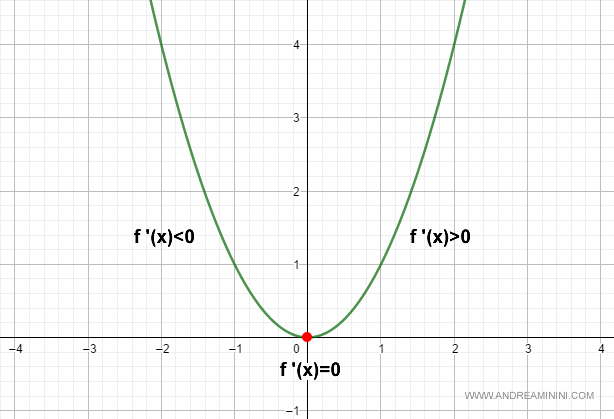
Thus, at x=0, the function has either a local maximum or a local minimum.
Is it a minimum or a maximum?
To determine which, we analyze the left-hand and right-hand derivatives around x0=0:
$$ f'_-(0) < 0 $$
$$ f'_+(0) > 0 $$
Here, because the function is decreasing to the left (negative derivative) and increasing to the right (positive derivative), x0 is a local minimum.
Note. Alternatively, if the function is twice differentiable, you can check the sign of the second derivative. If the second derivative is nonnegative, it indicates a minimum; if it’s nonpositive, it indicates a maximum.
Proof
If a function defined on [a, b] has a local maximum at x0, then it must increase to the left of x0 and decrease to the right.
This translates into the first derivative being positive on the left and negative on the right of x0:
$$ f'_-(x_0) = \lim_{h \rightarrow 0^-} \frac{f(x_0+h)-f(x_0)}{h} \ge 0 $$
$$ f'_+(x_0) = \lim_{h \rightarrow 0^+} \frac{f(x_0+h)-f(x_0)}{h} \le 0 $$
According to the criteria for differentiability at a point, a function is differentiable at x0 if its left-hand and right-hand derivatives are equal and coincide with f'(x0).
Therefore, the derivative at x0 must be zero, since it’s the only value shared by both one-sided derivatives.
$$ f'(x_0) = \lim_{h \rightarrow 0} \frac{f(x_0+h)-f(x_0)}{h} = 0 $$
Note. A similar argument holds for proving the existence of a local minimum. In that case, f(x) decreases to the left (negative left-hand derivative) and increases to the right (positive right-hand derivative) of x0. If the function is differentiable at x0, the first derivative must equal zero because it must match the values of both one-sided derivatives.
Local Extrema at the Endpoints
To determine whether an endpoint of an interval is a local maximum or minimum, we examine the one-sided derivative and the behavior of the function near that point. A point is a maximum if: $$ f'(x_0) \cdot (x - x_0) \le 0 $$ It’s a minimum if: $$ f'(x_0) \cdot (x - x_0) \ge 0 $$
Example
Consider the function f(x) defined on the interval [5, 10]:
$$ f(x)=2x $$
We want to check whether x=10 (the right endpoint B) is a local maximum.
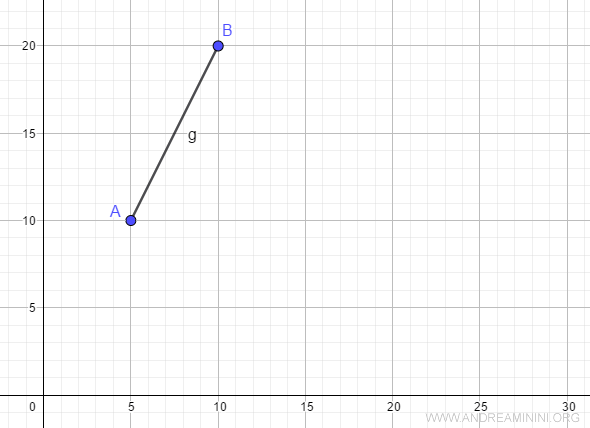
The right-hand derivative at f(10) does not exist because x=10 is the interval’s right endpoint.
However, the left-hand derivative at f(10) does exist and equals:
$$ f'_-(10)=2 $$
Applying the formula to assess the behavior of the function in the interval:
$$ f'(x_0) \cdot (x - x_0) $$
$$ 2 \cdot (x - 10) $$
Notice that for any x in the interval [5, 10], this expression is less than or equal to zero because (x - 10) is negative (or zero when x=10):
$$ 2 \cdot (x - 10) \le 0 $$
Therefore, the point x=10 is a local maximum.
Note. The same approach can be used to check whether the endpoint B is a local minimum. This method also applies to interior points, not just endpoints. For example, consider the function f(x)=sin x defined on the interval [1, 2]. Its derivative is f'(x)=cos x. We want to determine whether the point x=π/2 is a minimum, a maximum, or neither.
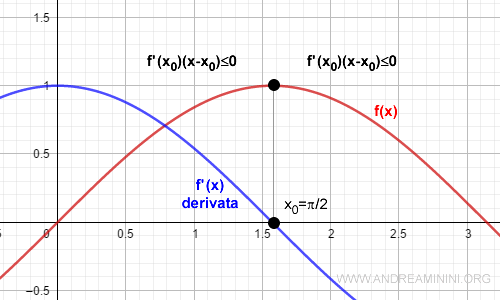
Let’s examine the neighborhood of x=π/2. To the left, the left-hand derivative f'-(x0)>0 and (x - x0)<0. To the right, the right-hand derivative f'+(x0)<0 and (x - x0)>0. In both cases, around x0=π/2, the expression is always less than or equal to zero: $$ f'(x_0) \cdot (x - x_0) \le 0 $$ Thus, x=π/2 is a point of local maximum for the function f(x)=sin x.
And so on.


